
Sign up for the Today newsletter
Get everything you need to know to start your day, delivered right to your inbox every morning.
Book challenges are mounting at schools and public libraries in Massachusetts and many Boston.com readers are troubled to see the national trend reflected here in the Bay State.
In 2022, there were 45 challenges on more than 30 books in Massachusetts, according to The American Library Association. Most of these books centered on LGBT issues and BIPOC or other minority groups. For years, book challenges in the Bay State were so rare that the Massachusetts School Library Association relied on national data rather than collecting its own. Since the organization started collecting data from member libraries in the fall of 2022, there have been 22 challenges.
Boston ALA and MSLA note that many member libraries don’t report their challenges, so the scope of the problem is likely larger than we realize.
We asked Boston.com readers if they were concerned about books on race, LGBTQ+, and other issues being banned from Massachusetts school libraries and 54% of the 409 people polled said they were worried.
“All people of all ages should have access, and be encouraged to utilize that access, to as wide a range as possible of information no matter what the subject. Our country was formed with this as a fundamental tenet,” said David W. from Worcester.
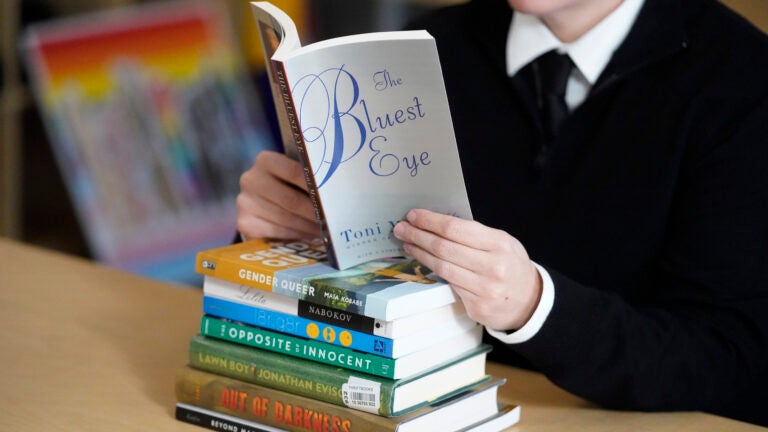
One of the groups leading the charge of challenging books in Massachusetts libraries is Massachusetts Informed Parents, which has put together a “Parental Advisory Book List” and urges parents to have books removed from their local community libraries.
Included in that list are books dealing with race, gender, and the LGBT community such as “Gender Queer: A Memoir,” “The Handmaid’s Tale,” “What Was Stonewall?,” “The Bluest Eye,” and more.
Many Boston.com readers said they don’t believe it’s a parent’s right to have books removed from public spaces.
“A parent has the right to help their child choose what to read or not read. However, that parent has absolutely no standing to usurp the rights of another parent to do the same,” said Jennifer M. from West Barnstable. “If you don’t want your child to read a specific book, then you need to have a conversation with your child. Period.”
Despite librarians and other educators ringing alarm bells about the rise in challenged and banned books, some readers believe that Massachusetts will rise above the “culture wars” and protect access to all books.
“I am not concerned that books will actually be banned in Massachusetts because I believe our school library and state officials are educated and reasonable enough to understand that a wide scope of reading materials is essential to the education of our children if we hope they will become well-informed adults,” said Kevin M. from Nahant.
Below you’ll find responses from readers sharing their thoughts on book bans in Massachusetts.
Responses have been lightly edited for length and clarity.
“I’m a teacher! Building critical thinking skills is essential to my practice. How can I encourage students to develop these skills without providing them with a range of readings by which they examine perspectives? Not everyone shares the same experiences. It would be educational malpractice if I didn’t expose my students to other narratives.” — Yolanda G., Roslindale
“Students should be protected from material that is inappropriate, but no one besides me has the right to decide what my kids may or may not read. You take care of your kids, I’ll take care of mine. Libraries and librarians are not the enemy. They are not groomers.” — Alan, North Andover
“I’d like to hope that Massachusetts, of all places, will resist these repressive and harmful efforts that are taking the nation by storm. One of the books cited above, [“Gender Queer” by Maia Kobabe], is an earnest graphic memoir (someone’s first-person life experiences told in comic format) that I desperately wish had existed when I was a teenager. It might have helped me to work through confusion and provided me with language to understand and explain things about myself that I instead had to struggle with for a couple of decades with few resources.
“Removing these books won’t make transgender people go away, or erase our (state and national) history of racial conflict and oppression, or prevent adolescents’ budding sexuality and curiosity. Taking away resources that allow young people to safely learn, explore and question life’s complexities is just a great way to foster shame, ignorance, confusion, and unsafe uneducated choices.
“Libraries are one of our societies’ greatest resources; the many valuable services they provide to our communities deserve support and appreciation, not vitriol and suppression. I hope this state, where I’m so proud and grateful to live, will withstand this disgusting national trend of attacks and attempted censorship.” — A.J., Brighton
“Book banning is fundamentally wrong in a free democratic republic. Leave such practices for totalitarian dictatorships.” — Tim, Westborough
“It is a small but vocal and organized minority making these challenges. Many of the challenges have nothing to do with teen books with explicit sex but may be any book by or about LGBTQ+, Black, Hispanic, Asian, or Native people, or about sex education. Worse, librarians are being harassed and threatened, including a bomb threat made against Boston Public Library during Banned Books Week last year. Polls have made it clear that people of all political parties are against book banning. But everyone must stand up for their local librarians and put a stop to the hate.” — Sharon H., Nahant
“These books are important. Everyone’s voice needs to be heard. This is not a parents’ rights issue. That is a dog whistle. We went with our kids to the library, we did not rely on someone else to choose what was appropriate for them.” — Lisa, Shrewsbury
“I’m a middle school librarian, in a very diverse community. I have watched this trend grow and also noticed the tactics used by the ‘book banners.’ I’m very concerned that their influence may outweigh the expertise of licensed school library teachers when we add books to our collections. It is very important that all our students/children see themselves represented in the library’s collections.” — Claudia P., Chicopee
“It really feels like we are introducing these topics too early to kids/young teens. It’s inappropriate.” — Steve, Dedham
“LGTBTQ+ issues do not need to be introduced to children. This by no means indicates the LGBTQ+ community is [made up of] bad people. This simply means that these are complex topics and introducing them to young people before they are ready to understand them is not fair to them. Force-feeding them to children out of left field is not fair and is sometimes what makes it an issue. We know many same-sex parents whose kids play with ours. It has never been an issue because we never made it one. We accept everyone! As parents, we should be able to decide how we introduce these topics. There are many topics that also fall into this category, not just LGBTQ+-centric ones.” — Anthony, Brookline
“Having worked in libraries over the last 20+ years and being a parent of young children, the idea of banning books is absurd. However, I believe that there are books, like the above-mentioned “Gender Queer” that do not belong in the children’s section. These books belong in the adult section with advisory warnings so that parents can make suitable choices for their own children. Parents should be the ones deciding what their children are or are not reading, not the local librarians and certainly not the government.” — Calliope, Billerica
“Libraries need to discriminate. They choose from hundreds of thousands of books and decide what is quality and appropriate for various ages. No books are being ‘banned.’ They are all available on Amazon and any parent can buy any book they feel they want their child to read. But parents have a right to keep the porn and inappropriate material out of their children’s purview.” — Steve S., formerly Cambridge
“The books can still be available in other libraries, and similar to how movies are rated “R”, some topics need not be brought up until kids are old enough to understand them in the proper context. I have no problem at all with any lifestyle choice, race, or other controversial elements in today’s society. That said, I do not want extremist activist positions (from the right or left) influencing the youth. I want science and facts to be the foundations of education so they can make informed decisions when they are old enough to make their own decisions.
“I am also fine with teaching the science or facts behind lifestyle choices, races, etc., but books written to influence opinion are not always good for kids who may too strongly identify with the emotional elements of the story vs. the raw facts of the reality associated with the positions. This has the danger of picking a side of an argument before they have the requisite information to understand what they are choosing.” — Shawn, Topsfield
“School is a place to learn and be educated. Students are minors who need guidance in the world. Books need to be filtered in this setting. However, I do not have an issue with having these controversial books at a public library outside schools.” — Cindy, Newton
Boston.com occasionally interacts with readers by conducting informal polls and surveys. These results should be read as an unscientific gauge of readers’ opinion

Get everything you need to know to start your day, delivered right to your inbox every morning.



Be civil. Be kind.
Read our full community guidelines.To comment, please create a screen name in your profile
To comment, please verify your email address