
Academics feel shaken by a nationwide ‘attack on higher ed’
Feeling shaken up by Claudine Gay’s resignation and the aftermath, some academics fear higher education is under attack.
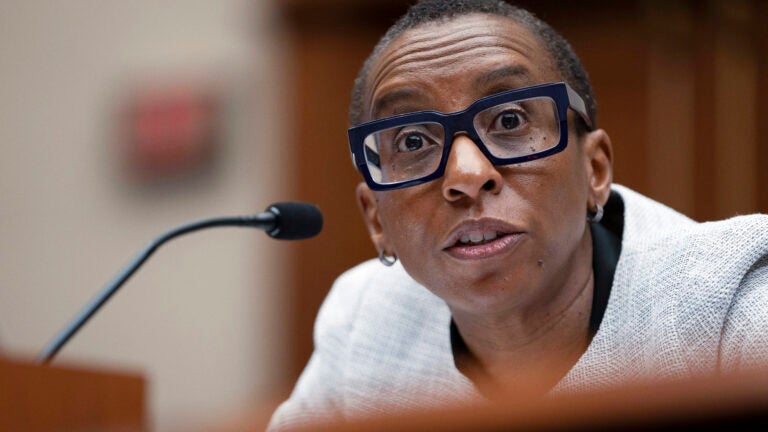
The aftermath of former Harvard president Claudine Gay’s resignation has been tumultuous for academia, according to some scholars in Greater Boston.
Gay’s resignation came after intense public criticism over her testimony at a congressional hearing on campus anti-Semitism and allegations of plagiarism. But the record-setting duration of her tenure and the speed of her departure, along with the intense public backlash she faced, reflects a growing movement that threatens higher education and university presidents in America, said Mary Churchill, a higher education administration expert.
“We’re in a time right now where higher ed is now seen as a tool in the political toolkit,” Churchill said. “It’s being used right now as a tool of the Republican Party, and it’s really anti-education.”
Churchill, who is also the associate dean for strategic initiatives and community engagement at Boston University Wheelock College of Education & Human Development, said she believes Gay’s resignation was “an attack on higher education” that she said reaches beyond just universities and their leaders.
“This is an attack on education — K through 12 is also being attacked, libraries are being attacked, books are being banned. It is an attack on knowledge,” she said. “And that terrifies me.”
Gay echoed this fear in an op-ed in the New York Times, describing her resignation as part of a “campaign” to oust her and weaken trusted institutions like Harvard.
“The campaign against me was about more than one university and one leader. This was merely a single skirmish in a broader war to unravel public faith in pillars of American society,” Gay wrote.
Leadership losses across higher education
Universities nationwide are experiencing high rates of turnover among their presidents, and particularly women of color presidents, Churchill said.
A report from the American Council of Education found that between 2006 and 2022, the average tenure of all presidents fell from 8.5 to 5.9 years. In addition, more than half (55%) of presidents said they planned to step down from their current roles within the next five years. Nearly one in five presidents of color who plan to step down within the next five years said they plan to retire without seeking another position.
The high turnover of presidents, particularly presidents of color, could have serious ramifications for the universities they represent, as well as the students and faculty they serve, according to the report.
“This anticipated change in leadership, particularly among already underrepresented groups, will not only affect the diversity of the presidency, but it will also impact several hundred institutions and the many students, faculty, and staff who attend and work at them,” the report found.
A growing anti-DEI movement
Churchill said the reasons for the high turnover rates among senior leadership within higher education institutions often comes down to the difficulty of the position, which is fueled by growing hostility toward higher education in general and diversity, equity, and inclusion (DEI) policies, specifically, nationwide.
Indeed, anti-DEI legislation has had universities across the country on edge. Since The Chronicle began tracking DEI legislation in early 2023, 52 bills have been introduced across 24 states.
Shaya Gregory Poku, the vice president of equity and social justice at Emerson College, wrote in the Bay State Banner that she believes Gay’s resignation was part of an anti-DEI movement that she predicts could play out at other institutions across the country.
“Not all conservatives are anti-DEI conservatives. And no leader should be immune from critique, including the head of a prestigious university, but the forces that successfully conspired to have Gay resign set a dangerous precedent,” she wrote.
Khalil Gibran Muhammad, a professor of history, race, and public policy at Harvard Kennedy School, agreed, telling the Chronicle of Higher Education that Gay’s resignation is just the beginning for attacks against DEI.
“The national conversation around DEI that has emerged in the resignation of Claudine Gay will open the floodgates for more attacks on DEI,” he said.
Boston.com readers, too, voiced concerns about the role that anti-DEI sentiments played in Gay’s resignation.
“[Claudine Gay’s resignation] had nothing to do with her congressional testimony. Rather, it was a small, loudly vocal group opposed to DEI, and entry quotas at universities having been pushing the agenda” said M.O. from Back Bay.
Greater academic scrutiny
But not all academics say a conservative campaign or anti-DEI sentiments were the main reason for Gay’s resignation. Ruth Hochberger, the former editor-in-chief of the New York Law Journal and a former professor at Columbia University, New York University, and City University of New York on legal and ethical issues in journalism, told Boston.com that she believes the plagiarism allegations made against Gay were the nail in the coffin.
“I do think that there is an attitude of going after elite educational institutions, but I don’t think it matters,” she said. “Plagiarism is not illegal, but it’s certainly unethical, and it’s certainly immoral and academics should be held to a higher standard.”
Hochberger said it is the number of accusations that are alarming (The Washington Free Beacon, a conservative online journal, alleges 40 total plagiarism accusations).
“This is not Fareed Zakaria cribbing something in one of his columns. This is the president of Harvard University,” Hochberger said.
There is one good thing Hochberger said has emerged in the wake of Gay’s resignation: greater scrutiny of all academics.
“I do think that the academy, as they call it, is going to be under a microscope. But you know what? Great. We should all be under microscopes for things that are dishonest. I have no tolerance for plagiarism,” she said.



Be civil. Be kind.
Read our full community guidelines.To comment, please create a screen name in your profile
To comment, please verify your email address