
Sign up for the Today newsletter
Get everything you need to know to start your day, delivered right to your inbox every morning.
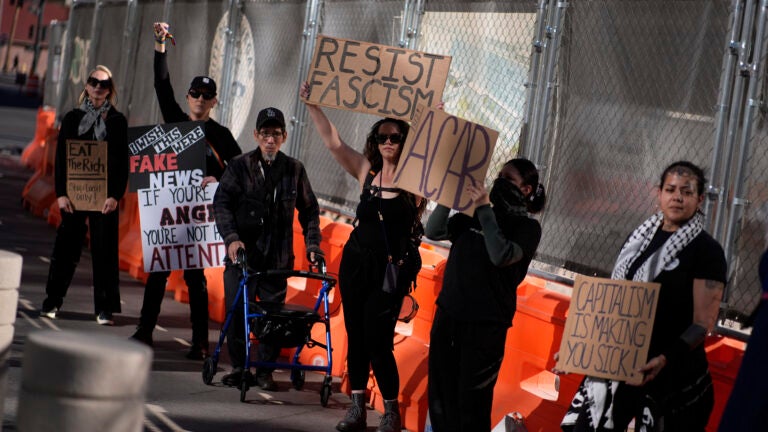
A grassroots organization is encouraging consumers to participate in an “economic blackout” on Friday as an act of “economic resistance” against corporate greed – a movement Boston.com readers, and some local businesses, say they are participating in.
“Large companies are squeezing consumers dry out of greed and the government isn’t doing a thing to stop it,” Boston.com reader Eric said.
The People’s Union USA, founded by John Schwartz according to their website, encourages Americans to boycott major retailers such as Amazon, Walmart, and Best Buy to challenge corporate power. The organization’s website said they are not affiliated with a political party, and plan to hold blackouts throughout the spring.
The planned boycott is scheduled to run until 11:59 p.m. EST on Friday. The group encouraged customers to refrain from making any purchases, both in store or online, and particularly not from big retailers or chains. The group advises shoppers to spend only on emergencies or essentials, to shop at local businesses, and to use cash over credit or debit cards.
When we asked Boston.com readers if they plan to participate in the blackout, the majority (65%) of the over 660 respondents to our poll said yes. On the contrary, 32% said they won’t participate, and just 3% were unsure.
Many proponents of the blackout said they see it as a way to show corporations the power of consumers.
“It’s a good experiment to see what impact as consumers we can have on large global organizations,” reader Chris L. from Melrose said.
S.L.C. from Chelsea agreed, arguing the no-spend day “[uses] our spending dollars to voice our opinion and show what is important to us.”
Local businesses have taken up the blackout too, like Gather Here, a fabric and yarn store, and sewing lounge in Cambridge that closed on Friday in solidarity with the movement.
“We have been asking people to vote with their wallet since we opened in February 2011 – to spend more at local businesses and support the small businesses in their communities because where we shop matters,” owner Virginia Johnson said in a post on social media.
Other proponents said it’s a way to protest the Trump administration, particularly the president’s inclusion of the world’s richest man, Elon Musk, and other billionaires in top-governmental roles.
On the other hand, some opponents expressed doubt about the actual impact and effectiveness of the economic blackout, while others argued it could end up hurting, not helping, small businesses.
“Best way to break corporate greed is to support small businesses and enforce antitrust laws so corporations don’t corner the market on a given item or business,” reader Michelle from Weymouth said.
Below, readers who will and won’t participate in the economic blackout share the reasoning behind their decision.
Responses have been lightly edited for grammar and clarity.
“Corporate greed has left too many working people behind. Income inequality is insane.” – Whitney T., North End
“Because we must end the billionaire greed and the advantage they feel over the middle class who are killing themselves to make ends meet.” – Maureen, Bradford
“Because it’s one of the few ways the working and middle classes can fight back against fascism, corporate greed, and the 1%. My family and I have already significantly reduced our overall spending and are avoiding non-essential purchases. We are also shopping for predominantly second hand and used items, as well as trying to avoid online purchases and prioritizing buying from local and small brick and mortar businesses. Purchases for new items have been minimized. We will continue to spend this way and aggressively save for the foreseeable future. As far as we’re concerned, the old days of wanton consumerism in our households are over.” – Adam B., Salem
“There’s only one language corporate America speaks: that’s the language of money. I’ve always spoken with my wallet and will continue to do so whenever I can.” – Richard M., Hudson
“I need some way to protest and show my disagreement with the DOGE cuts and overall philosophy of the federal government under President.” – Tracy L., York, Maine
“We need to make a statement that the direction this country is taking is not acceptable.” – Meg, Cape Cod
“I think it’s important to collectively send a message to the new administration.” – Kate M., Wellesley
“It may be the only way for citizens to be heard with the limited choices we have in recent elections. We need to push back on major corporations so they respond to us, especially the monopolies such as Amazon.” – Matt, Worcester
“I needed to find a focus for the anger growing daily in response to the actions of President Trump. I’m urging friends and family to join in. Maybe it’ll make a dent, get some attention, and garner more support for the next one(s).” – Kevin F., Cambridge
“It gives me a way to stand up and show my disappointment in the current economic and political climate.” – Kristin, Cohasset
“Personal protest – it may not have an impact but makes me feel like I can contribute to the dissatisfaction against the assault on our democracy.” – A.M.H., Quincy
“I feel helpless in so many ways. It’s a simple way to participate in trying to be heard.” – AnnMarie S., Plymouth
“It’s one small gesture to take back some power from corporations. Maybe it will be a gateway for me to be more intentional about spending.” – Allison M., Plymouth
“It’s a long shot but I hope it at least demonstrates that workers are the ones that hold the power in a capitalist society. They make the goods, they buy most of it.” – John B., Southeastern Massachusetts
“I feel it is time that businesses understand the buying power of consumers and we are not a pawn in a political game.” – Mona R., Worcester
“These major corporations forget that it is the little people, not the millionaires/billionaires, that support them. Without us, they have nothing.” – Kathleen, Boston
“To send a message that big box stores are not the way to go. Careful planning, spend locally and pay in cash if you can. It is an amazing feeling. I purposely try to spend cash locally and away from big box stores.” – L.M., Medford
“It’s the next best thing to a general strike – hit the big corporations in the wallet! If enough people participate, and continue to do so in the future (there are several other blackouts planned in the coming weeks and months!), it will make an impact and have policy ramifications.” – Meredith, Maynard
“If you want to help the economy, spend money. Delaying purchases does nothing.” – Dave, Dracut
“While I agree credit card companies are preying upon consumers and businesses alike, corporations that sell goods employ my fellow Americans. Not only that, but the vast majority of Americans with any kind of retirement fund are invested in corporations. It seems silly to try to bring down the very entities we invest in to fund our future.” – Shawn, Revere
“I work as a teacher and I take care of my family. There are many more problems in the world that I would like to put my efforts towards rather than ‘showing’ corporations that I will not purchase their goods and services on a particular day.” – Laura F., Northborough
“The economic blackout concept is absurd and ultimately hurts no one more than those who decided this was a brilliant way to protest the consumer. Big Box vendors can easily survive this with no more than a bump in revenue while small mom-and-pop shops, already stretched thin on inflationary costs and egregious taxes and regulations, can go under entirely. Talk about biting off the nose to spite the face.” – Casey, Raynham
“I’m not privileged enough to participate in the economic blackout. I have to drive my children to school and actually go to work that day, so I might have to get gas. I might have to buy food for my family because I haven’t planned our meal plans out that well like the wealthy elite have already done because of all their free time. This blackout is for people who have both time and money to actually partake in these kinds of affairs. The rest of us have regular middle and lower class lives to live.” – Rosie K., Northborough
“Those who believe an ‘economic blackout’ of any duration has a positive effect on the US economy are ignorant of fundamental economics. Consumer spending, a key metric of economic demand, is essential for GDP growth. Lower consumer spending puts the brakes on GDP; higher consumer spending accelerates a nation’s Gross Domestic Product (GDP). Growing GDP creates a higher standard of living in the nation.” – Robert S., South Shore
“It’s a waste of time. Also, shopping locally can be fine, but it’s always more expensive [than Big Box stores].” – Bonnie T., Braintree
“Businesses should stay open and ask to shop locally, not close.” – Bob, Lynn
Boston.com occasionally interacts with readers by conducting informal polls and surveys. These results should be read as an unscientific gauge of readers’ opinion.

Get everything you need to know to start your day, delivered right to your inbox every morning.




To comment, please create a screen name in your profile
To comment, please verify your email address
Conversation
This discussion has ended. Please join elsewhere on Boston.com