
Sign up for the Today newsletter
Get everything you need to know to start your day, delivered right to your inbox every morning.
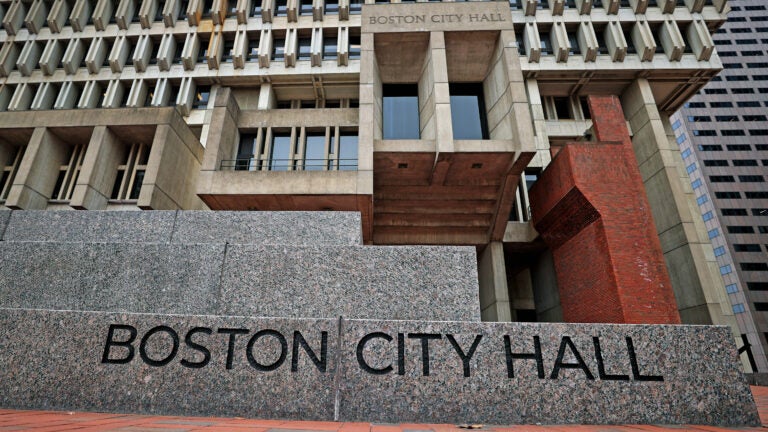
Boston City Hall was designated a historical landmark for its architectural, cultural, and civic significance, Boston Mayor Michelle Wu and the Boston Landmarks Commission announced on Jan. 24.
The Brutalist building has been a polarizing subject for Bostonians since it was built in 1968, and its landmark designation was similarly met with praise alongside disapproval from Boston.com readers. When we asked readers in December if the building deserved the landmark status, nearly 300 readers responded. Three-quarters of readers (75%) said they believe City Hall doesn’t deserve landmark status, while just under a quarter (25%) said it definitely qualifies.
Many who celebrated its landmark designation said its unique architectural design was more than worthy of preservation.
“It is a unique and compelling design. I have always loved it in spite of the criticism it received,” reader S.D. from the South End said when we asked if it deserved landmark status.
Reader Gregory L. from Holliston agreed, fondly calling the building “my beautiful, Brutal, non-elegant City Hall!”
And Jon-Lawrence from Onset summed it up nicely when he noted that, regardless of public opinion for or against the building, it makes people stop and think – which is an essential role of art and architecture.
“Regardless of whether or not you enjoy the architecture of City Hall, you have to admit that it does elicit a visceral response from just about everybody and anybody, not just architects or architecture critics, he said. “This, I believe, is a hallmark of both good art and iconic architecture.”
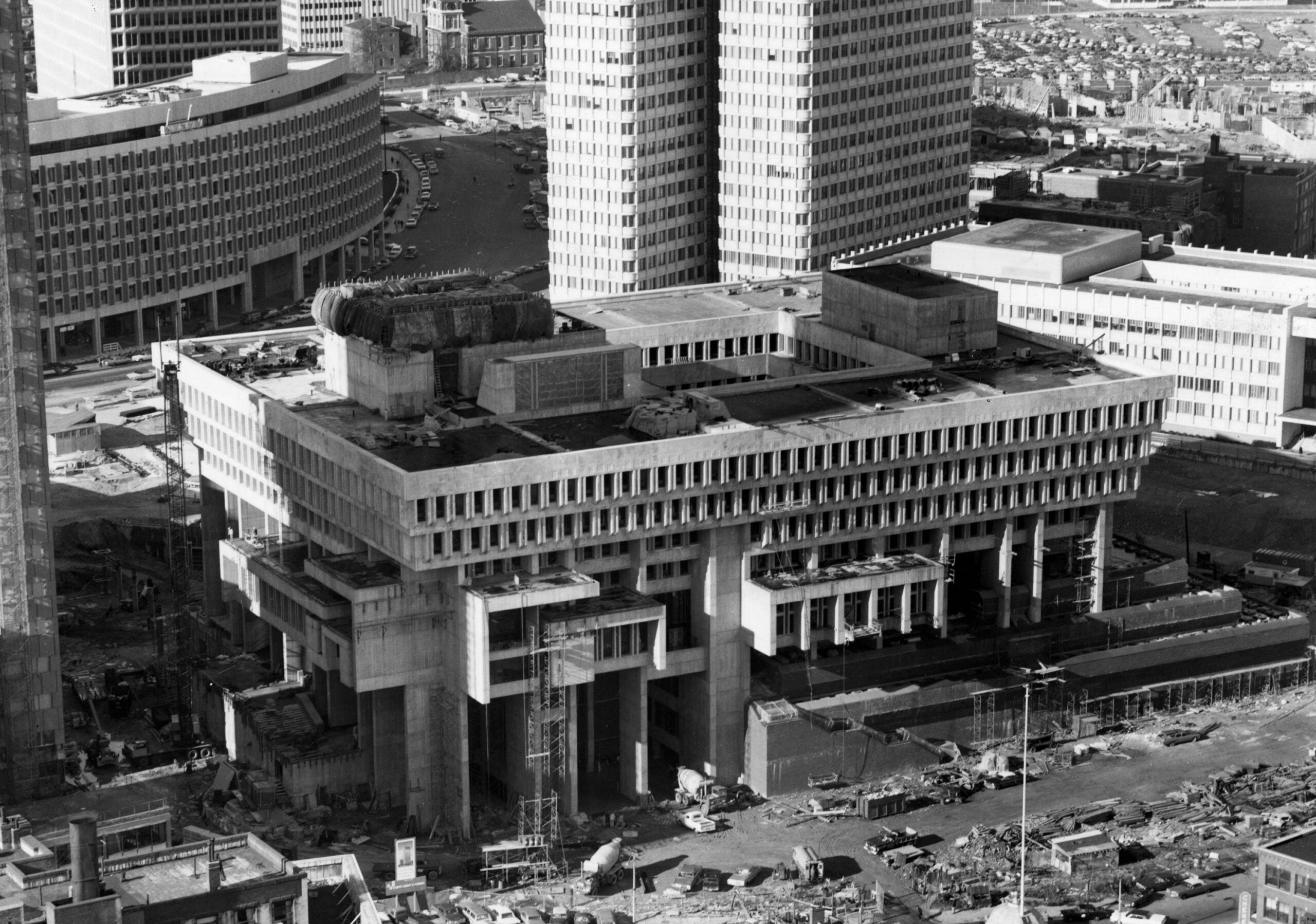
Completed in 1968, Boston City Hall was built where the former Scollay Square neighborhood stood. The Scollay Square neighborhood served as “the entertainment capital of Boston” from the mid-19th century until the decade following World War II, according to the West End museum. But by the end of World War II, the neighborhood had fallen into decline and became a red-light district. It was razed in the early 1960s to construct the Government Center complex, which included the new City Hall, Center Plaza, and the JFK Federal building.
Many readers who said they were against City Hall’s landmark designation attributed their feelings to Boston’s controversial history of urban renewal and the demolition of Scollay Square.
“The fact that it replaced the old buildings in historic Scollay Square is only one of the reasons I consider it an abomination,” reader Anabel G. from Lexington said.
Other readers said they simply don’t like the Brutalist style – J.U from Newton called it “a concrete nightmare” – while others said they have long-standing gripes with the design.
“I wrote a paper about Boston City Hall in 1973 while at Boston University discussing the form and function of different buildings. I still feel that it represents faceless government bureaucracy with an ugly fortress-like facade. I still don’t like it,” reader Lorenzo from Rhode Island said.
Below, see a sampling of reader responses on Boston City Hall’s architecture and its landmark designation.
Responses have been lightly edited for grammar and clarity.
“I understand the argument for protection if we’re looking at City Hall as a piece of art: all architecture is art to some extent. I enjoy art that challenges my view of what is aesthetically pleasing or that otherwise encourages me to examine my preconceptions. I appreciate portions of City Hall when viewed in this way.
But City Hall Plaza is not just art: it’s a major part of our downtown, a symbol of our city and its government, and a reminder of the harm done by urban renewal. For me, City Hall falls in the same category as the West End redevelopment, the I-93 demolitions, Logan Airport’s expansion into East Boston, and the Bowker overpass: a reminder of misguided 20th century decisions that destroyed productive neighborhoods and public parks. City Hall is likely here to stay, but I would like to see homes and businesses return to what is now the Plaza, and I’d like to see some historical architecture that pays tribute to what stood in Scollay Square before the city government decided it was better off as rubble.” – Lucas G., Jamaica Plain
“The building is hideous! The entire Government Center development was ill conceived and has never been user friendly. The proof lies in the time and effort spent over the years trying to redesign the barren wind swept plaza. Massive concrete buildings do not invite human interaction. Please, no honors for this travesty!” – Joseph Z., Boston
“It is a concrete monstrosity surrounded by what used to be commercial and residential property, but is now just a useless, expansive, windy, open plaza.” – Padraig O., Dorchester
“Ugliest building in Boston – and that’s just the outside. Head inside, and you have a dystopian horror show totally void of light, warmth, and air. And I haven’t even touched on the landscaping; It’s a place where bricks come to die.” – Kevin T., Beacon Hill
“There is nothing remarkable about Boston City Hall or the plaza. It should not have landmark status. But then again, neither should Fenway Park.” – Michelle, Boston
“All the changes to City Hall Plaza have made it less ugly over time. It’s an important historical building, but it shouldn’t be frozen in time. Boston is a living city, not a museum.” – Mike, Cambridge
“It would be better to be able to fully update the building, which historic status will not allow.” – Mit G., Newton
“I am delighted to hear that Boston City Council has officially accepted the landmark designation for Boston City Hall, marking a significant milestone in preserving this iconic piece of design. This decision not only protects its distinctive Brutalist architecture but also highlights the many forms in which beauty can be expressed through design.” – Maria S., Waltham
“Boston City Hall is such a unique building. It has seen so much history since it was built in 1968. As you come into the lobby, you are presented with a wonderful open space that is not found in some other government buildings where you are greeted by a small closed off space. I have noticed when I go to City Hall that there are often wedding parties and couples being photographed around the building as their wedding photos. Just as an aside, I have noticed how wonderfully cool the lower levels of City Hall are during summer months. Perhaps it was a ‘green building’ ahead of its time.” – Nancy, Beacon Hill
“Boston City Hall is perhaps the finest example of so-called concrete ‘brutal’ architecture (this name is based upon the French word ‘brut,’ which means dry or unpainted). Many people dislike concrete ‘brutal’ design, and these days, it’s very much out of fashion. However, City Hall is a historically fine structure that uses eye-catching ‘brut’ architecture very effectively.” – Rick W., South Boston
“It is a daring, forward-thinking design that helped send the message that Boston was making changes and ready to face the future. It seems to have worked, given what a prosperous, beautiful, clean city it is today. So yes, even though I think it is foreboding and unattractive, I think it should have landmark status.” – Jane, Boston
“Brutalism is an important aesthetic within the world of architecture, even if it is not appreciated by all. Taking the public’s opinion on renovating city hall would be like taking the public’s opinion on conserving a painting at the MFA or Isabella Stewart Gardiner.” – Sean M., Fenway
“Boston City Hall is certainly not the most beautiful building in Boston, or even the most beautiful city hall, but it is a famous example of an important architectural style, and it can be really interesting to explore. I’m not sure I would build something like that, but I think the world is more interesting with buildings like this in it.” – Micah D., Lexington
“Throughout history, stunning buildings like the original Penn Station have been tragically demolished, in part due to changing tastes and a lack of appreciation for their aesthetic value at the time. As Brutalism gains increasing recognition, it would be an error to not protect one of its most iconic landmarks.” – Robert S., Cambridge
“It is an important example of modern architecture in Boston. The contrast of concrete against the brick plaza blends, old and new, both visually and functionally. The longer it exists, the more significant it becomes in the life of the city. It would be a shame to lose this example of 20th century civic architecture which is part of what attracts people the world over to Boston.” – Douglas O., Hartford, Connecticut
“I worked in City Hall for eight years, and prior to that as a teenage CETA worker, I helped carry files from Old City Hall to new City Hall during its opening. It is, in my opinion, an architectural marvel of what I call the New Boston, yet fits in quite nicely with Faneuil Hall and Quincy Marketplace. It is now a Boston landmark.” – Patterson R., Norwood
Boston.com occasionally interacts with readers by conducting informal polls and surveys. These results should be read as an unscientific gauge of readers’ opinion.

Get everything you need to know to start your day, delivered right to your inbox every morning.





To comment, please create a screen name in your profile
To comment, please verify your email address
Conversation
This discussion has ended. Please join elsewhere on Boston.com