


Sign up for the Today newsletter
Get everything you need to know to start your day, delivered right to your inbox every morning.
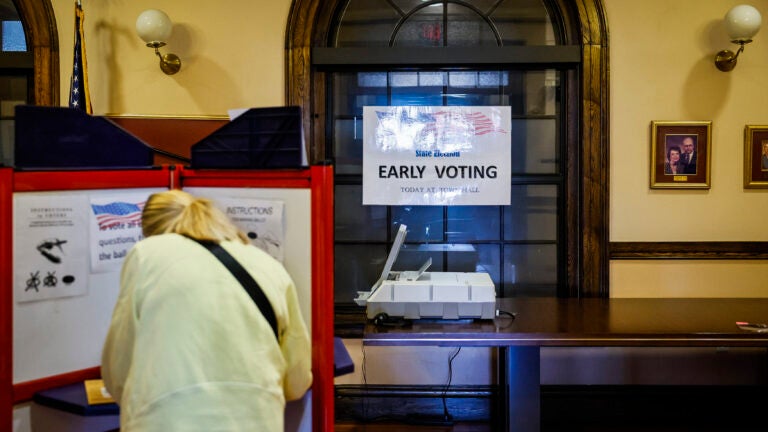
At the 2024 Massachusetts state election on Nov. 5, voters will get the chance to weigh in on five ballot questions that could have a profound impact on the state.
The five measures cover issues ranging from the Legislature to psychedelics to MCAS testing, and have faced fierce debate by proponents and opponents of the measures. Not to mention the ballot questions have also racked up millions in donations, too.
We asked Boston.com readers how they plan to vote on the five ballot questions for the 2024 Massachusetts state election, and 3,766 responded.
Below, see how readers plan to vote and hear their perspective for and against each ballot question.
Question 1 asks voters to decide if the Office of the State Auditor should have the power to conduct an audit of the state Legislature. If passed, the state auditor would be given the express authorization to audit the Massachusetts Legislature.
The majority (80%) of the 784 Boston.com readers who responded said they would vote yes on Question 1, arguing it provides more transparency and public scrutiny of how taxpayer dollars are spent. Opponents (15%) of the law say the passage of Question 1 would undermine the separation of powers between the branches of government.
“We deserve the right to know how the government operates and how money and power are used. If we truly believe that the government should be for the people, then we should be able to see the inner workings of the government.” – Harrison C., Charlestown
“Our legislature lacks transparency and accountability. This, I hope, will help alleviate those problems.” – Donald, Natick
“Taxpayers need a way for ‘checks and balances’ to be in place to verify our tax money isn’t abused and mismanaged. As a parent, I’m expected to keep a balanced budget for my family to live and eat from, so why can’t the state? The abuse and mismanagement of our money needs to be stopped.” – William S., Andover
“To completely achieve any meaningful goals, there’s a cost to taxpayers as well as opening up the possibility of lawsuits, further costing taxpayers even more money. Although transparency is important, this way of asking for it seems flawed.” – Patricia, Pembroke
“There is too much focus on executive authority and it must be curbed. The objective of this question is best addressed by electing better candidates that will focus on reform.” – Fred D., Milton
“Separation of powers is fundamental to our system of government and this bill shifts too much power into the executive branch. Additionally, it will be virtually impossible to claim to be ‘independent’ when one branch of government audits another.” – Magee, Danvers
Question 2 asks voters to decide if the MCAS or any other statewide or districtwide assessments in English, mathematics, and science and technology should be eliminated as a requirement for high school graduation.
If passed, Question 2 would remove MCAS as a graduation requirement for high school students. Students would still take the test, but their diploma would not hinge on their passing MCAS, and instead, on their district’s graduation standards.
Proponents of the law say the test puts unnecessary stress on students, and disproportionately affects students with disabilities or from marginalized backgrounds. Opponents of the law say having a state-wide requirement for graduation is important for measuring academic performance.
Boston.com readers were nearly split on either side of the ballot measure, with 40% of the 803 who responded plan to vote yes on Question 2 and just over half (53%) plan to vote no. Seven percent of readers said they were undecided on how to vote.
“I have three children with learning disabilities, including ADD and dyslexia. They all get support and thrive in the classroom where they can take their time to complete work, have repeated instructions and more. The anxiety in my house during MCAS is through the roof. These kids are not great test takers and their scores reflect that. Knowing that my child may not be able to graduate from high school, even though they work hard and maintain high marks semester after semester, leaves me with the same anxiety that this will ruin their future, break all our hearts and lessen their resolve to work hard and fight through their disabilities to succeed.” – Kate H., Greater Boston
“I’m a student who took the MCAS in high school, and I am generally opposed to the use of standardized tests as metrics of success. While a robust education is necessary in a lot of ways to achieve success, I was miserable throughout much of my schooling because so much of the focus was put on teaching to test, and even though I did well, by the time of my senior year, I was burnt out on learning to test requirements. The MCAS does little that other tests cannot do, and I believe that there are better ways to maintain our high schooling standards that don’t punish students who do not test well and burn out students that do.” – Donnelly L., Orleans
“As a Special Needs teacher, I work with students who through no fault of their own, aren’t able to grasp many of the abstract concepts presented in these tests. They work as hard as anyone else in high school, and many times much harder than your average high school because of disabilities that they have. Yet when it comes to finally graduating, they can’t. They get a certificate of attendance, not a diploma. These are students who are very capable of being a contributing member of society, but because they lack a HS Diploma, they can’t even get the most basic job. Countless students who have gone through 12+ years of public school, who have worked hard and have successfully passed all of their classes, still can’t get a high school diploma solely because of the MCAS.” – David D., Billerica
“Although imperfect, the requirement for a minimum demonstration of proficiency related to a common standard of education, representative of skills that have legitimate utility in everyday life, is a reasonable measure of the success of the educational process. Without any performance measure, the potential for an undetected complete failure of the system is real and dangerous. Far better to strive to improve teaching skills for the underprivileged and for those with learning disabilities.” – James W., South End
“I don’t trust individual towns or school committees to each come up with standards as comprehensive as the MCAS. Teachers and administrators and budgets are already overwhelmed.” – Jill G., Quincy
“If MCAS is removed, then there should be a state-wide requirement to graduate from high school. This ballot question fails to have a replacement for MCAS.” – Jim, Dracut
Question 3 asks voters to decide whether ride-hailing drivers should be allowed to form unions for collective bargaining with transportation companies such as Uber and Lyft. If passed, drivers would have to collect signatures from at least 25% of active drivers to form a union. Then, if a union is formed, the state would oversee union negotiations and approve the negotiated recommendations on wages, benefits, and terms and conditions of work.
Proponents of the law said giving drivers the right to unionize gives them fair and equal protections in an industry that can be volatile and exploitative. Opponents said unionization would take away a drivers’ independence and flexibility.
Boston.com readers were split on the question, with 36% of the 461 polled voted yes, nearly half (48%) voted no, and 17% undecided.
“They are a private group and have the right to unionize, at their discretion. This will also force insurance coverage, which will be a better environment for riders and drivers.” – Gilly B., Springfield
“Everyone deserves fair and equal protections. Currently this is an exploitative industry with the drivers bearing most of the financial burden of liability and risk.” – John, Boston
“Everyone deserves the right to join a union; unions make work life safer and therefore contribute to safer communities for all.” – Anabel G., Lexington
“I’m voting no on Question 3 because drivers should remain independent and have the flexibility to make their own schedules. Unionizing could take away this freedom and impose rules that don’t work for everyone. There are better ways to improve conditions for drivers without sacrificing their independence.” – T.S., Boston
“I have been a part time driver. The flexibility is the best thing rideshare employment has. It is meant to be gig work, not a 9 to 5 job. Unions will ruin this flexibility.” – Alex, Roxbury
“Although I support the right to unionize in general, I disagree with the 25% minimum of drivers signing onto the union. This is far too low; I would support the measure if it is 80% or above. The union should not be forced upon all of the drivers.” – Jim D., Canton
Question 4 asks voters to decide whether “magic mushrooms” and other natural psychedelic substances should be legalized in certain circumstances for adults aged 21 and up.
If the ballot measure passes, adults would be able to purchase five psychedelic substances — psilocybin, psilocyn, dimethyltryptamine, mescaline, and ibogaine — at approved locations for use under the supervision of licensed facilitators.
The ballot question would also decriminalize the possession and growing of small amounts for personal use, allowing adults over the age of 21 to grow psychedelic substances in a 12-foot-by-12-foot area at home and give away limited quantities to other adults.
Boston.com readers were split on the question, with 45% of the 360 who responded say they plan to vote yes, 49% plan to vote no, and 6% were undecided.
“There is a massive, potential life-saving opportunity for Massachusetts to bring legalized and regular psychedelic therapies to so many of the Commonwealth’s citizens who experience debilitating, misunderstood, stigmatized life-threatening mental/behavioral health conditions.” – Mink S., Dorchester
“I have dealt with severe treatment resistant depression and PTSD for over 15 years. Intranasal ketamine was the first treatment that helped ease my depression from severe to moderate most of the time, and having imagery during the sessions was life changing in starting to shift how certain trauma affected me. For the first time since I was a child I started having some ability to feel excitement, calm, love, and joy. I have a long way to go and believe psychedelic assisted therapy would help make further progress possible and potentially allow me to work.” – Ari, Boston
“Helping people with mental health issues that are backed by scientific studies and providing a holistic alternative to highly addictive prescription medications. It also brings in new tax revenue which is a bonus. This ballot question is a unique chance to prove that we are truly one of the most progressive states in the country.” – Paul, Lexington
“I think that this could be very dangerous and sends the wrong message to children about the safety of mushrooms, which in the wrong person could lead to irreparable neurological damage. The homegrowing option will lead to use outside of controlled facilities, and inevitably lead to accidents and deaths.” – Eva, Brookline
“I want to vote for this, but being able to grow and share them seems just too risky. I’d rather these be provided by licensed growers and be available only to medically licensed groups that will administer them under supervision to keep the person ingesting them, along with the people around them, safe. This bill needs more work in my opinion, but I’m sad that it’s not in a place where I feel it’s safe to vote for it.” – Aimee G., Fitchburg
“I want to vote yes but I don’t trust that the safeguards in place to keep this from spiraling out of control are sufficient. That said, I am generally okay with decriminalization if it is done in the right way.” – Alex, Roxbury
Question 5 asks voters to decide if the tipped minimum wage of $6.75, plus tips, should be eliminated in favor of paying servers and bartenders the state minimum wage of $15 an hour.
Currently, tipped employees are paid $6.75 an hour, plus tips that must legally combine to equal or be higher than the regular minimum wage amount of $15 an hour. If their tips do not reach $15 an hour at the end of a shift, then their employers are required by law to pay the difference.
If passed, the measure would increase the minimum wage for tipped workers gradually over five years.
The majority (57%) of the 1,300 Boston.com readers polled said they plan to vote no on Question 5, while 32% said they plan to vote yes. Ten percent were undecided.
“Tips being mandatory is anti-consumer. This ballot measure paves the road a little closer to menu price transparency and fair wages for tipped employees. A tip should be a tip, it wasn’t meant to be part of the price.” – Jack, Boston
“Pooling tips to benefit all the workers at the restaurant makes sense to me. Why should only the server benefit when many other people prepared my meal?” – Philip G., Hingham
“Reduce the tipping burden on customers!” – Beth B., Auburndale
“The tipped worker is already guaranteed $15 an hour by law, should their tips not cover. This will remove tipping at restaurants, increase prices, and lower take home pay for tipped workers. This is bad for anyone who works for tips.” – Chris, Foxborough
“I’m a bartender and have no complaints about the current system. Neighborhood restaurants are already dealing with sky high operation costs, adding another could be the end of many smaller establishments.” – Laurie, Dorchester
“Having worked as a server, bartender and manager in restaurants across the country for my entire adult life, I can say with certainty that tipped employees don’t want this. They make double or triple minimum wage in tips now, and their employers would certainly have to cut staffing as part of the solution if this measure passes, which would jeopardize that income. Tip pooling would also cut into their earnings. Especially in Massachusetts, there are many safeguards for tipped employees to ensure that they are not taken advantage of while being paid less than the state minimum. Honestly, this seems like a strange place to introduce this, as tipped workers are well protected under the law here.” – Karen S., South Deerfield

Get everything you need to know to start your day, delivered right to your inbox every morning.




To comment, please create a screen name in your profile
To comment, please verify your email address
Conversation
This discussion has ended. Please join elsewhere on Boston.com