
Sign up for the Today newsletter
Get everything you need to know to start your day, delivered right to your inbox every morning.
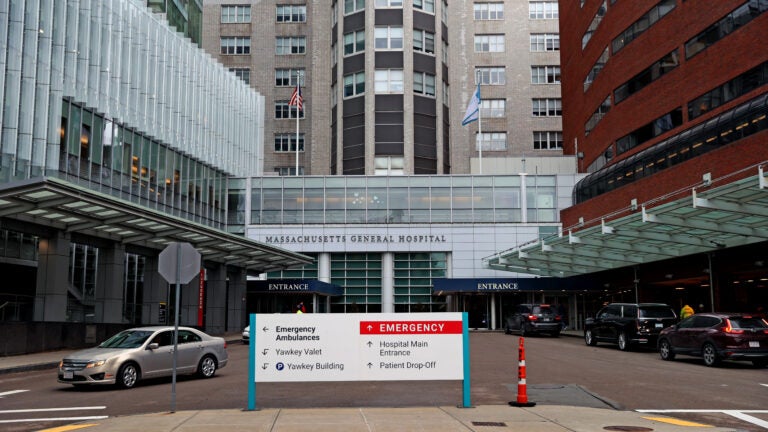
This story was told by Elsa Imbimbo, a primary care doctor at Massachusetts General Hospital (MGH) and a physician organizer at Mass General Brigham (MGB). She is one of nearly 300 primary care doctors in the MGB system, which includes MGH and Brigham and Women’s Hospital, who have petitioned to unionize.
Elsa’s story has been edited from a conversation with Annie Jonas.
When I arrived in Boston, I really liked the fact that MGH has built-in professional development for newly graduated residents, where we get to start off for the first two years at a reduced schedule that’s still considered full time.
Full-time primary care at MGH is considered eight half-day clinic sessions, and then you get two half days of administrative time. So rather than start right at that level, the MGH plan for new hires out of residency is to give you two years where you’re doing six clinical sessions per week, and then you have a full day where you get professional development time. It’s a mix of structured and unstructured.

After two years, you get to eight half-day sessions per week. That was one of the things that I really thought was going to be helpful for me, and just making sure that I could get to know the practice, understand how primary care works as an attending, and start to make some professional connections here. And it’s been great.
The great things about working here are my colleagues. They are wonderful. They’re insightful, generous with their time and their advice, especially for somebody new.
I had somebody just write down their phone number and leave it on my desk my first day and say, ‘Please call me if you need any advice.’ Everyone’s always looking out for each other. And we have a great team of nurses, medical assistants, and front desk staff, so it’s just a very supportive overall environment.
But in the [14 months] that I’ve spent here so far, there’s definitely some things that we can improve. Those things had contributed to my inspiration to organize. The first part as inspiration to organize for me is just the idea that, do you want to have a seat at the table or not? Do we just want to be submitting thoughts on a survey, or do we want to set up this formal process of being able to craft our professional environment with leadership?
With the process of organizing and negotiating a contract, we’re going to be able to set this baseline of work standards in writing. We can feel really confident that top-down changes won’t be coming through without our input.
My colleagues who’ve been here for longer, they’ve seen some changes that have come down that, had their voices been important in the process, maybe wouldn’t have happened.
I think having a union is a good thing and helpful thing, because it ensures that the physicians who are actually doing the day-to-day work of seeing patients are having their voices heard when it comes to decisions that are made at the practice level, at the hospital level.
I have talked to dozens of my colleagues in primary care over the last year and in the process of organizing, and I’ve actually only ever heard of three doctors who work that full-time, eight half-day sessions per week. Eight half-days per week is not sustainable.
I’m planning to stay at my current six half-day sessions, and that means I’m going to take a 25% pay cut. That leaves me at 0.75 FTE (full-time equivalent). I’m taking that trade off, just based on advice from colleagues that it’s not a good idea to put yourself in a position where you’re going to start to get overwhelmed with that clinical time.
Often, the eight hours of administrative time per week is not enough to really deal with all of the accumulated work throughout the week, because each time you meet with a patient, you’re not solving all the problems in that visit. Every meeting sort of generates new action items and points for follow up.
In a full day, I would see 14 patients. We have seven patients per half day. We get half an hour per patient. It would be nice to have a little bit more flexibility within the schedule, because sometimes you can foresee a visit being much faster or much longer, and it would be a little bit more helpful to have some more modularity to the schedules.
For a long time, there’s been this very established concept of what we call “Pajama Time,” which is being at home with your family, but logging back on to do work. I haven’t spoken to anyone who doesn’t work from home after hours, after working their standard day. The goal should be to have almost all of our work done in our office hours. For me, that’s the reason to stay at the six clinical sessions, because I feel like I’m able to do most of my work in my office hours.
But when you get to those eight half-day sessions per week, you’re doing a lot of work at home. Some people are okay with that, but a lot of people are not – I would say most people are not. I think that’s really the issue that we’re trying to address, i.e. some of our work changes.
When we have all these really fantastic medical assistants and front desk staff in our offices who then leave because they’re not being compensated well enough or there aren’t enough benefits and incentives to stay and make a career out of this job, then we’re losing all these great people who are supportive to us.
We need to make sure that there’s really robust resources around us, so that we feel like we can get our work done, and that we’re really delivering the best care we can. When I have to put in more work, I want to feel like I’m doing the best job that I can do, and that I’m really giving the patients the best care, that I’m giving everybody equal care; I’m able to treat all of my patients the same, regardless of their financial status. This burnout or moral injury really hits when you feel like, ‘I’m trying my best, but this is not the care that I saw myself giving as a PCP. I want my actions to have better results.’
A lot of these problems are national problems. We’ve got a primary care shortage across the entire country, to the point where it’s a running joke online that most young people don’t have a doctor. There’s so many reasons why, and a lot of them just have to do with the huge barriers to completing medical training.
I think as unionized physicians, as unionized primary care doctors, we would have the most control over retaining our current primary care colleagues in the workforce and recruiting new residency graduates to primary care, and really making this the best job it can possibly be.
Mass General and Brigham and Women’s are huge names in healthcare. They’re national leaders. And I think this would be a great opportunity for MGB to take on this challenge, to work with us and create these new solutions to these primarily local problems, but also national problems. We can really be a huge influence on the future of healthcare, and one way that we intend to do that is to form a collaboration council with Mass General Brigham leadership.
Physicians unionizing is not necessarily new. It has become more prominent lately as physicians have become employees rather than private practice professionals. I definitely understand why people are skeptical. But we’re in this moment where the status quo is not working, and if we extrapolate from the current status quo, what we will get is: a progressively aging population, fewer doctors to care for patients who have increasingly complex medical conditions, and adding patients to panels of overwhelmed doctors. It creates this cycle and pushes more and more of us into early retirement or change of career. And we already see that happening with the push towards concierge medicine.
This is a moment where we have to recognize that something has to change, and both here at MGB and across the country, forming doctors unions is the first step. We are the people who are doing this work, day in and day out, and we’re going to have the best solutions to face our moment in healthcare right now. It’s a little bit uncertain, it’s a little bit new. But I think in time, people will start to understand the importance of their PCP, their colleagues, having a really strong voice in what our next steps are in healthcare. I think we can make primary care better for patients, for physicians. I’m really excited for the possibilities.
Sorry. This form is no longer available.

Get everything you need to know to start your day, delivered right to your inbox every morning.





To comment, please create a screen name in your profile
To comment, please verify your email address
Conversation
This discussion has ended. Please join elsewhere on Boston.com