
Sign up for the Today newsletter
Get everything you need to know to start your day, delivered right to your inbox every morning.
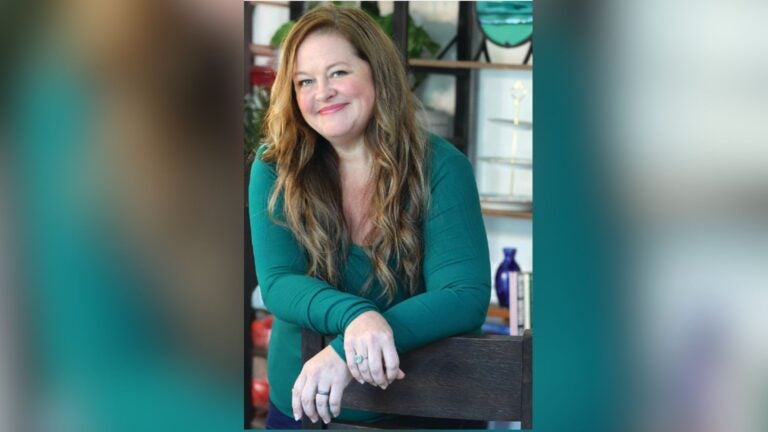
When New York Times bestselling novelist Kate Quinn was a student at Boston University, she had three big loves: The Red Sox, the Boston Public Library and, Vinny Testa’s.
“Vinny Testa’s was great for college students because they served huge amounts of good food, and it was very reasonable. So if you were broke, it was a great spot,” the bestselling novelist, 44, says with a laugh in a recent phone interview.
Heaps of good stuff at a low (or no) price is one reason Quinn loved the Boston Public Library.

“My BPL library card was very important to me because I was a student— I was broke. I didn’t have the funds to buy books. So going to the BPL every week for a stack of books was essential,” says the California native, who studied to be an opera singer at Boston University.
While earning her Bachelors in Voice Performance from BU (‘04) and then her Master’s in Voice Performance and Historical Performance (‘06), “I was also writing on the side, querying literary agents. I’d take my laptop to the BPL to write novels,” she says.
In fact, the Sox fan wrote her first novel as a BU freshman. More on that later.
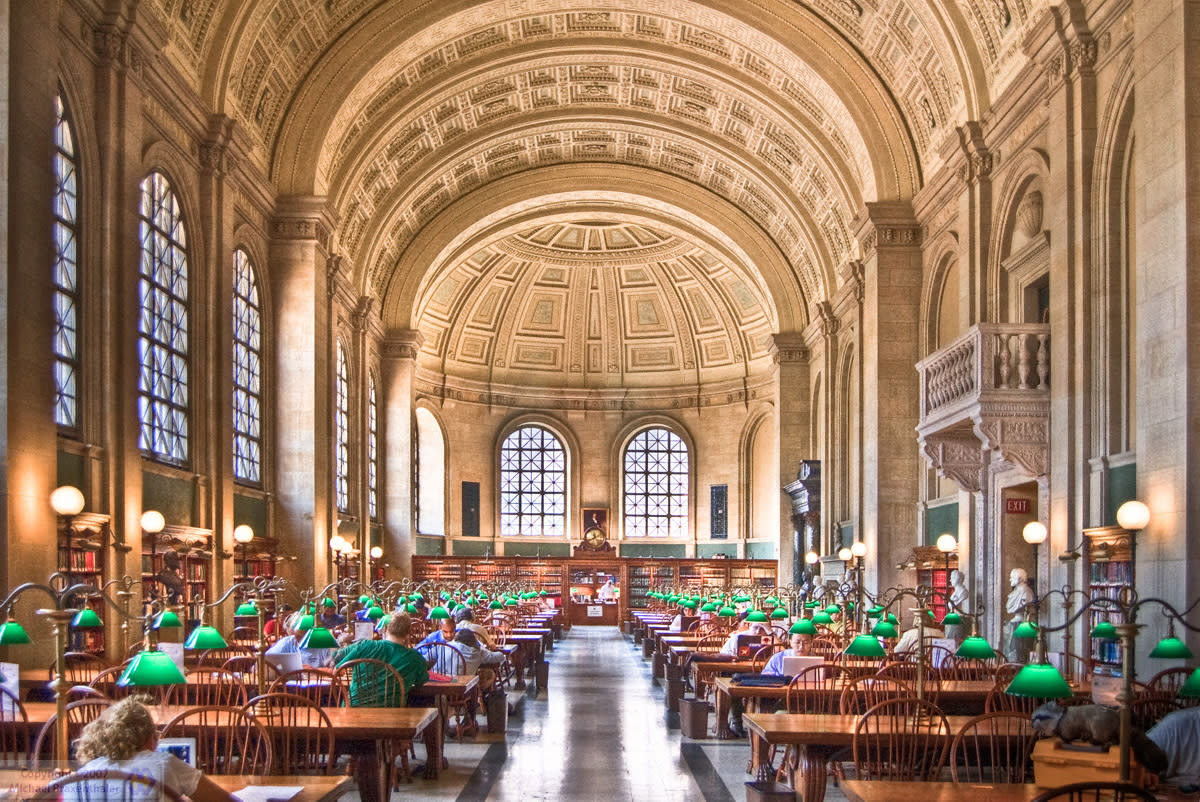
“The BPL is such a beautiful place, that as soon as I started thinking about what a dream library would look like, I thought: ‘It would look like the reading room at the BPL.’”
The former Boston resident’s bread-and-butter – what’s made Quinn a Name in the book world– are her bestselling WWI and WWII-set novels. I devoured “The Rose Code” and “The Alice Network,” the latter a Reese Witherspoon Book Club pick.
Quinn’s latest novel, “The Astral Library,” debuted at No. 2 on the New York Times bestsellers list. It’s part love letter to books, part love letter to Boston, and the BPL is its star, serving as a magical portal (a la the wardrobe in C.S. Lewis’s Narnia series) to the titular Astral Library.
So I was intrigued by two things here. One: Quinn’s sharp pivot from historical fiction to a fantasy/magical realism novel.
Two: her authentic love for the Boston Public Library. It shines on every page. It could make even the most half-hearted reader want to run there now to cozy up with a book.
The nutshell: Alix is 26 years old, has $36.82 in her bank account, and lives with two roommates (one works at Union Oyster House) in a two-bedroom in Southie. Then she gets the boot. And loses her job.
With no family and only one friend — Beau, who owns a high-end shop on Newbury Street— she’s desperate for a life-escape.
Then, one wet evening in April, she walks into the Boston Public Library and her life changes. A door in the BPL is a portal to the fantastical Astral Library.
With a wise Yoda-like “Librarian” as a guide, it can take readers in need — most running from something — and spit them out into pages of any public domain book they chose. They then live as side characters in that world. (One Astral visitor, for example, lives in Jane Austen’s “Pride and Prejudice,” marries Colonel Fitzwilliam, and has a baby.)
Before Alix can escape into a new life, “a shadowy enemy emerges to threaten everyone the Astral Library has ever helped protect,” as the publisher synopsis tells us. Alix and the Librarian find themselves in Sherlock Holmes’s London and Gatsby’s parties as danger draws closer. “But who does their enemy really wish to destroy — Alix, the Librarian, or the Library itself?”
I called the former Boston and Winthrop resident to talk Newbury Street, the Red Sox, opera, and what she’s working on next.
I’ve always been a fantasy fan. It’s where I learned to love story. Before I could read, my father read me [C.S. Lewis’s] Narnia series, [L. Frank Baum’s] Oz series. So the idea of secret worlds and hidden doors was baked into me.
Then during lockdown, escapism was on my mind. By mid-2021, the only escaping I’d done within the last 18 months was slipping into the pages of a book. It just popped into my head: What if you could escape into the world of a book and live there. I took it to my editor and agent, and honestly thought 50/50 chance they would shoot it down, but they liked it. [laughs] I was thrilled.
The Boston Public Library is what you imagine a library should look like. It looks like the dream of a library.

As soon as I realized that, I thought, “Well, it’s going to have to be a Boston book, and my hero will be a Boston girl.” It’s a city I know and love. Of all the cities I’ve lived in, Boston is my favorite.
I went to Boston University for my bachelor’s and master’s degrees, and worked odd jobs there afterwards. So I lived in Boston from 2000 through around 2008. At BU, I studied music. I was training to be an opera singer.
Yeah, BU had a great music program. I applied to music schools all over the country. Ironically, I’d also been accepted to Boston Conservatory, New England Conservatory, so I was getting a very strong arrow pointing me toward Boston [laughs].
My freshman year at BU, I wrote the historical novel that would ultimately be my debut: “Mistress of Rome,” set in first century Rome. Then I wrote more historical fiction. I wrote a mystery. I was always writing something [laughs]
Yeah, but I wrote my very first historical novel [just for myself] at age 10 — a little 121-page novel about a girl in medieval Ireland. “Mistress of Rome” was maybe the eighth book I’d written, but my first published (in 2010.)
Maybe seven in Boston. But only “Rome” was published.

It’s just beautiful. I love that reading room because it’s open to anybody. You can go in, work, read as long as you want. There’s a self-policing hush. It’s this lovely quiet that’s just delicious and peaceful. It’s beauty and peace point to the larger theme of the book, which is that public libraries are so important as as sanctuary spaces and community spaces.
We met my freshman year. He was a couple years ahead of me at BU. We both lived in the same dorm, that’s where we bumped into each other. He was [also] in the Navy. His ship was in Maine. When it transferred to San Diego, I moved with him. We got married in ‘09. We’ve done a fair amount of moving around since.
I love Trident Booksellers & Cafe on Newbury street. I miss the Common. I love Fenway Park. I’m a huge Red Sox fan. I was there in ’04 when they won it all. I was one of those people running out into Kenmore Square in the middle of the night to hug complete strangers. That was me.
I lived in Winthrop for a while as well; that was a great spot. There’s always spots I love to visit whenever I’m able to drop through Boston.
I knew I wanted the costume shop to be a key location in the book, and I thought Beau would want a stylish location. So I immediately thought: lower end of Newbury Street. I spent a lot of hours on Newbury Street [laughs].
There was a hot spot called Vox on Newbury Street that I used to love. It’s not there anymore, but I put it in the book, and I call it Vox II. It was a great spot to have a martini with friends after work.
The coffee shop wasn’t named after anything because it wasn’t a very nice place to work, so I didn’t want to call it Trident [laughs.]
I certainly enjoyed my detour to fantasy or magical realism, but my next book is straight historical fiction. The working title is “The Woman on the Mountain,” about the suffragette movement in the UK before World War I. The history is really fantastic.
First, I hope they’re entertained because that’s the first job of any novelist. But I also hope they come away with thoughts about their local libraries and how important they are, and the idea that libraries are safe sanctuary spaces —not just repositories of books. They’re community assets and places where free information is paramount. Those things are increasingly important.
Go to the BPL and have fun with the reading room. It’s such a gorgeous space. I hope more people discover it every year.
Lauren Daley is a freelance culture writer. She can be reached at [email protected]. She tweets @laurendaley1, and Instagrams at @laurendaley1. Read more stories on Facebook here.
Get everything you need to know to start your day, delivered right to your inbox every morning.



Be civil. Be kind.
Read our full community guidelines.To comment, please create a screen name in your profile
To comment, please verify your email address