Review: Do you dare? Test yourself in Land Rover’s Discovery
Meet Discovery, an ace among luxury SUVs.
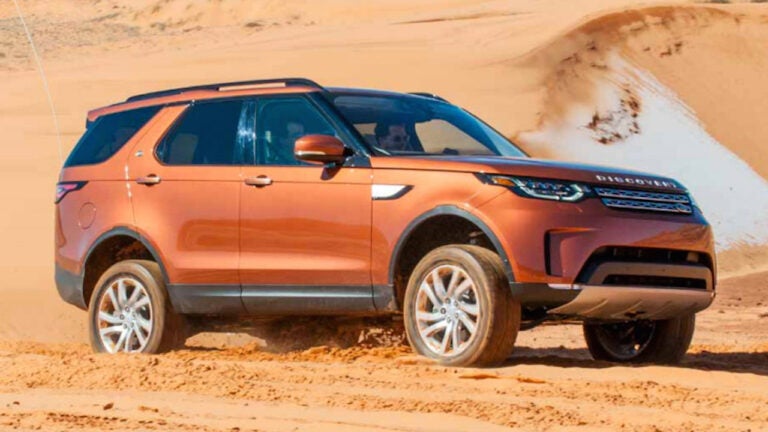
Kanab, UTAH—At some point, all you have is trust. I’m pinned to the driver’s seat in a Land Rover Discovery, not as it felt earlier on the empty desert highway, passing strings of campers and old Buicks. My vehicle is glued to a steep rock incline. The windshield displays nothing but blue sky and a chipper Scottish man standing by the very far corner of my hood, waving and shouting at me to prevent gravity from hurling 5,000 pounds of Land Rover and writer on their backs.
“I have no idea if this will work!” Ronnie Dale says, chuckling in a thick brogue.
He’s joking, probably. All four tires spin as I attempt the climb. The seat belt cinches my torso while I creep back a few inches to try again, and at this angle, the belt can’t loosen. I unbuckle at my own peril, stab the throttle, and the horizon dips into view. In seconds the big Rover levels itself on a crag. A few feet ahead on the trail, another Land Rover tips 25 degrees sideways, one wheel in the air. I’m next.
Truth is, Dale knows it’ll work, and work again and again. Land Rover staff know their limits because they’ve built trucks for seven decades and led off-road excursions across the entire planet. Sure, my adventure is merely a publicity campaign to sell cars, but it’s legit. In a four-wheel-drive Rover on an expertly guided tour, you learn to place total faith in complete strangers.
That’s crucial for this 2017 Discovery, which in its fifth generation looks nothing like the rugged, hard-edged squares of the last four. Designers reduced the stepped roof, which rises so that passengers in the second and third rows can afford more headroom, to a minor kink. The split tailgate is gone, replaced by a one-piece hatch and an optional bench that folds down from the inside. Everything looks buffed, streamlined, and polished for aerodynamics. The height-adjustable air suspension that affords 11 inches of clearance isn’t standard anymore. Neither is the two-speed transfer case, which Land Rover made optional for 2014. A smartphone app can fold both rows of power seats.
So the Discovery, formerly known in our country as the LR4, is becoming comfortable as a mainstream crossover. I miss the old box, but not how it drove.
Land Rover claims to have shed 1,000 pounds due to extensive aluminum construction, and whatever the actual weight, this new Discovery feels like a sports sedan in comparison. The LR4 maneuvered like a ship in choppy water, diving and rolling at the slowest of speeds. The steering was inaccurate and wobbly. You could excuse the LR4’s sloppiness because it belonged on an African safari and you chose to drive it through Connecticut. The new Discovery model handles more sharply than a Range Rover Sport. It goes on sale in late April, at prices starting from $50,985 for the base SE to $66,945 for the HSE Luxury Td6 diesel.
Inside, the Discovery copies the more expensive Range Rover right down to the angled dashboard and wide digital screens. The seats are cushier and the front headrests on our demo cars were pillow-topped. Acceleration from the supercharged 3.0-liter V-6 and 8-speed automatic is more than sufficient, and while I didn’t observe fuel economy during our two-day drive, the Discovery no longer drinks like college students. A new diesel model, with a 3.0-liter turbocharged V-6 sourced from Ford, is down on horsepower over the gasoline V-6 (254 versus 340) but offers considerably more torque (443 pound-feet at 1,750 rpm, compared to 332 pound-feet at 3,500 rpm). Not only is the diesel EPA-rated at 26 mpg highway, it’s an absolute hoot in the sand.
On the second day, I’m drifting the Discovery through Coral Pink Sand Dunes State Park, a 4,000-acre swath of desert you might find in the Middle East, only partially covered in snow and pine trees. “Drive it like you stole it, the computers will figure out the rest,” Dale says.
Land Rover’s Terrain Response 2 is a master of all surfaces, as it adapts throttle, transmission, differential locks, and various other settings to the deep ruts we’re carving into the dunes. (Our fully loaded Rover had the two-speed transfer case and air suspension essential for such tasks.) But flooring any 4×4 through sand and flinging the wheel back and forth is one goof away from flipping over.
Thankfully, the worst I experienced were the parking sensors failing. A steady, loud beep—normally, what you’d hear when you’re a foot away from a garage wall—wouldn’t stop, not after attempting to disable the system in the main screen, stopping to wipe the sensors clean, and shutting the car off. I restarted, and then the screen went dead. After seven decades—and I say this after experiencing all kinds of failures in various Land Rover models over seven years—you still can’t trust British electronics.
But the Discovery is such an ace among luxury SUVs precisely because it’s so over-engineered (Land Rover even digitized a Golden Retriever to ensure big dogs could stretch out in the cargo hold). I couldn’t confirm if that cargo hold was any roomier than the LR4, since I was too busy cleaning sand out of my ears. With a Land Rover, it’s best to keep some faith.
Clifford Atiyeh can be reached at [email protected].