
Alternative wheels initiative making it in Massachusetts
Electric car options get Commonwealth support.
Boston.com Cars is your go-to resource for coverage of local car news, events, and reviews. In the market for a car or truck? Check out our new car specials and used car specials curated by our local dealer network.
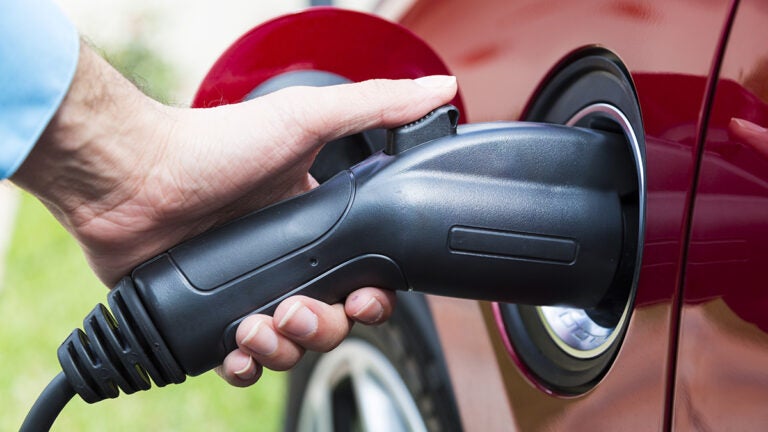
Stephen Russell, the Commonwealth’s alternative transportation coordinator, spends much of his time crisscrossing the state in an electric vehicle, his Nissan Leaf hatchback.
He meets with municipal officials and fleet managers, tirelessly pushing for increased use of EVs and growing the number of clean options for municipal and private vehicles.
The state initiatives are part of the nationwide Clean Cities Coalition and Massachusetts Department of Energy Resources (DOER).
In his travels, Russell practices what he preaches by using the state’s network of 447 charging stations (with 1,144 outlets) to keep rolling.
“You have to plan your trip any time you’re going more than 100 miles,” he said. As an example, a recent trip to Holyoke meant a half-hour stop at the Auburn Mall for lunch while the Leaf was on a high-output charger.
Between trips, he gave us an update on some of the state’s initiatives.
Rebates: The state’s MOR-EV program has dispersed $5.9 million to 2,766 EV and EV hybrid buyers as of mid-October. Begun in June, 2014, the program offers rebates to all-electric and gas-electric hybrids. Massachusetts ranks second only to California in offering these incentives. An electric vehicle license plate is a no-cost option that alerts first responders that there is a large drive battery in the vehicle.
Electric school buses: Concord, Cambridge, and Amherst are working on plans to add an eLion all-electric school bus to their fleets. When parked during the school day, the buses conceivably could plug into the school and add enough power to prevent maximum usage charges.
11th Annual Alt Wheels Fleet Day: The Alt Wheels annual program started 13 years ago at Larz Anderson Auto Museum in Brookline and, two years later, evolved into a major program for fleet managers. This year, 180 attendees were at the Four Points by Sheraton in Norwood for an all-day series of sessions on autonomous vehicles plus EV and fuel cell vehicle (FCV) ride-and-drive opportunities. Representatives from Ford, GM, Nissan, and Toyota gave presentations on what vehicles are available today and what are coming down the road. There were also separate sessions on various alternative fuels: propane, biodiesel, ethanol, CNG, electric, and hydrogen.
Fuel Cells: We’ve been waiting for the development of a private-sector, hydrogen-fueling network stretching from New England to New Jersey. However, in the meantime, forklift manufacturer Hyster-Yale acquired Billerica-based Nuvera, a maker of fuel cells, and it is successfully marketing hydrogen-powered forklifts for large warehouse applications such as the 800,000 square foot food distribution plant in Plympton.
Home Chargers: Another initiative is to get a 220-volt outlet for EV charging included in building code updates, saving the later cost of retrofitting home charging stations.
Biodiesel: Russell learned of the benefits of biodiesel while working as the fleet manager for the city of Keene, N.H. “The fuel provided more power, fewer emissions, and has the added benefit of lubricating diesel engines, something that’s important now that sulfur has been removed from diesel fuels. But we found something else,” he said. “It reduces the non-visible particulates in diesel exhaust, something that’s not part of emissions tests. And reducing those resulted in far fewer headaches among those exposed to the exhaust fumes in fleet situations.”
Bill Griffith can be reached at [email protected]. Follow him on Twitter @MrAutoWriter.



To comment, please create a screen name in your profile
To comment, please verify your email address
Conversation
This discussion has ended. Please join elsewhere on Boston.com