
Cars are stars at Boston Cup and Opera House
Old Mercedes get their moment in the spotlight
Boston.com Cars is your go-to resource for coverage of local car news, events, and reviews. In the market for a car or truck? Check out our new car specials and used car specials curated by our local dealer network.
Normally, Downtown Boston is the last place that needs more cars, given traffic congestion and the difficulty and expense of parking.
This weekend, however, there’s plenty of auto-related activity going on within a four-block area of the Parkman Bandstand on Boston Common.
On Sunday, it’s the fifth annual Boston Cup classic car show on the Common.
The show runs from 9 a.m.-2 p.m. One of the highlights of the event is the parade of antique and special vehicles leaving the area.
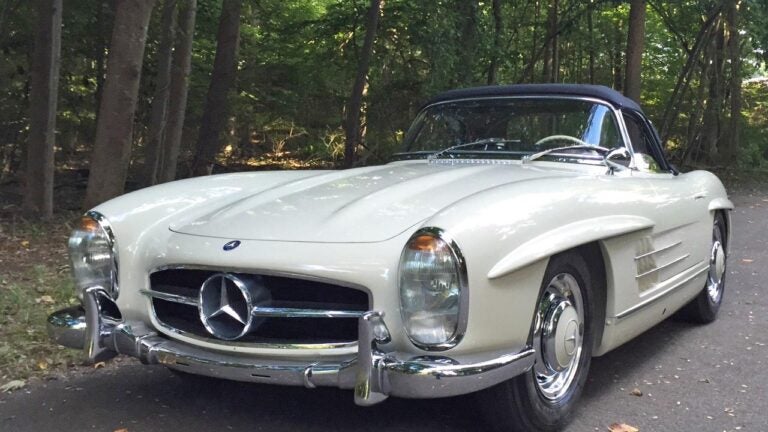
Among the star cars on display are Brian Wilson’s 1965 Aston Martin DB5 LHD and a 1960 Mercedes-Benz 300 SL Roadster once owned by Sony Bono.
New for this year is a Baby Boomer Class of vehicles to match oldies tunes such as “Little Deuce Coupe,” “Fun, Fun, Fun,” (T-Bird), “Little GTO,” “Hey Little Cobra,” and “Mustang Sally.”
At least one of the cars on view also will win an invitation to the Amelia Island Concours in Florida next March 10-12.
Chris Brewer, an auto-show judge and PR director for Amelia Island, will be on hand to select a car for that nationally acclaimed show.
Other awards are voted on by the owners of the cars on display.
To be a success, an auto show needs a great venue. Boston Common, the country’s oldest public park, certainly qualifies.
Rich Doucette, among the founding fathers of this show, pulled the proverbial rabbit from the hat to launch the show during the Menino administration and has been able to establish this show as an annual event.
In recent years, presenting sponsor Herb Chambers Companies has helped attract a long list of sponsors and vendors to the show.
New for 2016 was a Dragone Auto Auction yesterday at the Revere Hotel on Stuart Street, which appears to be a step towards making this a weekend event.
But, as Doucette says, “Today the cars are the stars.”

READY FOR THEIR CAMEOS: Three of the Mercedes diesels that are prepped for their roles in “Carmen” at the Boston Opera House.
Meanwhile, around the corner on Washington Street, a half-dozen classic Mercedes-Benz diesels dating from the mid-1970s to mid-80s are taking center stage in the Boston Lyric Opera (BLO) company’s production of “Carmen.”
“Carmen,” which runs through Oct. 2, is a co-production of the BLO and San Francisco Opera.
Director Calixto Bieito discovered the Spanish city of Cueta in North Africa, which exists in a kind of time warp (think Cuba for old American cars) with many of the M-B diesels still in operation there after more than 30 years of hard use.
It got him to thinking. His production is set in a somewhat nebulous post-Franco time period in the late 1900s.
Since importing cars from North Africa for the stage set was out of the question, the cars now in Boston were purchased in California for the SFO’s production. “It gives new meaning to the term California Car,” says John Michael Kennedy, publicist for the production.
SFO personnel scoured eBay, Craigslist, and local ads to find the aging diesel Benzes. In their time, they were a luxury vehicle but many of us remember them for having the rear of the car covered in black soot from the exhaust of then-not-so-clean-burning diesel engines.
For their stage appearance, the engines were removed, lightening the Benzes by roughly 1,200 pounds (and avoiding fluid leaks), and the bottoms, sealed to prevent debris from falling onto the stage.
Trunks, sunroofs, and hoods were reinforced and one sedan was converted to a convertible because the only original convertible the troupe could find was both too expensive to purchase and in too good condition.
“Dirt, dust, minor dents, and missing chrome trim, all are good for the production,” says Anna Labykina, technical director.
“In addition, the Mercedes’ star hood emblems have been replaced with rubber versions because the 80-member cast performs over, under, around, and inside the vehicles,” she says.
The front and rear windshields remain, though they’ve been given an opaque coating to prevent reflections and give performers a better view for footing.
“We had to find a few spare windshields just in case,” she says, “because a cast member put a foot through one during rehearsals.”
Five of the Benzes get pushed into position (steering and brakes still work fine) during the performance while one has a 1.5 HP electric motor so it can be “driven” during its production numbers. The trunks, it seems, are functional, holding props for scene changes.
Labykina arranged to have the cars shipped from California in a pair of 53-foot enclosed trailers. A normal car-carrier, which could have accommodated all six, was out of the question because there was no way to drive the vehicles up the ramps.
All this does puts a new slant on the term “show car.”
Bill Griffith can be reached at [email protected]. Follow him on Twitter @MrAutoWriter.





To comment, please create a screen name in your profile
To comment, please verify your email address
Conversation
This discussion has ended. Please join elsewhere on Boston.com