
Review: Hyundai Veloster makes daily commute fun
It's daring in form and function.
Boston.com Cars is your go-to resource for coverage of local car news, events, and reviews. In the market for a car or truck? Check out our new car specials and used car specials curated by our local dealer network.
Recall the early years of Hyundai in America. The Korean automaker arrived in North America in 1986 and sold only one model, the Excel. It was available in three body styles: sedan, five-door hatch, and three-door hatch. While cars like the Golf were a credit to the hatchback persona for being fun to drive, the Excel was anything but. It took almost 30 years, but Hyundai has built a true hot-hatch, the Veloster.
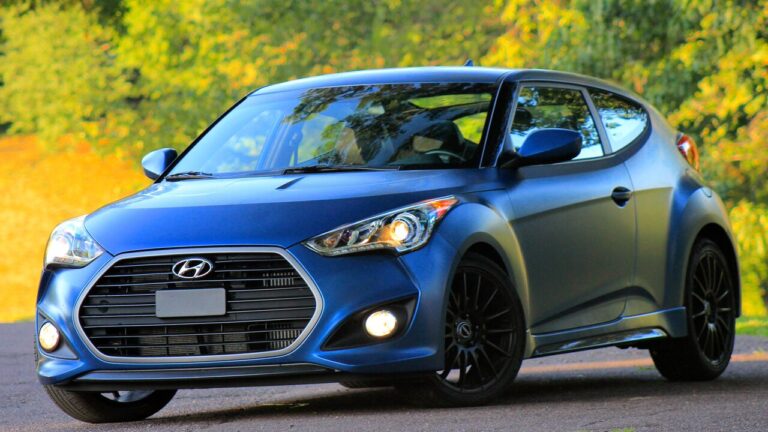
The Veloster does not look like your ordinary compact commuter car. From the angry headlights and the scalloped hood to the grille that seems to go on for miles, the Veloster is quite the head-turner. It features a high rear roof that slopes back at a rakish angle, making for a hatch-coupe layout.
The unusual styling of the Veloster is matched by its unorthodox seating layout. Look at it from the driver’s side, and you’ll see a single door, which gives the impression of a coupe. But walk over to the passenger side, and it gains a door. In the spirit of a true commuter car, it makes the driver’s side more accommodating for the individual piloting this hot hatch. On the other side, it makes ingress and egress easier for both rows.
Hyundai also put this second-row door on the passenger side to force back seat occupants to get out on the curbside of the vehicle, rather than open their door to bike and vehicle traffic.
When it comes to daily practicality, the Veloster delivers. Though cargo space tops out at 34.7 cubic feet, the hatch opens very wide, allowing you to cram more awkwardly shaped objects through the opening.
With the hatch closed, the driver actually only sees out the lower portion of the window, which distorts the view of cars near the edge. In addition to that, the large C-pillars make for some legit blind spots. The standard backup camera is a must, and if you live in the city and parallel park a lot, the optional parking sensors are just as crucial.

FROM ANOTHER PLANET? The otherworldly interior has a surprisingly ergonomic layout.
You may notice that the Veloster doesn’t have the typical glossy paint job. No, this test car features matte blue, one of the latest fads in automotive styling. It is part of the Rally Edition package, and includes stiffer springs, sport dampers, stabilizer bar, leather seating with blue accents, and 18-inch Rays lightweight alloy wheels.
While the matte blue does look pretty great on our test model, be warned—matte finishes scratch and become distorted easily. Wipe over it with the wrong type of cloth or product, and you’ll mess it up. In fact, Hyundai has an eight-page pamphlet on how to care for matte paint. Before deciding on this awesome looking paint, decide if you are ready to make that kind of commitment to a non-essential component of the vehicle.
The unorthodox exterior is rivaled by its futuristic interior. Despite its “Danger-Will-Rodgers!” cabin layout, the Veloster has surprisingly intuitive controls. It has sequential dials—one for temperature, the next for fan speed, and side buttons for fan direction. Everything else is up top in a more conventional touch screen layout.
The Veloster Turbo comes equipped with an eponymous 1.8-liter turbocharged inline-4 that makes 201 hp and 195 lb.-ft. of torque. Power is put to the front wheels through a 6-speed manual transmission fitted with a B&M Racing sport shifter. Shifts are smooth. Not the precision “click-click” of a Miata, but it’s a far cry from the vague shifter feel of a ’90’s manual Hyundai.
The manual features a pull-tab for reverse, but it is a bit aggressive, and you have to have the shifter nearly center for the pull-tab to engage. On multiple occasions, I was coming out of first or second and quickly wanted to shift to reverse (like in parallel parking), and it would not engage.
Once on the road, the Veloster is a very engaging car to drive. It can corner well, and though there is the plowing sensation of a front-wheel-drive car at times, it is fun to drive and doesn’t punish you with an overly harsh ride. The steering could be a little heavier, but it was responsive enough to turn any commute into an entertaining experience.
The 2016 Hyundai Veloster starts at $18,000. A Turbo model starts at $22,600, and our Rally Edition Turbo carried a sticker price of $24,775.
With the Genesis luxury sub-brand growing and even a pickup on the way, the Hyundai brand has come a long way since its humble beginnings. The 2016 Veloster strikes the greatest contrast to those days, delivering a vehicle that is only similar in market segment to its predecessors. The Veloster is one of the leading hatchbacks in a group of very fun-to-drive cars like the Focus and Golf.
Whether you go for the base model or this Rally Edition, the Veloster will inject some much needed excitement into your daily commute.
2016 Hyundai Veloster Turbo Rally Edition
THE BASICS
Price: $18,000. As tested: $24,775. Fuel economy, EPA estimated: 25/33. Fuel economy, Globe observed: 26.5 mpg. Drivetrain: 1.6L turbocharged I4, 6-MT, front-wheel-drive. Body: 3-door hatchback.
THE SPECIFICS
Horsepower: 201. Overall length: 166.1 in. Wheelbase: 104.3 in. Height: 55.1 in. Width: 71.1 in. Curb weight: 2,646 lbs.
THE GOOD
Eye-catching looks, unique door layout, fun to drive.
THE BAD
Compromised rear visibility, maintaining matte paint could prove laborious.
THE BOTTOM LINE
A reliable commuter car with more than the requisite flair.
ALSO CONSIDER
Volkswagen Golf/GTI, Ford Focus, Honda CR-Z.
George Kennedy is a freelance automotive journalist. He can be reached at [email protected] or on Twitter @GKenns101.




To comment, please create a screen name in your profile
To comment, please verify your email address
Conversation
This discussion has ended. Please join elsewhere on Boston.com