
Review: Commuting in the BMW i3 EV can be a free ride
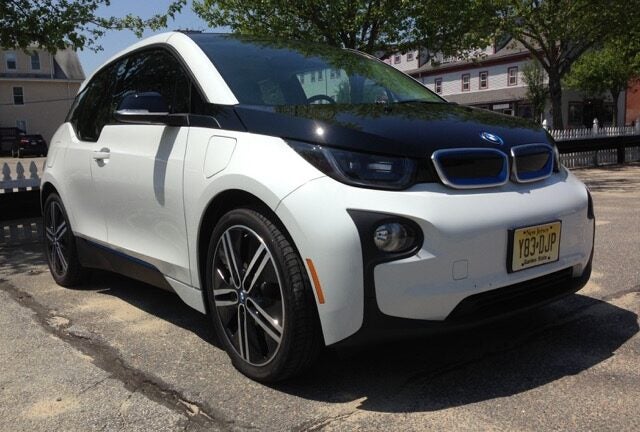
Your first 30 seconds behind the wheel will tell you there’s something inherently different about the 2016 BMW i3. Yes, this is an electric vehicle, but try to tamp down the range-anxiety fears that have kept most of the car-buying public from even considering a car of the zero-emissions variety.
Your should trust that a brand as reputable as BMW has given a lot of thought to the EV market and developed sufficient fail-safes to make this a car for commuters to consider. After test driving the i3 over the course of a week, I believe BMW’s electric gambit is more about changing perceptions than being idiosyncratic.
Say the electric i3 actually is fun to drive and you can hear the laughter from snobby super car aficionados. True, that on my first jaunt with the EV, I was so transfixed by how much range I had left in the 22-kilowatt-hour lithium-ion battery pack that I barely noticed the appeal of the car’s concave, tub-like, carbon-fiber-and-responsively-forested-eucalyptus-wood-trimmed dashboard. It’s a beautiful machine.
I really didn’t need to worry about range since the distance from where I picked up the car in Middleborough to my office in Acton was only 60 miles. At the outset, the display confidently assured me I had 78 miles of driving still available on the remaining charge. It was also comforting to know that this particular version of the i3 comes equipped with a Range Extender gasoline-electric generator containing a 2-gallon fuel tank that can add another 78 miles to my drive time. Clearly, this was enough to get me to one of the multitude of gas stations along the way, should I run out of electrical juice AND drain the tank.

No center column blocks entry to the back seat, a cool design trick.
Eventually, I settled down, realizing that I could get back and forth to work with this vehicle—a 160-mile roundtrip—and not have to pay a dime for electricity. That’s right, free recharging.
Public charging stations are located near both ends of my commute and neither required payment. I was able to recharge the i3 in three hours, accomplished while I was at work. A handy app on my smartphone informed me when the car was fully charged.
OK, I’m leaving out a few small details. I had to ask a friend to give me a ride from the charging station to my office, four miles away. And, at the other end of my commute, I had to walk the mile from the charging station to my home, or ask my wife to pick me up.
But there are other options. The preferred ones include finding a DC Fast Charging station that’ll pump you up to an 80 percent charge in 20 minutes, or rely on the gasoline fallback of the Range Extender to get you to your front door.
Once there, BMW makes it easy to charge up the i3’s battery pack with a supplied electrical cord that’ll plug into a standard household electrical outlet. Come back 12 hours later, and you are good to go. There’s also an optional 220-volt charging station you can install at home that does the job in about three hours.
Are you getting nervous? Is this too much adaptation to contemplate? You say you don’t want to own a BMW that costs you almost nothing to drive? Remember this: According to greencarreports.com, most commuters travel less than 40 miles to work. If that includes you, why not take this free ride?
If resistance to change is natural, the i3 provides plenty to resist. It’s not everyday that a manufacturer decides to put coach-style doors on a two-tone, four-passenger subcompact hatchback. There’s no center column, or B-pillar, to block you rear view, a design decision that makes entry and exit easier for rear passengers.
For the driver, the forward view is expansive, and there’s much to like about the design of the cockpit. The electronic shifter, for example, is positioned on a steering column that also incorporates the vehicle’s start/stop switch and its park button.

EASY REACH: The i3’s steering column incorporates the vehicle’s start/stop switch and its park button.
A 170-horsepower electric motor motivates the i3, providing an instantaneous 184 lb.-ft. of torque to the rear wheels through a single-speed transmission. The drive system employs regenerative braking to recapture energy that’s usually lost as the vehicle slows down. The process is so aggressive that it’s possible for the driver to feather the accelerator to achieve controlled braking without actually using the brake pedal. This was a totally new behind-the-wheel experience for me that quickly became natural.
[You can find local deals on BMWs here].
Mileage estimates for the i3 peak at a combined city/highway 124 miles per gallon equivalent in the base battery electric model, and drop to 117 mpgs in the Range Extender model. Be sure to evaluate these numbers based on your cost of electricity to get a fair comparison with the cost of owning a gasoline-powered vehicle. If one drives the Range Extender model solely using the gasoline-powered generator, fuel economy is estimated to be 39 mpg.
The i3 clearly represents a challenge for some buyers, and not just because of its $42,400 base price, which is offset by tax incentives. The combination of its unconventional looks and electric performance requires a bit of rethinking on the whole driving experience. I suggest, you consider it long overdue therapy.





To comment, please create a screen name in your profile
To comment, please verify your email address
Conversation
This discussion has ended. Please join elsewhere on Boston.com