
Review: New Honda Ridgeline is a mid-sized pickup with unique features
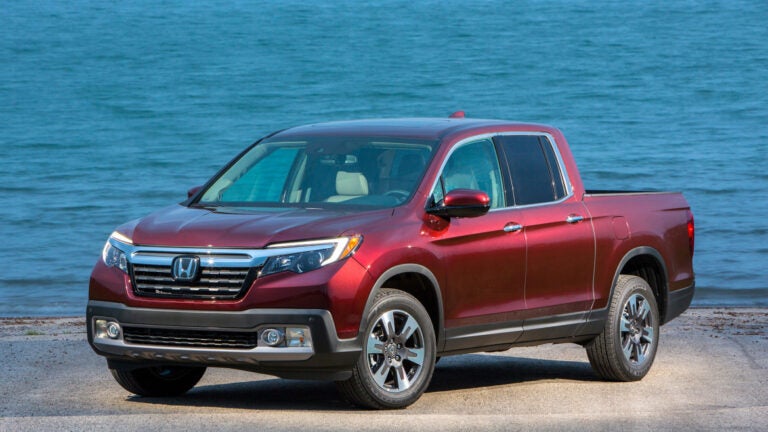
Last sold for the 2014 model year, the Honda Ridgeline pickup truck has gotten its first real redesign since its 2006 debut. As before, it has one engine, a V-6, but it now offers front- along with all-wheel drive. The new Ridgeline still retains the interior and underpinnings of the Pilot SUV, but it now looks like a conventional pickup with a lot of features no other competitor in the midsize truck market offers.
The original Ridgeline’s odd styling was polarizing, but it served to keep Honda fans in the driver’s seat of a Honda pickup. The biggest change in the new Ridgeline is the body. It’s taken on the look of a conventional crew-cab four-door pickup. The new look is much more appealing to pickup lovers than the original design, and should draw from a wider market, or at least entice some non-brand-biased pickup cross-shoppers to take it for a test drive.
Current Honda owners will find the 2017 Ridgeline blends in nicely with other cars, SUVs or minivans parked in their garage because it shares many parts with the SUV and minivan stable mates. It’s a Pilot from the back of the rear doors forward. The headlights and grille are thinner and more aerodynamic than the previous truck’s, and it’s a complete departure from the more traditional styling of its Toyota, GM, and Nissan competitors.
The 2017 Ridgeline isn’t going to wow the young at heart or those with a real bent toward true off-roadin’. There are no winches, aftermarket bumpers, wheels or tire combos to personalize it the way many millennial, midsize pickup buyers prefer. It’s also an inch or so short on ground clearance compared with the Tacoma, and Honda doesn’t offer any type of sport or off-road trim like either GM or Toyota.

AND YOU CAN CAMP IN THE BACK: Sure enough, you can pitch a tent in the flatbed, which is 5.5 inches wider, and sleep under the stars.
I was skeptical of how the Ridgeline would drive and handle with a 280-horsepower, normally aspirated 3.5-liter V-6, but my skepticism was short-lived. Honda still retains the six-speed, which is antiquated technology in this age of eight- and 10-speeds. However, the engineers parlayed old technology with a satisfying change in gear ratios to complement the extra 30 hp and 15 pounds-feet of torque (262 pounds-feet).
On the open road, the Ridgeline excels on all counts. It glides through corners like a sports car, brakes smoothly, and has by far the quietest inside of any pickup I’ve driven, of any size. The truck’s suspension is 50 percent brand new, and the other half is re-engineered from the Pilot with stronger bearings and lower A-arms, and struts designed to handle pickup-like loads. Honda engineers have also loaded it up with sound-insulating materials and made major improvements to battle annoying road-induced noise.
After driving the new Ridgeline in a number of different off-pavement settings, I can attest that its traction algorithms are well done. Honda’s all-wheel drive makes a good driver look great in sand and loose conditions, and it performs in ways that make the four-wheel-drive systems in the Colorado and Tacoma look clunky and sluggish.
You never touch a dial or have to shift in or out of four-wheel drive in the Ridgeline all-wheel-drive model. You just select what type of conditions you are driving in and its computers do the rest.
Now up to modern standards, the Ridgeline’s V-6 outpowers the Colorado and Tacoma gas V-6 engines and equals or bests them in fuel economy. The front-wheel-drive version of the Ridgeline pulls an EPA-estimated 19/26/22 mpg (city/highway/combined), which beats the V-6 rear-drive Colorado (18/26/21 mpg) and Tacoma (19/24/21 mpg). The all-wheel-drive version is almost as fuel-friendly, with an estimated 18/25/21 mpg.
The Ridgeline’s interior is shared with the new Pilot SUV. The seats are supportive and comfortable on long drives. Slip into the driver’s seat and you immediately think you are in a full-size pickup. Headroom is plentiful, even for Texans who never take off their cowboy hats. Neither the driver nor the front passenger is squeezed between the door panels and the center console. There’s enough legroom up front for Kobe Bryant to get comfortable.
Honda did a good job bringing the old model into this century when it comes to keeping our electronic umbilical cords connected. The trim levels I drove, the top-of-the-line Black Edition and RTL-E, had the newest in Honda electronics, including a tablet-sized 8-inch touch-screen, a truck bed audio system, Apple CarPlay, Android Auto, a 3-D Garmin navigation system, and HD radio. Need to connect your iPhone or Android? It’s wirelessly handled in seconds. The RTL-T audio system pumps 225 watts through seven speakers, while the RTL-E and Black Edition get 540 watts and eight speakers.
The other cool feature in upper trim levels (RTL-E and Black Edition) is a theaterlike 540-watt sound system that uses the bedsides and front bed wall as speakers. Couple that with a 115-volt power outlet in the bed that provides 400 watts when the engine is idling, and you can stand a 60-inch flat-screen against the back cab wall and crank up the volume to rattle the campsite.
Honda was the first manufacturer to put a “trunk’’ in the bed of a pickup and remains the only one to do so with the 2017 Ridgeline. It’s one of the coolest features of any pickup, regardless of size. The rear half of the 5-foot-4 fiberglass molded composite bed can be lifted to reveal a cargo storage area that’s big enough to easily hold an 82-quart cooler, the largest golf bag, backpacks, fishing equipment, tools, or all the riding gear you and your passengers need for a day of fun. The original dual-action tailgate remains as well, providing the choice of swing-away or drop-down to fit the need.
The Ridgeline’s bed is made of a special fiberglass composite material that’s impervious to denting. Even dropping a bucket load of rocks in the bed has no effect on its looks or structural integrity. Bed material is also UV-resistant so it will not fade.
[You can find local deals on Hondas here].
If you’re into camping, bike-riding or all-terrain vehicles, the bed is 5.5 inches wider and 3.9 inches longer than the 2016’s, making it the biggest in the midsize class.
The Ridgeline also showed its surefootedness towing a trailer loaded with 3,600 pounds of Honda ATVs. The shorter gear ratios really help it get the load moving quickly, and the 28 percent stiffer unibody design and revised struts tuning keep it level and stable through dips and turns.
There’s not another pickup on the market with as complete a set of active-safety options as the new Ridgeline—though availability depends on the trim level selected. The Honda Sensing suite of safety technologies includes adaptive cruise control, lane departure prevention, forward collision warning with automatic emergency braking, rear cross-traffic alert, lane departure prevention, and other automated systems that keep the driver well-informed of where the vehicle is in relation to anything and everyone around it.
What the truck doesn’t sense, the driver can see directly. Visibility is excellent for a pickup. The new body design with the conventional bed style makes it easy to see everything except what’s right behind the bed—and that is taken care of by the backup camera system.
The Honda Ridgeline is going to turn a lot more heads than it did in 2006 or even 2014. Having the look of a conventional pickup with the quietness, roominess, ride, handling and safety features of a unibody is attractive to many car and SUV owners in the market for a small pickup. The Ridgeline doesn’t ride or handle like its competitors; it’s far more refined. Add in the option of two-wheel drive along with an entry-level price for the RT model of $30,375 (all prices include destination) and Honda’s redesigned pickup is going to get some serious lookers. Even the loaded RTL-E ($42,270) and Black Edition ($43,770) all-wheel-drive-only models should compete well against the top-tier Toyota and GM midsize pickups because of all the on- and off-pavement capabilities the Ridgeline provides, along with the utility function of the bigger bed. Honda now has a true pickup in the stable that is capable and competitive in many other ways to its rivals.





To comment, please create a screen name in your profile
To comment, please verify your email address
Conversation
This discussion has ended. Please join elsewhere on Boston.com