
Review: Sleek 2016 Chevrolet Cruze packs lots of new technology
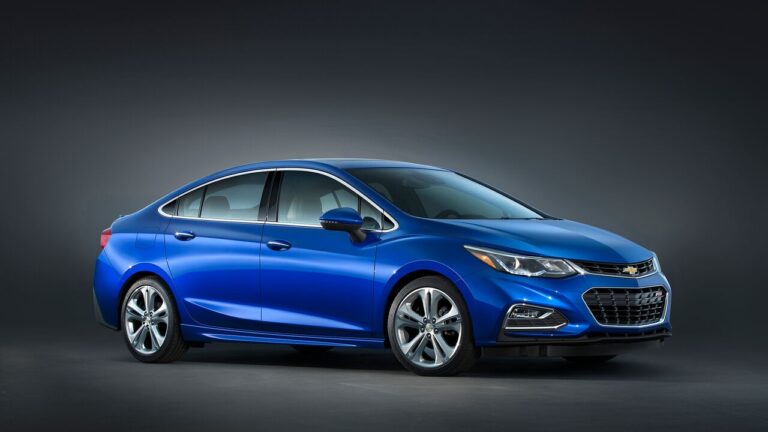
Chevrolet’s second-generation 2016 Cruze compact sedan builds upon the qualities we liked in the original, such as a quiet ride, while adding a refined turbocharged four-cylinder engine for every trim level and greater in-car connectivity.
The refinement we’ve liked in Chevrolet’s newer cars, such as the Malibu midsize sedan and full-size Impala, is present in the Cruze, and it’s especially evident in the new turbocharged, 1.4-liter four-cylinder engine. Rated at 153 horsepower, the four-cylinder drives the front wheels through a six-speed manual or a six-speed automatic transmission. Most Cruzes come with the automatic, which is the transmission I tested.
The turbo four-cylinder sounds refined when accelerating, even under full throttle, and power builds smoothly. Acceleration is adequate; it feels about as swift as the 2016 Honda Civic with the base 2.0-liter four-cylinder. Still, the turbo four-cylinder does have some reserve power at highway speeds for passing.
The six-speed automatic made a couple abrupt shifts during a day of driving, but gear changes were otherwise smooth and the transmission readily kicked down a few gears for more passing power. Like the four-cylinder engine, the transmission’s overall refinement is on par with what you’d experience in an entry-level luxury car.
The one aspect of the drivetrain that’s a little annoying is its lack of power when cruising at 55 to 60 mph. With the automatic, the engine is turning at around 1,700 rpm and the small four-cylinder just doesn’t make a lot of power there.
Some willingness on the transmission’s part to stay in a lower gear for more power would be nice, as would the inclusion of a Sport mode or shift paddles (the Cruze doesn’t offer either) to give you more control of transmission behavior.
All automatic-equipped Cruze models have an engine stop-start feature, which is designed to save gas by automatically turning off the engine when you come to a stop and then restarting it as you lift your foot off the brake pedal.
Unlike many stop-start systems, you can’t turn the Cruze’s system off; it’s on whenever the car is running. It’s a seamless experience, though, and I didn’t feel the urge to turn it off, even if I could have. Engine restarts are smooth and accompanied by just a hint of engine noise. It’s one of the most unobtrusive stop-start systems I’ve tested.

SMART PLAY: This new Cruze introduces a 7-inch, touch screen multimedia system that supports Apple CarPlay and Android Auto. The screen will mirror select smartphone apps on the dashboard screen, including the phone’s navigation system.
The one issue I had with the stop-start system is that the intensity of the climate control fan drops when the engine is in auto-stop mode, which noticeably reduced the system’s cooling effectiveness while I waited for a stoplight to turn green.
Stop-start technology, a substantial curb weight reduction of around 250 pounds, and more aerodynamic styling have contributed to significant increases in EPA-estimated gas mileage; automatic-transmission models are rated at 30/42/35 mpg city/highway/combined. (The Premier trim carries a 30/40/34 mpg estimate due to the weight of additional features and different tires with greater rolling resistance.)
Like the Civic, Mazda3, and others in the compact-car class, the Cruze has a taut suspension that lets you feel bumps in the road. It handles them well; there’s no harshness as the suspension reacts to them.
The Premier’s suspension has an additional linkage on the rear torsion beam for better handling, and while body roll is well managed on winding roads, the Cruze isn’t as fun to drive through corners as the new Civic. The Cruze’s center of gravity feels higher than the Civic’s, but, more significant, its steering isn’t as involving due to minimal feedback. It takes only a light touch to turn the steering wheel, which helps make the Cruze easy to maneuver in the city.
[You can find local deals on Chevrolet here.]
The Cruze is sleeker than its predecessor with a roofline that’s nearly an inch lower, but the new design doesn’t compromise front-seat comfort. The Premier’s power-adjustable bucket seat was comfortable for a day of driving, with side bolsters that weren’t overly restrictive.
The backseat is also pleasant for adult passengers, offering decent legroom and headroom, but views out the side window are restricted by that sleek roofline; I was staring at part of the headliner when looking out the window.
Chevrolet has packed a lot of standard technology in the Cruze, including a backup camera and a 7-inch touch screen multimedia system that supports Apple CarPlay and Android Auto, which mirror select smartphone apps on the dashboard screen, including the phone’s navigation system.
The larger, optional, 8-inch touch screen also supports CarPlay and Android Auto, and it took only a few seconds for the system to recognize my iPhone and display apps on the screen. These systems make it easy to bring stored and streaming media on your phone into the car and to safely use your phone’s navigation capability when you need it. I was surprised, though, to see just one USB port in the front of the cabin, especially considering other Chevrolet models like the Malibu offer multiple USB ports.
With the launch of the redesigned Cruze, it’s hard to think of a time when Chevrolet had a stronger lineup of compact, midsize, and full-size cars.
The Cruze isn’t the sportiest car in the compact class, but with a starting price of $17,495 ($19,995 for the least expensive version with the optional automatic transmission), it packs a lot of value with technology that should appeal to the young, connected car buyers that Chevrolet hopes to reach.





To comment, please create a screen name in your profile
To comment, please verify your email address
Conversation
This discussion has ended. Please join elsewhere on Boston.com