
Speed limits up, so are fatalities; new tow tester
You know the big difference between driving in Florida and driving in Massachusetts?
Speed.
Yup. Massachusetts drivers are slower. You’re reading that correctly.
At least in this respect we seem more civilized than those who daily show that southern hospitality doesn’t extend to the highways.
Massachusetts drivers may bemoan how fast their highway companions are driving, but the sheer volume of traffic, especially in Eastern Massachusetts, actually keeps our overall speeds down.
Then, when you get outside of the Greater Boston Metro areas, the Massachusetts State Police, by and large, are on patrol, keeping speeds within reason.
Driving in Florida, on the other hand, has become a culture shock.
On most highways in the Sunshine State, indeed, throughout the southeastern states, the speed limit is 70 miles per hour, meaning general traffic is moving at 75 and those pushing the limit are over 80 mph.
The faster speeds on the interstates has translated onto most city streets, where the speed limit often is posted at 45 mph.
A few years ago, pushing it around town meant someone would be doing 50. Now folks regularly exceed 60.
With the combination of RVs, 18-wheelers, senior citizens, folks towing boat and camper trailers, plus a huge number of construction vehicles, there’s a wide variety of vehicles and drivers on the road.
When things go wrong, it happens fast, and it’s usually ugly. The Florida news media is filled with daily stories about crashes, often fatal. The resulting traffic backups often are massive.
All of the above is a trend I’ve noticed over the past few years, but I didn’t have any data to back it up.
Now, a study by the Insurance Institute for Highway Safety (IIHS) shows that speed limit increases over the past two decades have cost an additional 33,000 lives nationwide. The IIHS says that in 2013, the last year of the study, 1,900 additional people died on US roads as a result of higher speed limits. That essentially cancels the number of lives saved by frontal airbags that year.
A bit of history: In 1973, Congress passed the National Maximum Speed Limit (55 mph) as a method of conserving fuel during the oil shortages. The result: a dramatic drop in highway fatalities in an era when cars weren’t particularly safe.
In 1987, Congress relaxed the law, allowing states to increase speed limits to 65 mph on rural interstates. In 1995, the law was repealed, allowing states to set their own limits. Each time fatalities increased.
“As large a number as it is, 33,000 likely is an underestimate,’’ says Charles Farmer, IIHS director of research and statistical services and the study’s author. “Since the end of this study in 2013, speeds have only become more extreme, and the trend shows no sign of abating.’’
Indeed, those who say, “It’s the wild west out there on the highway,’’ may be right.
Texas has an 85 mph highway speed limit, Utah is at 80, and 14 other states (including Maine) are at 75. The rest of New England and the Northeast remains at 65.
Mountain of Data
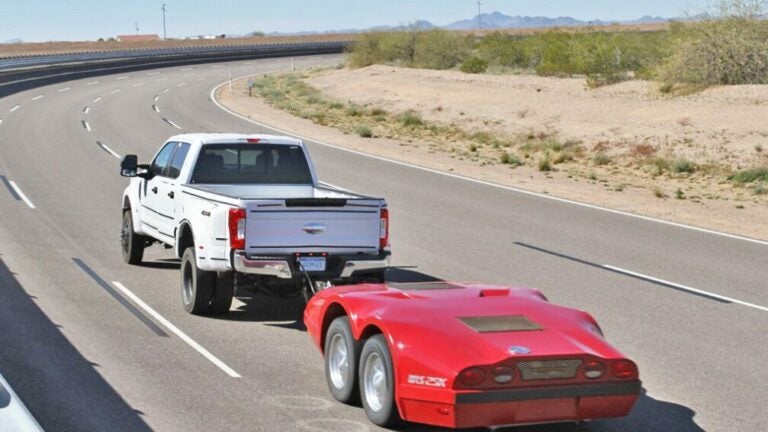
Engineers can simulate a lot of towing loads via computer design, but eventually you’d think they have to test a truck’s capability on the roads.
These days, pickups are getting so strong that the traditional dynamometer sleds aren’t enough to challenge their power output.
These dynos are important because they can simulate a steep grade by providing a brake limiter to pull against the vehicle. Essentially, it’s a series of electric coils wired together and energized to act like a large magnet.
Ford recently built a new dyno that can exert a pull of 5,620 pounds, almost triple its predecessor’s 2,000-pound limit. It also can simulate a 30 percent grade.
The setup has allowed engineers to virtually test the new Super Duty F-Series over two traditional towing test sites, Davis Dam and Townes Pass. Davis Dam goes from sea level to more than 3,000 feet in 11.2 miles. Townes Pass is a 16-mile pull with an average grade of 5.1 percent, maxing at 10.1 percent.
It’d be nice if drivers likewise could virtually tow their trailers around the country.
Playing Darts
The feeling here is that the Dodge Dart long has been an underrated vehicle.
After news that the Dart would be phased out after the 2016 model year, reports now say that Fiat Chrysler might be seeking another manufacturer to build both the Dart and Chrysler 200 going forward.
For now, the Dart lineup is being trimmed to three versions, the base SXT, a new Turbo, and the GT.
Buyers may find some good deals as Dodge is lowering the base prices on each model while keeping an attractive array of features. The SXT, for example, comes with keyless entry, FCA’s Uconnect voice command with Bluetooth, satellite radio, air, cruise control, and steering wheel controls. It has a 2.0-liter four.
The Turbo comes with a 1.4-liter turbo engine and manual transmission.
The GT Sport has a 2.4-liter 4-cylinder with more appearance features and larger (8.4-inch) Uconnect touch screen.
Etc.
The weather hasn’t been all that cooperative for early-season auto gatherings. The New England region of the National El Camino Owners Association has scheduled its spring Dust-Off next Sunday morning at 9:30. The group is gathering for breakfast at the Wine Stop in North Andover (formerly Jimmy’s Famous Pizza), then will drive to Lowell’s National Historical Park.





To comment, please create a screen name in your profile
To comment, please verify your email address
Conversation
This discussion has ended. Please join elsewhere on Boston.com