
Heritage Museum’s presidential Steamer on display in D.C.
Who knew?
We were planning on making a short mention that the Heritage Museums and Gardens in Sandwich had opened for its 2016 season yesterday.
It would have been nice to note that a 1934 Derby Bentley is joining the museum car carousel display this year as part of its ongoing exhibition “Cut! Costume and the Cinema’’ that runs through October.
Frankly, I want to make a road trip to see both the cars and the display of United States maps made from recycled license plates by Stephen Blyth.
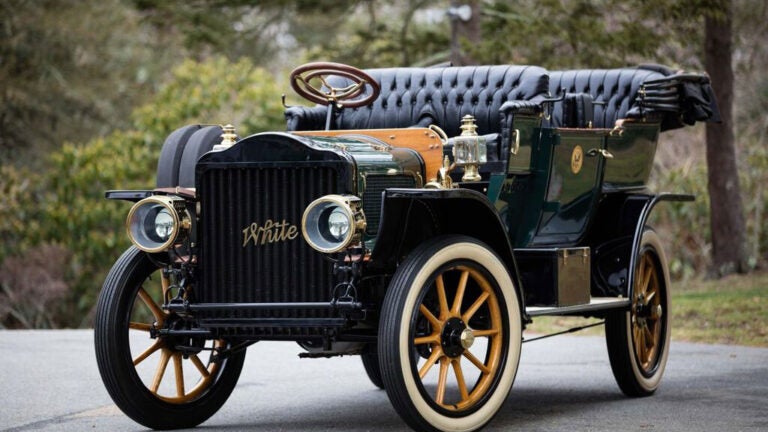
But a call to the museum produced a lot more. It seems that another car, a 1909 White Steam car from the museum’s collection, was spirited away a few weeks ago.
Now it’s on display on the National Mall in Washington, D.C., through April 26.
It turns out that the 1909 White was part of the first White House limousine fleet. Now it has become the ninth vehicle to be documented and recognized by the National Historic Vehicle Register and archived in the Library of Congress.
The 10th vehicle to be recognized is the 1962 Willys CJ-6 used by President Reagan at the Reagan Ranch in California, It, too, is on display on the mall.
The 1909 White Steam Car is the only known survivor of the first four automobiles in the inaugural White House fleet. It was capable of speeds of 60 mph (and more), a capability which Taft reportedly not only enjoyed but also encouraged.
“At Heritage, our American automobile collection inspires visitors to explore the evolution and revolution that the automobile represents … and their social impact,’’ says Ellen Spear, president and CEO.
“The D.C. exhibition brings to life the personal side of these two former presidents,’’ says Mark Gessler, president of the Historic Vehicle Association, which is organizing the second-ever Cars at the Capital exhibition. The first was in 2014.
“President Taft was the first president to promote the automobile. He insisted on an automobile parade in nearly all of the American towns he visited. For President Reagan, his Jeep reflected his unpretentious nature and the enjoyment he derived for working on his ranch,’’ says Gessler.
As the story goes, there was a debate in Congress about appropriating money for Taft’s automobiles.
“One legislator is said to have remarked about the 300-pound-plus Taft, “The President proposes to abandon horses for the reason that the gentleman does not wish to violate the law against cruelty to animals.’’
Headlights (cont.)
Driving at night can be challenging, especially if it’s rainy and there aren’t any streetlights.
Now, imagine how much more difficult it would be if you didn’t have headlights either.
A week ago, we wrote about the first-ever headlight ratings from the Insurance Institute for Highway Safety (IIHS).
The quick summary of the IIHS findings is that today’s speed limits outpace headlights’ ability to give drivers the visibility they need for safe driving.
No wonder that the National Highway Traffic Safety Administration (NHTSA) data say the fatality rate for vehicle occupants during dark hours is three times higher than in the daytime.
Even as researchers work on improving headlight technology, an autonomous driving element creeps into the story as it always seems to do these days.
Ford last week said that one of its autonomous research vehicles, a Fusion hybrid, made a successful nighttime sojourn with NO headlights on curving deserted desert roads at its Arizona Proving Ground.
Normally, autonomous driving vehicles use a combination of cameras (which require light), radar, and LIDAR, an acronym for light detection and radar. The test shows that, at least in some controlled instances, the LIDAR system can function independently on a road without streetlights or headlights.
“It shows the test cars aren’t reliant on the sun shining or cameras detecting painted white lines on asphalt,’’ says Jim McBride, Ford technical leader for autonomous vehicles. “Actually, LIDAR allows autonomous cars to drive just as well in the dark as they do in the light of day.’’
Ford engineers, wearing night-vision goggles, monitored the test both from within and outside the Fusion.
Night vision allowed them to see the LIDAR operate within a grid of infrared laser beams. The LIDAR system shoots out 2.8 million laser pulses per second to scan the surrounding environment.
That data is matched against (and with) the stored data from 3D maps, road markings, geography, topography, and landmarks such as signs, trees, and buildings.
“I was inside the car. I could feel it moving, but when I looked out the window (without goggles), I only saw darkness,’’ says Wayne Williams, a Ford researcher. “As I rode in the back seat, I was following the car’s progress in real time via computer monitoring. It stayed precisely on track along these winding roads.’’
Ford, like other manufacturers, has more than a decade of autonomous vehicle research behind it as it seeks to achieve SAE International Level 4—that’s the AD (the somewhat sacrilegious acronym for true Autonomous Driving), the type which does not require a driver to intervene and take control of the vehicle.
For those of us who are leery of this future, it keeps coming.
Volvo recently announced an initiative to put 100 self-driving cars on the road in a Chinese city to-be-named to test its systems in the hands of local drivers.
Headlights will be operating.
Etc.
Today is the 46th anniversary Ford V-8 Club flea market-car show at Fitchburg Airport from 8 a.m.-1 p.m. If they get the right weather, this event could draw nearly 1,000 cars. The first 500 get dashboard plaques. This is also a big vendor show, with up to 400 vendor spaces.





To comment, please create a screen name in your profile
To comment, please verify your email address
Conversation
This discussion has ended. Please join elsewhere on Boston.com