
Sylvania reflects on the 1st IIHS headlight ratings
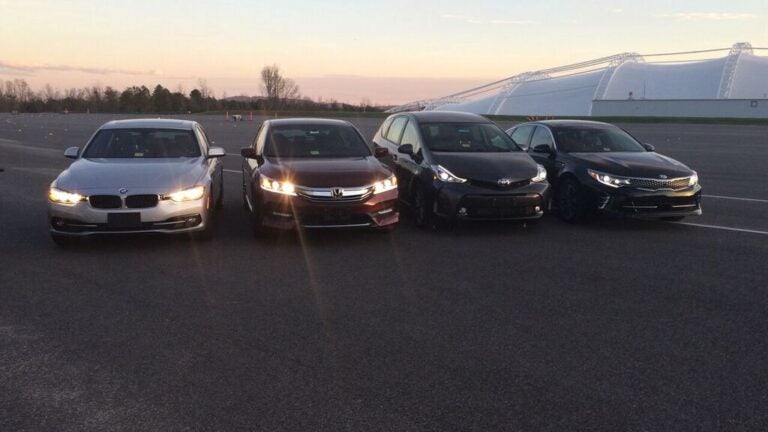
April is Car Care Month, which makes it a good time to talk about headlights—both replacing bulbs and refinishing those cloudy lenses.
That thought was reinforced a few weeks ago when the Insurance Institute for Highway Safety (IIHS) released its ratings of headlight performance in midsize sedans.
Only one vehicle, the Toyota Prius V, out of 31 cars tested earned a “good’’ rating in the institute’s first-ever headlight ratings.
Even that honor comes with an asterisk. The Prius V merits that rating only when equipped with an advanced technology package, an option that is available on the highest trim level. When it’s equipped with standard halogen lights and without high beam assist, the Prius V actually earns a poor rating.
Currently, the IIHS is testing small SUVs; pickup trucks are next in line.
“So far, what we’re seeing is that the small SUVs aren’t doing any better than the sedans,’’ says Russ Rader, senior vice president for communications for the IIHS.
So what’s a driver to do?
“One thing drivers can and probably should do is have their dealer make sure their headlights are aimed properly,’’ says Rader. “Part of the problem comes from headlights that just aren’t aligned right.’’
Many drivers, and not just the elderly, say night driving is their biggest concern.
The folks at Osram Sylvania’s automotive lighting division based in Hillsboro, N.H., conducted focus groups about what consumers wanted most in replacement lights.
“Of all the people we spoke with, only one’s first priority was longer-lasting bulbs,’’ says Brian Noble, marketing manager for aftermarket automotive products. “The rest wanted better night vision.’’
The IIHS’ Rader echoed that topic. “A lot of people who have trouble driving at night may have more of a lighting problem than a vision problem.’’
Sylvania’s Bart Terburg, regulatory affairs manager for Sylvania, has worked closely with government officials on headlight regulations because the company’s products are used by virtually all manufacturers.
“The IIHS was very open about its testing plans,’’ he says. “But every headlight on the market already goes through 20 test points to make sure it fits within the mandated specifications. Every reflector has a slightly different design in how it transfers the light from the bulb onto the roadway.’’
What’s interesting in the IIHS testing is that the testing was done with cars on the market now.
“Most people realize that there’s a three-to-five-year design cycle involved in bringing cars to market,’’ says Terborg. “So you may see some new products coming in 18 months; it could be with halogen, Xenon/HID (high-intensity discharge), or LED bulbs.’’
One of those systems, which is available on a limited basis in Europe, uses the front-facing camera systems already on many cars. It has the ability to regulate how much light comes out of the headlights and where it is aimed.
“In effect, it allows you to drive with your high beams on all the time,’’ says Jonathan Dunlap, Sylvania’s LED systems portfolio manager. “The system allows more light to be directed straight ahead and at the roadside where you might have pedestrians or other objects while at the same time cutting glare in the direction of oncoming traffic.’’
“This system isn’t legal in the United States,’’ says Terburg. “The SAE [Society of Automotive Engineers] is working with the government on how to introduce it.’’ Terburg also is chairman of the SAE’s lighting systems group.
Meanwhile, there’s plenty a customer can do with a four- or five-year-old car to improve nighttime lighting and some things they shouldn’t be doing.
“From an aftermarket perspective, there are better choices out there,’’ says Sylvania’s Noble. “We continue to preach that message.
“We have five families of aftermarket bulbs in our SilverStar family that allow customers to select replacement products, depending on whether they want whiter, brighter, or more illumination down the road,’’ he says.
“The reality is that any bulb will dim over time, depending on the number of hours driven at night. That’s why we recommend you replace lights in pairs. I always liken it to replacing a bulb that burns out in your living room. Even if you’re just replacing a 60-watt bulb, the new one always seems brighter.’’
For a long time, Sylvania resisted getting into the headlight lens refinishing market, but it saw the need was there.
“We’re not a chemical company,’’ says Noble. “But we kept seeing that products weren’t truly effective in doing the job because they didn’t deal with the cause of the problem—the UV rays that cause fading and haziness. So we came out with a restoration kit that realistically should work for five or six more years, in effect the remaining life of the car.’’
One thing the Sylvania team doesn’t recommend is buying an online kit to convert your vehicle’s lights to LED or HID.
“These lights weren’t designed for your car,’’ says Noble, “and there’s a very good chance they won’t be in legal compliance. US Customs has an enforcement arm that confiscates several hundred containers of these products every year. The trouble is, they don’t have enough people to fully do the job.
“If you install them, you not only might not be seeing better yourself, but you might be blinding other drivers.’’
A look into the future came in the Volvo XC90 we recently tested, noting that the headlights performed admirably.
Volvo had used its signature Thor’s Hammer daytime running lights with LED “active bending’’ headlights and auto high beams.
It’ll be interesting to see what the IIHS thinks when they test larger SUVs’ headlights down the road.




To comment, please create a screen name in your profile
To comment, please verify your email address
Conversation
This discussion has ended. Please join elsewhere on Boston.com