
2016 Lamborghini Huracan Spyder goes anywhere, rain or shine
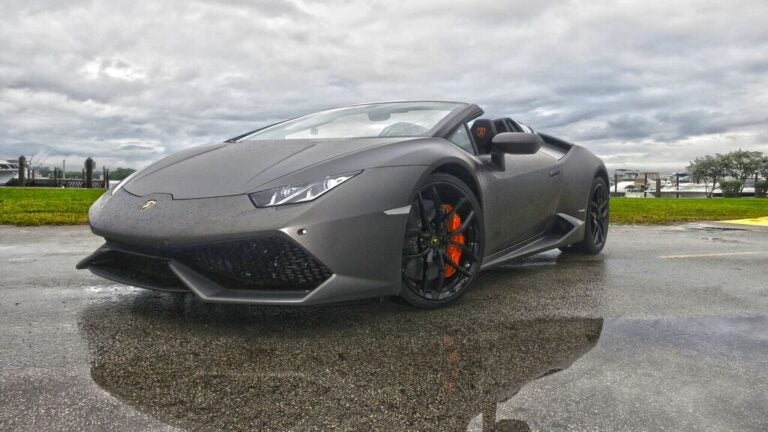
MIAMI—Below 63 mph, rainwater will soak your brow and bead on the Lamborghini Huracan Spyder’s leather seats. At that point, you will need to drop below 31 mph and wait 17 seconds for the fabric top to resurface, then remember to shift the seven-speed dual-clutch transmission at 8,500 rpm, all 10 cylinders howling furiously against the downpour.
Such precise calculations are highly valuable when you’re a Lamborghini driver in Miami, where tropical storms conspire and dissipate in frantic, unexpected bursts. I’ve only got a few hours to drive Lamborghini’s latest wedged hairdryer, the 2016 Huracan Spyder LP 610-4, and staying dry is at the very bottom of my agenda.
The Huracan is the smaller, tamer Lamborghini that greets everyday unpleasantries, like the occasional Florida shower, with grace. In the larger Aventador Roadster, there is no fabric top. You must remember to carry two carbon fiber roof panels with you, which means zero trunk space up front. Then you’ll need to pull over, carefully extract them, slot them in order, clamp each one tight, and make sure no one is trying to ambush you. In an actual storm, this would never happen. That’s why Lamborghini makes two cars.
But in southern Florida, Lambo drivers have nowhere to go. The seven-lane highways are clogged, the A1A is stop-and-go sludge, and Miami rarely trudges past 20 mph, or 5 if you’re seeing to be seen by the bars and nightspots on Ocean Drive. Compared with Lamborghini’s usual fluorescent Post-It note colors, my car’s matte gray paint and polished black rims would have faded into the clouds were it not for Tropicana orange splashes on the brake calipers, seat stripes, and dashboard suede. It’s an elegant, remarkably precise interior for an Italian supercar—the Huracan shares its bone structure with the Audi R8—although the pop-out cupholder is useful only if you’re willing to clean Italian carpet. The rearview mirror doesn’t auto-dim and looks like it came off a Fiat, not that you can see anything with it. But there are worse ways to spend a rainy Monday than in a $315,000 Lamborghini.
It’s almost like the Huracan Spyder was made for rush hour. It shifts smoothly, never lurches in the standard Strada driving mode, steers lightly, and has great A/C. If you’ve driven an Audi convertible, you’ll be comfortable here, as the electronics and switchgear—save for the turn signals and wiper controls mounted on the steering wheel spokes—are identical. Like in the new TT and R8, the Huracan Spyder has an all-digital LCD instrument panel solely for the driver’s view.

The Lamborghini Huracan’s elegant interior takes it all in stride.
The only central display shows three virtual gauges for oil pressure, oil temperature, and battery voltage, all written in Italian. Maps can take up the instrument panel’s entire screen, a useful and oddly safe use of this technology since it requires but a mild glance downward. Any passenger wishing to view directions must lean over, which was fairly impossible in my car’s stiff carbon fiber seats. Before you add that $7,210 option, ask yourself, do you like resting on granite countertops?
Story continues after gallery
Cars with the worst gas mileage (that are totally awesome)
[bdc-gallery id=”1431105″]
All that carbon fiber does something amazing to the Huracan Spyder’s structural rigidity, which feels no less solid than in the coupe. The body’s ultra-low stance and thin-profile, 20-inch tires deliver the exact opposite feeling of those seats. Magnetic shocks—which instantly change viscosity, and therefore resistance to movement, by shocking tiny suspended metal particles with variable electrical current—soak up all but the nastiest road imperfections. Compared with the coupe, the Spyder’s shocks are softer to start, even with the aggressive Sport or Corsa driving modes engaged. The Spyder, without any extra bracing, is roughly 265 pounds heavier. You’d never notice.
When an open road does appear, the roofless Huracan assaults the air up to 201 mph, at which point all casual conversations cease. Actually, the talking stops anytime you pelt the throttle, the exhaust wailing and backfiring the heat of 602 horsepower. It’s not the Grucci fireworks show of a Jaguar F-type R, but nothing is so foreign and beautiful sounding as an unrestricted 10-cylinder engine, and this one especially. Handling and furious all-wheel-drive grip are never in doubt.
For lucky New England Snowbirds who flock to Florida for months on end, a Huracan Spyder would be a natural choice even up north. Here, we’re gushing with incredible roads where you can properly exercise a Lamborghini, rain or shine.

FAST AND SMOOTH: The Audi R8 gives the Lamborghini a run for its money, that being $100,000 less for a similarly exhilarating ride.
Alternative Choice: 2015 Audi R8 V10 Plus
You may be thinking, “What, a previous-generation supercar? How dare you, Globe!’’ I haven’t driven the latest 2017 Audi R8, and the Spyder version won’t be out for at least another year. But I can tell you that the outgoing 2015 R8 is nearly as much bonkers fun for about $100,000 less. The first-gen R8 is based on the Lamborghini Gallardo, the Huracan’s predecessor, and was always the better car to drive. The Audi’s seven-speed, dual-clutch transmission is fast and smooth. The suspension, steering, and the entire attitude of the R8 is more approachable (read: non-life-threatening) at any speed. I tested a V10 Plus coupe with 550 hp—basically, the same 5.2-liter V-10 as in the Huracan, minus a few mods—and carbon ceramic brakes. Do you like loud exhausts, razor-sharp steering, and everyday comfort? How about comic book hero styling and no pretension for extraneous technology, like a real ignition key and physical dials? The first-gen R8 was a stunner, and since Audi made only mild body tweaks to the new car’s body, it’ll stay that way.




To comment, please create a screen name in your profile
To comment, please verify your email address
Conversation
This discussion has ended. Please join elsewhere on Boston.com