
Buy or lease that car? Do the math, make the call
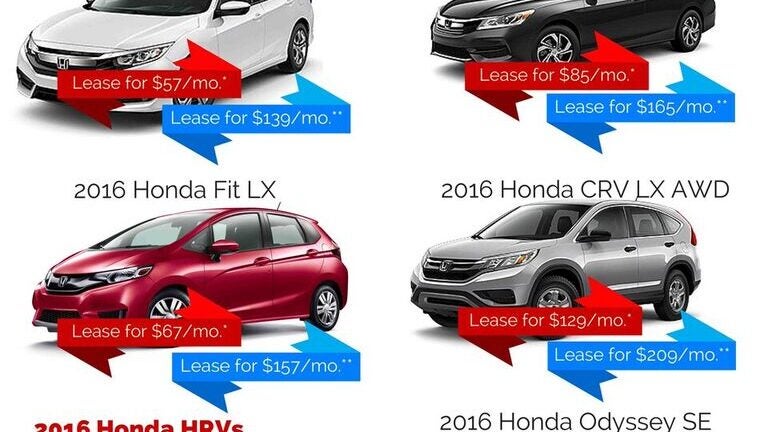
Buy or lease? It’s a lot like own or rent? Would you rather deal with an ongoing payment or pay it off and have equity in an older car?
I’ve always operated on the principle of keeping it simple. Any time I considered getting into a lease, computing the deal in advance seemed impossible. I’d assume the deals were filled with hidden fees and perhaps some sort of problem at the end.
Presidents Day always brings a surge in auto-buying interest with huge inventories available across every price point and lots of advertised specials.
We all come into the deal with different needs, financial resources, and hopes. But one thing we all can do ahead of time is our homework.
Looking for the right car is fun; doing the math can be more like work and involve some legwork.
Unless you buy a lot of cars, the deal never really is simple even though dealerships (and salesmen) generally are efficient at plowing through the small mountain of paperwork that accompanies any deal.
Tip: Consummating a deal takes time. A wise shopper hits the dealership during the week before a busy weekend.
Today, a majority of buyers have done half of their homework. They know the car they want and how much they hope to pay for it, often contacting dealers about a specific vehicle by its inventory number.
But how many have done the financial preparation?
That involves contacting your bank or credit union and checking what you can get for an interest rate—a tool you can use to get a matching or better rate at the dealership. I learned this the hard way, paying 1.5 percent too much on a car loan.
Story continues after gallery
The Best Cars for the Money according to U.S. News and World Report
[bdc-gallery id=”1424128″]
If you know the car you want to buy or lease, you also can ask two other specific and important (for leasing) questions:
1. What is the projected residual value of that vehicle at the end of your planned lease, whether it’s 24, 36, or 48 months or something in between?
2. What is the money factor? That’s the interest rate you’ll be paying. However, in figuring a lease, dealers use a figure that’s the interest rate divided by 2,400. Why? I’m not sure, but for a 3 percent loan it would be .0000125 (.03/2400) or .0000250 for a 6 percent loan.
Buying usually is simpler—if you want to know exactly where your money is going.
For starters, you should know what you can afford and are willing to spend.
You should also know that a new car comes with sales tax, dealer fees, excise tax, and perhaps changes to your insurance policy.
But financing is relatively straightforward.
Taking it by steps:
1. You negotiate the price of the new car.
2. You then negotiate the trade-in value of your used car (if applicable). Remember they are two separate deals.
3. Add in the fees: Dealer fee, registration, tax, finance charge.
4. Come to a bottom line and decide whether you’re going to write a check or finance or, as many do, a combination of both.
If all the nuances of pricing aren’t your concern, that $349 per month for a 36-month lease can be attractive along with the knowledge that you’re always going to be in a relatively new vehicle.
Trying to anticipate the cost of leasing a particular vehicle, on the other hand, requires some planning. Even if you do your homework, it’s hard to predict an exact bottom-line cost. Prerequisites are basic arithmetic skills and the aforementioned residual values and bank “money costs.’’
David Rosenberg of Prime Auto Group has a well-done video explaining leasing. You can find it on the group’s website, www.drivedprime.com.
It’s fairly simple to watch him put down the basic numbers, and we’re using the numbers and math from his video. However, we changed the interest rate from 6 percent to 3 percent, hoping you have a great credit score and interest rates don’t rise this week. The numbers involved:
1. Lease term. For our example: 36 months.
2. Sticker price: $25,000.
3. Negotiated sale price. Example: $22,000.
4. Residual value. A figure you need to obtain. In this case, our car will be worth 50 percent of its sticker price ($12,500) after three years. Depreciation is computed from the original sticker price, not the negotiated sales price.
5. Money factor (interest rate): Our example: 3 percent or .0000125 (.03 divided by 2,400).
Next, you have to compute three costs to add together for your monthly payment.
First is the monthly depreciation cost.
In our case, that’s $22,000 minus 12,500; $9,500 is the amount the car will depreciate over three years. Divide that $9,500 by 36 (the number of months in the lease) and you get (I hope) $264 per month.
Second is the finance charge. Add the sales price ($22,000) and residual value ($12,500) for a total of $34,500 and multiply by the money factor (.00125) for a monthly charge of $43.13.
Add the two monthly charges: $264 and $43.13 for a monthly payment of $317.13.
Oops. We forgot the tax. Multiply that by 6.25 percent for an additional $19.82 per month.
That brings our total to $336.95.
But we’re not really done.
You’re still looking at a security deposit (likely one month’s payment in advance), a bank fee, dealer document, and registration fee. Figure at least $1,500 and likely more for these. Other friends warn me of extra costs such as acquisition and disposal fees, excess mileage charges, wear and tear. And don’t forget the excise tax.
No one ever said homework is easy.
But it does make the dealership experience less confusing and gives you plenty to discuss.




To comment, please create a screen name in your profile
To comment, please verify your email address
Conversation
This discussion has ended. Please join elsewhere on Boston.com