
The Toyota RAV4 Hybrid delivers awesome mileage
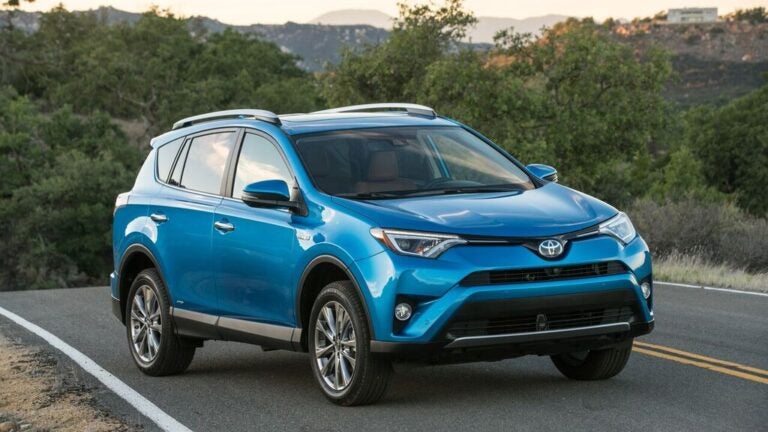
The 2015 gas-powered RAV4 was described as “competent’’ in our recent $28,000 Compact SUV Challenge, and that’s also a good way to describe the overall driving experience of this 2016 hybrid version. Yes, there’s more horsepower (194 horsepower in the hybrid versus 176 in the gas-powered version) and torque (206 lb.-ft. compared with 172). But owing to the hybrid’s extra weight of about 320 pounds, the RAV4 Hybrid is hardly transformed into a rocket ship. It feels only slightly quicker than the gas-powered version.
There’s good, sharp acceleration in the hybrid from a standstill, and any acceleration from low speed is acceptable for the class. However, when you need to pass at highway speeds, you’ll have to anticipate and plan your moves.
Though it’s not a typical continuously variable automatic transmission, Toyota’s hybrid system uses continuously variable gear ratios rather than separate gears. The RAV4 Hybrid’s response is better than a lot of CVTs and hybrids I’ve tested; instead of the “elastic’’ response of the worst models, the power comes on more directly, with a predictable response. The RAV4 Hybrid does sound harsher, though, than the gas-only RAV4.
You never forget you’re driving a hybrid, either. There’s a persistent whine and/or whistle that comes from the hybrid system and is most noticeable during acceleration and braking. The noise is pretty faint when you’re coasting along, so if you’re the sort to listen to music when you drive, you might not notice it at all.
QUIETER RIDE: A heavier body and some sound-deadening materials have lowered noise levels in the 2016 hybrid.
The RAV4 Hybrid’s ride is no different from the previous generation’s gas-powered version. Of its competitors, I find the Escape has the best ride, with a great ability to soak up bumps and still allow for quick changes in direction. The CR-V and Equinox trail a bit because, while comfortable, they don’t inspire confidence when pushed. The RAV4 Hybrid trails all of them in the ability to absorb bumps, but it’s competitive with the CR-V and Equinox in the handling department.
The RAV4 Hybrid gets EPA-estimated gas mileage of 34/31/33 mpg city/highway/combined. By comparison, the gas-powered RAV4 gets an estimated 22/29/25 mpg with all-wheel-drive and 23/30/26 mpg with its standard front-wheel-drive.
Comparing the RAV4 Hybrid’s combined fuel economy of 33 mpg with its all-wheel-drive, four-cylinder competition, the Toyota easily bests the Equinox (23 mpg) Escape (25 mpg with the 1.6-liter engine), and CR-V (27 mpg). The Subaru Crosstrek Hybrid is rated 30/34/31 mpg city/highway/combined, so the RAV4 Hybrid bests its city and combined figures but trails it on the highway. It’s been our experience that combined mileage figures are closest to what drivers get in the “real world,’’ so the RAV4’s victory there is significant.
For 2016, all RAV4s have a more uniform interior appearance across all trim levels. Gone are the sometimes mismatched trim pieces, as are the faux carbon-fiber inlays around the door-lock switches.

CLEAN LINES: The RAV4’s comfortable interior offers ample room front and back and a handsome uniform appearance.
I was comfortable both as a passenger and driver during my day in the RAV4 Hybrid, and the new upper door trim padding on all but the base model played a part in that. I also think the material choices—especially the new mocha-colored interior—look at least as good, if not better, than what anybody else is offering in this class. While Toyota has made a number of changes to the interior design, it will look familiar to RAV4 owners.
Toyota increased the amount of sound-deadening material in all RAV4s for 2016, and it’s largely paid off in the hybrid version. Yes, there is the odd, persistent drivetrain noise, but there’s very little wind noise. While road noise is still noticeable, it’s improved.
Finally, backseat room remains very good.
The RAV4 Hybrid is available with either a 6.1-inch (XLE) or 7.0-inch (Limited) touch screen for controlling various functions. Both screens have good resolution and respond quickly to inputs. I think the revised Sync 3.0 system that Ford uses is the best in the class, but Toyota’s system is almost as good in terms of responsiveness and in the ease of switching between menus.
Story continues after gallery
The greenest cars at the N.E. Auto Show
[bdc-gallery id=”1425886″]
RAV4 Hybrid buyers who’ve had experience in Toyota hybrid vehicles will find familiar screens to check energy use, battery power regeneration, and fuel economy. For 2016, though, those screens now are color, both in the Prius and in the RAV4 Hybrid.
Sadly, there was only one USB port in the car.
Toyota has also worked a bit on the cargo area, and a height-adjustable power liftgate is standard on all RAV4s—hybrid or otherwise—except the base LE trim (where it’s not even optional). What’s neat about the Toyota system is that while sitting in the front seat you can adjust how high the liftgate opens, so if you’ve pulled into a garage with lower clearance, you can make that adjustment without getting out of the car.
The RAV4 Hybrid loses almost 3 cubic feet of cargo space compared with the gas-powered RAV4 because of the hybrid system’s batteries. Toyota also reworked the RAV4’s in-cabin storage, giving it new cupholders and a no-slip mat on the center console tray.
The RAV4 Hybrid has not been crash-tested by the Insurance Institute for Highway Safety. According to IIHS, though, the 2015 results should carry over to both the gas and hybrid versions in 2016.
Beyond the required front airbags, antilock brakes, and electronic stability system, safety options include a Toyota Safety Sense option package that’s standard on the RAV4 Limited (hybrid or otherwise) and available on XLE and SE models. Bundled in that package are a precollision braking system, lane departure alert, adaptive cruise control. There’s also trailer-sway control on all hybrid and gas-powered RAV4s except the SE.
Overall, while the RAV4 Hybrid isn’t a bad vehicle, it’s not a clear winner in its segment in any area except mileage. When gas prices are low, that might not be enough to attract shoppers.





To comment, please create a screen name in your profile
To comment, please verify your email address
Conversation
This discussion has ended. Please join elsewhere on Boston.com