
BMW 7-Series discovers comfort without losing its grip
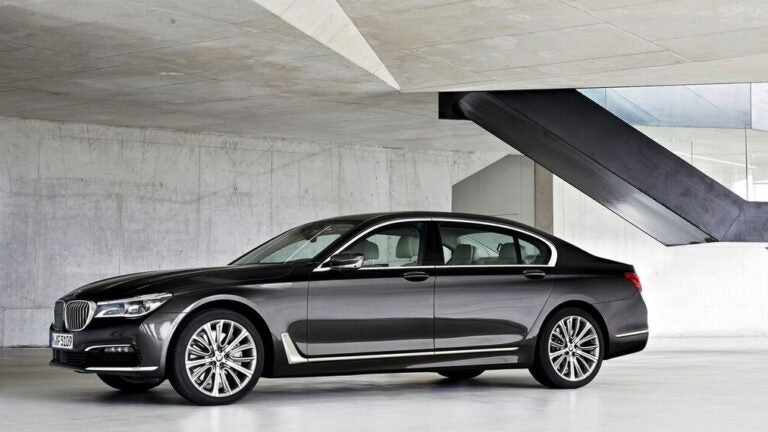
Eventually, opposing enemies must bury their bad blood. BMW and Mercedes cannot do away with each other, not after a century of legendary competition. Each reacts to the other’s triumphs and failures. One digs a hole, the other makes it deeper. And so on. As vitriolic automotive rivalries go, BMW’s flagship sedan has compromised its position and joined the enemy. For the first time, it has no shame trying to be a great Mercedes.
BMW still says it builds the ultimate driving machine, except you can’t drive a 2016 7-Series. You glide. You feel nothing but quiet, damped movements, the foam-wrapped, earplug-sealed, Tempurpedic mattress ride not unlike an S-class. In Comfort+ mode, the car even floats like a Lincoln over bumps, the steering light as a Lexus. This is change, and it’s hard to believe.
Visually, it’s virtually the same as the outgoing BMW sedan that debuted for 2009. Same elegant stance, same crisp sheet metal that Hyundai always tries to copy. Width and wheelbase are identical, and length and height measurements have barely moved. Inside, there’s the usual BMW simplicity, with hard buttons and an intuitive new touch screen, very unlike the Benz’s intimidating, animating display. But it’s all familiar. Everything that has changed is either hidden or summoned by freaky Silicon Valley voodoo.
Spin your index finger clockwise in front of the dash. You’ve just raised the stereo volume. Brush your palm to the right. You ignored your mom’s phone call (not nice). The 7-Series has gesture controls that let you handle a few brief commands without voice. The key fob is not a key fob. It’s a touch screen-enabled pocket app that can check on your car’s vitals. There are two perfume canisters. The entry lighting doesn’t throw a spotlight underneath the side mirrors. It shoots out an angled walkway path several feet long from an insanely precise beam underneath the door sill. The body is up to 190 pounds lighter and stronger than ever because carbon fiber stampings have been bonded to aluminum and steel. The moonroof has glass etchings that illuminate to mimic a night sky. Rear passengers can get a sports massage. The rear wheels steer the car. Anti-roll bars adjust electronically. GPS satellites keep the 8-speed transmission in the proper gear. Most of this has never been done before.

BACKSEAT DRIVERS DELIGHT: Fancy a massage? There’s also onboard WiFi, a removable tablet for backseat passengers, and wireless phone charging for all.
The quality of the leather, stitching padding, and all of the switchgear has gone up several steps. Connectivity options are supreme. There’s onboard WiFi, a removable tablet for backseat passengers, and wireless phone charging, plus a gazillion more things within the iDrive menus. The Rolls-Royce Ghost, based almost entirely on the previous 7-Series and triple the price, is a dustbin by comparison. It’s not as drop-dead incredible as an S-class inside, yet the BMW’s interior is far more approachable and logical. Drive a 7-Series and you won’t need to retake driver’s ed (but just in case you do, BMW will dispatch a “genius’’ for at-home lessons).
For 2016, BMW is only importing the long-wheelbase variants and drops the “L’’ from those names, so a 740i is really a 740Li. The potent, silky smooth engines remain. At $82,295 to start, the 740i has a 3.0-liter twin-turbo inline-6 with 320 horsepower (up five), while the 750i xDrive I sampled (something like $130,000 with all the options) employs a 4.4-liter twin-turbo V-8 good for 445 horsepower. I didn’t verify fuel economy for so brief a drive, but the EPA rates my test car at 16 mpg city/25 mpg highway. The V-12 and diesel models will come later, as will a new plug-in hybrid 740e with a promised 23-mile electric range (and a 2.0-liter 4-cylinder!).
Story continues after gallery
BMW 7-Series and other clean diesel options
[bdc-gallery id=”1424458″]
On my drive, BMW left me roaming the Catskills completely alone without a planned route, a mesmerizing experience that never happens on media test drives. As I was parked, fiddling with the 1,400-watt Bowers & Wilkins stereo, a black bear started toward the car. Had it been dark, the night vision might have detected the animal. But since this BMW can only drive itself when in motion (there’s a self-steering, auto-braking system called Traffic Jam Assistant), I was the one who had to select reverse and scoot away. As you’ve by now guessed, there are few things the new 7 can’t do.
In Sport+ mode, the 7-Series firms up like a BMW should. The steering gets firmer, the air suspension tightens, and the car generally feels a size smaller. There’s no real sense of road feel and it’s not particularly enjoyable. If driving excites you, buy the Jaguar XJ. Because once out of bear country, the 7-Series is back to coddling and pampering in the most un-BMW fashion. It’s wrong in the right way. BMW will be 100 years old in 2016, and while executives will never admit what inspired this car’s development, it ought to give Mercedes most of the credit.





To comment, please create a screen name in your profile
To comment, please verify your email address
Conversation
This discussion has ended. Please join elsewhere on Boston.com