
Driver’s guide: What you need to know about rearview cameras
The basics
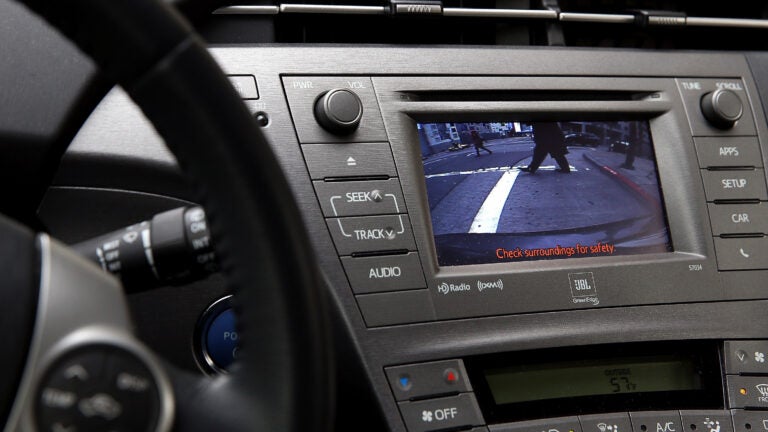
Rearview cameras, also known as backup cameras, rear cameras, or reversing cameras, are a tool to help drivers see things (or people) that may be hidden by their vehicle’s rear bumper and prevent “backover accidents.’’
Here’s how it works. A camera installed in the rear of the vehicle feeds a view onto the console or dashboard display of what’s behind the vehicle. The camera allows the driver to see any objects or pedestrians that have moved within a vehicle’s blind zone while the driver is backing up.
Russ Rader, senior vice president of communications for the Insurance Institute for Highway Safety (IIHS), says backover crashes pose the biggest threat to young children and the elderly.
Statistics from the National Highway Traffic Safety Administration (NHTSA) back up Rader’s claim. NHTSA says 210 fatalities and 15,000 injuries are caused each year by backover crashes. The agency says 31 percent of these fatalities are children under 5 years old, while adults ages 70 years and older account for 26 percent.
“Backup cameras can reduce the blind zone by as much as 90 percent,’’ said Rader.
As Consumer Reports points out, all vehicles have “significant blind zones,’’ with larger vehicles having much greater blind zones than smaller vehicles. For example, midsize and large SUVs have blind zones of 18 and 19 feet respectively, while pickups have blind zones of 24 feet, compared to 12 feet for a sedan.
For shorter drivers (5 feet, 1 inch and under) these blind zones can increase by several feet.
Story continues after gallery
The safest new cars of 2016
[bdc-gallery id=”1431181″]
History
Nissan was the first auto manufacturer to offer a vehicle with rearview camera technology in the United States. The feature made its market debut with the 2002 Infiniti Q45.
Rader says by 2005, 5 percent of consumer vehicles were equipped with rearview cameras. Today, he says about 90 percent of vehicles offer a rearview camera.
“I think the spread of the technology shows that consumers are interested,’’ said Rader. He also points out the technology has become very affordable and is not an added expense for consumers.
Law of the land
When it made the announcement, the agency said many manufacturers were already installing rearview cameras in response to consumer demand. The agency believes the requirement could save dozens of lives each year and prevent many more injuries.
Rader said IIHS is very supportive of NHTSA’s requirement for new vehicles to be equipped with rearview cameras, saying it has “a lot of potential’’ to prevent tragic backover accidents.
But while he believes rearview cameras can save lives by preventing backover crashes, Rader says automatic braking for reverse driving would make the systems even more effective.
“Just like automatic braking prevents crashes when a vehicle is moving forward, sensors in the rear could detect an object, stop the vehicle automatically, and prevent a collision,’’ he said.
However, Rader added, the real key to preventing tragedies involving young children is for parents to be watchful, especially near the driveway.
“Rearview cameras don’t replace and are not a substitute for the vigilance of parents,’’ said Rader. “A rearview camera is not a panacea, but they can help.’’




To comment, please create a screen name in your profile
To comment, please verify your email address
Conversation
This discussion has ended. Please join elsewhere on Boston.com