
Is the Mazda CX-3 a hatchback or a small SUV?
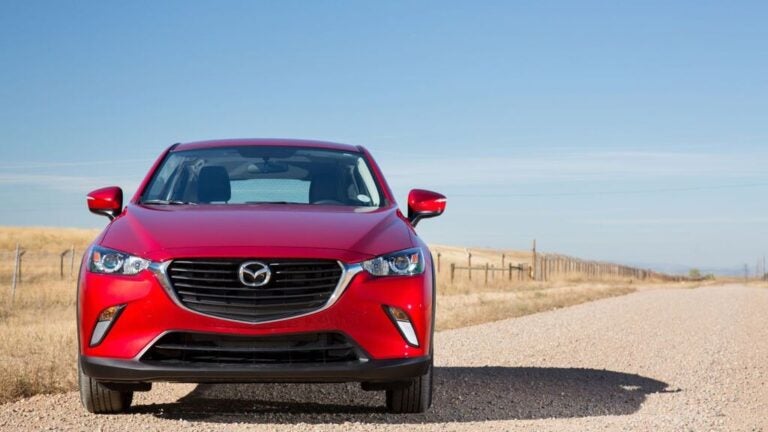
In a burgeoning class of tall hatchback cars masquerading as small SUVs, the Mazda CX-3 is … a hatchback—a sharp-looking, nimble one, with a quality interior and high gas mileage, but hardly an SUV.
This is a good thing. In a not-very-sporty, not-very-quick class, the CX-3 is definitely sporty and reasonably quick, with a great drivetrain. There is less cabin and cargo room and lower ground clearance than competitors, but that’s why this isn’t an SUV, although that’s how it’s being marketed.
Apart from its optional all-wheel-drive, the only thing distinguishing the CX-3 from the hatchback version of Mazda’s own Mazda3 compact car is interior space—of which it has less. Oh, and also its price, which is higher. Having established that the CX-3 is in direct competition with the Mazda3, I predict the CX-3 nonetheless will excel in the market and demonstrate why automakers are producing these subcompacts and successfully selling them for more money than hatchback cars. Americans prefer SUVs over hatchbacks and (gasp!) wagons, practical considerations be damned. What else could explain the unquestionable appeal of what’s proving to be a class of unremarkable vehicles?
The CX-3 comes in Sport, Touring, and Grand Touring trim levels, each with a 2.0-liter four-cylinder engine, a six-speed automatic transmission and a choice of front- or all-wheel-drive. I tested the Touring and Grand Touring. The options, including the base model, range in price from $19,960 to $26,240 and have an estimated 27-29 mpg/city and 32–35 mpg/hwy.

NICE NOSE: Like all of Mazda’s recent introductions, this CX-3 is pretty to look at.
Like so many of Mazda’s current models, the CX-3 looks great. Its snub-nosed front end recalls a competitor, the 2016 Mitsubishi Outlander Sport. The CX-3 also has the same kind of gray trim along its rocker panels and wheel arches that’s seen on direct competitors, such as the Subaru XV Crosstrek and the upscale Audi Allroad, both current market stars.
With ground clearance of 6.1 inches, the CX-3 is probably the most grounded-looking of the subcompact SUVs, though the Mini Countryman sits just 5.9 inches off the ground. The otherwise tall Chevrolet Trax clears just 6.2 inches. The Honda HR-V tops out at 6.7 inches, the Fiat 500X at 7.9, and the Crosstrek, Outlander Sport, and Jeep Renegade max out between 8 and 8.7 inches. (See what I meant by the burgeoning subcompact SUV class?)
Also note that the CX-3 has no ground-clearance advantage versus the Mazda3 hatchback, so only its all-wheel-drive will improve snow performance. For comparison, the CX-3 is 7.3 inches shorter from bumper to bumper, narrower by more than an inch, but 3.4 inches taller at the roofline versus the Mazda3. The compact CX-5 is 10.4 inches longer and 5.0 inches higher.
Where the CX-3 clearly beats every other model in its class is with its powertrain. The CX-3 has a 2.0-liter four-cylinder whose 146 horsepower compares to the Trax, HR-V, Outlander Sport, and Crosstrek, but its curb weight is much lighter than all four, by as much as 388 pounds comparing all-wheel-drive models.
Interior space is arguably the CX-3’s greatest shortfall. By the numbers, front-seat legroom is on the high side, shy of only the Crosstrek. Front headroom is less than all competitors, yet I, at 6 feet tall, was perfectly fine in the driver’s seat—even in the Grand Touring, whose standard moonroof (optional on Touring) robs almost an additional inch of space.
With all its newly introduced models, the subcompact SUV class has some nice interiors, and the CX-3 is right up there. The Sport has cloth seats, the Touring gets a nice combination of cloth and imitation leather, and the Grand Touring’s genuine leather has faux suede seat inserts and door panels.
The main shortfall I noted was that the displays flanking the Touring’s speedometer gauge were too dim to see, even in overcast daylight. The Grand Touring, which has a central tachometer instead, with an inset digital speedometer and seemingly the same bookending displays, didn’t have this problem. The Grand Touring also adds Active Driving Display (a head-up display using a small, transparent window atop the dashboard).
The CX-3 combines a few simple mechanical controls with a standard Mazda Connect system, which comprises a 7-inch display atop the dashboard and a controller knob and buttons on the center console. The display functions as a touch screen when the car is stationary, but the knob is necessary once in motion. Though it looks like what we’ve come to perceive as a navigation system, the navigation function comes only on the Grand Touring, where it’s standard. The system has control sections labeled Applications, Entertainment, Communications, and Settings. As of now, Mazda doesn’t support Apple CarPlay or Android Auto, which some cars offer as a means to add onscreen navigation from a compatible smartphone.
Story continues after gallery
Mazda CX-3 and other new and improved car for 2016
[bdc-gallery id=”1424836″]
A relatively new offering from Mazda is Mazda Mobile Start, a telematics-style system that allows the owner to remote-start the car, find the car, lock, and unlock the doors by means of a smartphone. It requires $500 dealer-installed cellular hardware and, after one year of initial service, a $65 annual subscription.
The CX-3’s cargo volume behind the backseat is roughly half that of several competitors, and it’s among the smallest with the backseat folded down, as well. The Mini Countryman is one exception, having less cargo volume with its seats down, but it still edges out the Mazda with the seats up. Specifically, the CX-3 has 12.4 and 44.5 cubic feet behind the seats and maximum, respectively. The Mazda3 hatch has 20.2 and 47.1 cubic feet.
A backup camera is standard. The Touring adds a blind spot monitor with rear cross-traffic alert, and the Grand Touring adds an adaptive front lighting system.
We want to believe subcompact SUVs are valued for their roominess and versatility, and if that’s true the CX-3 has some disadvantages due to its smaller interior volume. But it’s cleverly equipped with features that count, including the multimedia system and nicer materials and controls up high, where occupants see and interact with them.
You’ll have to step up to a Sport trim for more advanced features, like heated seats, keyless access, and heated side signal mirrors, along with the first tier of active safety features detailed above. Naturally, it’s the top, GT trim that impresses most, with LED headlights, fog lights and taillights; a head-up display; automatic climate control; leather seats; and more.





To comment, please create a screen name in your profile
To comment, please verify your email address
Conversation
This discussion has ended. Please join elsewhere on Boston.com