
Watch as we let a Tesla Model S take the wheel
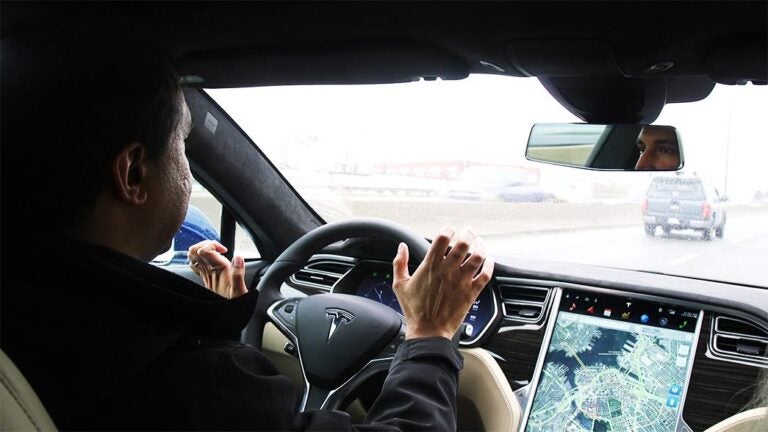
What is it like to let go of a car’s steering wheel and let it do the driving?
It’s both terrifying and relaxing at the same time, if you can believe that.
Electric automaker Tesla officially opened its first Boston-based store at the Shops at the Prudential Center on Wednesday. Visitors can stop in the store to learn more about Tesla products and even take a Model S for a test drive.
Boston.com took Tesla up on the offer for a test drive. And we were sure to put the company’s Autopilot feature to the test.
What is Autopilot?
Tesla released its Autopilot program as an over-the-air software upgrade for its users in October. By tuning in to a series of built-in sensors, radar, and fleet data, Tesla is offering motorists a glimpse into the future of self-driving cars. Tesla owners can activate the upgrade for $2,500.
The best way to describe it, says Tesla spokesperson Alexis Georgeson, is as a “driver assistance feature.’’ Think of it as a very advanced form of cruise control.
“It’s simply there to make driving more enjoyable and eliminate some of the stress and tedious tasks of driving,’’ she said.
But she also stressed that this is definitely not a self-driving car. The program is still in beta, which is even indicated on the console’s display screen. So while Tesla has made a strong advancement, drivers are still very much a part of the company’s driving equation.
“I think it gives you a taste of what the future has in store for autonomous driving,’’ said Alexis. “We’re still a few years away from fully autonomous vehicles.’’
Story continues after gallery
Want an affordable car with lots of tech? Here are 9 options:
[bdc-gallery id=”1420402″]
The test drive
We picked up our test vehicle, a Tesla Model S P90D, in front of the Prudential Center and headed for I-93. Alexis pointed out that a highway setting is the only environment where Autopilot works.
“It will only allow you to engage it when it can read the lines on the road, when you’re on the highway and it can recognize there are lanes there, or when there’s a car in front of you that it feels comfortable following,’’ she said.
The Model S P90D can start around $108,000. Adding a battery upgrade that offers super fast acceleration in “Ludicrous’’ mode bumps the price up significantly to about $118,000. Our test vehicle, which was equipped with several additional upgrades, was valued at about $141,000.
Once we got onto I-93, turning the feature on was as easy as activating a car’s windshield wiper or a turn signal. A switch is located on the lower left side of the steering wheel and with two quick taps, Autopilot gently chimed to life.
When the system engages, a pair of light blue icons, a steering wheel and a speedometer icon, light up on the dashboard display and a message flashes warning the driver to keep their hands on the wheel. But apart from these signals, it’s easy for Autopilot to go unnoticed once it’s engaged.
For the sake of testing, I planned to ignore the vehicle’s warning about keeping my hands on the wheel. At first, I was reluctant to let go. After all, we were traveling on I-93 southbound at 55 miles per hour. The Model S clearly sensed I was reluctant to take my hands off the steering wheel because when I turned the wheel ever so slightly, Autopilot immediately disengaged and I was driving the car again.
We tried it again, but this time my foot tapped the brake and the car once again switched Autopilot off.
But the third time was just right.
At a pre-set speed of 55 mph, I gently tapped the Autopilot switch and it took control. The vehicle’s speed had dropped to about 50 mph, and I felt it accelerate to meet the 55 mph I had entered.
With my hands just a few inches from the wheel, Autopilot steered the car as the lanes of I-93 bent and swerved. Whenever another car switched lanes and pulled ahead of us, the car’s brakes kicked in to slow the vehicle down and maintain a safe distance between the us and the vehicle ahead.
But the most amazing part of the test was yet to come.
After making sure there were no other cars coming, I switched on the car’s blinker with Autopilot engaged. With my hands just a few inches away from the wheel, the car moved one lane over to the left and centered itself in the new lane and resumed driving.
Being behind the wheel of a car that is changing lanes with no help from you is a startling experience. But Tesla’s vehicle made the maneuver with such little resistance that it was eerily calm and equally exhilarating to behold.
It was so cool, I had to see it in action a few more times. Each time the car could tell how far apart it was from the other cars on the road and knew to position evenly itself between the lane dividers.

Tesla opened its first Boston-based store at the Prudential Center on November 11, 2015.
End of the road
While it was cool to let a car take control, even briefly Autopilot’s biggest selling point is its ability to return control to the driver without any significant effort. By either taking control of the steering wheel or tapping the brake pedal, Autopilot switches off and the driver is back in control. There was no button to push or switch to activate. All you have to do is drive.
We wrapped up the test and headed back the Prudential Center to drop the test vehicle off.
At the end of the test, it was clear to me that Tesla has definitely found a way to offer consumers a glimpse into the future of self-driving cars.
That said, it is important to remember that Autopilot is only a glimpse of the future. Autopilot is definitely a cool feature, but it’s not a substitute for a flesh-and-blood driver’s judgment. Not yet, anyway.



To comment, please create a screen name in your profile
To comment, please verify your email address
Conversation
This discussion has ended. Please join elsewhere on Boston.com