
Crawl Control helps Tacoma reach the top
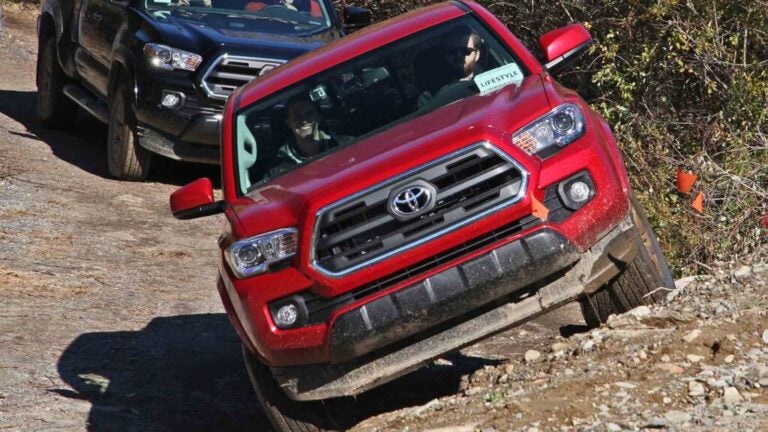
We caught quite a show down at the Xfinity Center in Mansfield on the Friday before Halloween. Best of all, we were part of the proceedings.
Even though the venue—formerly known as Great Woods, the Tweeter Center, and Comcast Center¬—is mostly known for musical acts, this time the melodies were served up by the engines and four-wheel-drive systems of the 2016 Toyota Tacoma taking on an obstacle course of considerable challenge.
Off-roading isn’t a quiet endeavor. The Tacoma’s high strength steel frames groaned as they flexed, crawled over rocks and telephone poles, and covered themselves with glory (aka mud).
Today, many cars offer park assist, where the car does the steering. Tacoma’s new Crawl Control system leaves the steering to the driver but takes over the throttle and braking. We climbed a 30-degree hill (heading up, all you see is the sky so it’s an act of faith to keep moving) then came over the crest to see an equally steep downhill (think of the view when you reach the apex of a roller coaster at the moment you start down).
Except we never went flying down the hill, still being under the guidance of the crawl control.
The Crawl Control has five settings—1-to-5 miles per hour—and is part of the redesigned Tacoma’s Multi-Terrain system that lists moguls, mud, sand, loose rock, and rocks-and-dirt among its settings.
Seemingly no detail was too small (literally) in redesigning Toyota’s midsize pickup.
The company had been riding 10 straight years of leading the midsize segment in sales. Granted, there wasn’t all that much competition for some of that time, but Toyota has had a great run, selling more than 7 million Tacomas since 1964.
A year ago, GM figured out the right midsize pickup formula and re-entered the segment with the Chevrolet Colorado and GMC Canyon. GM’s strategy was to attract more upscale buyers by making the trucks both tough and high-tech with lots of lifestyle-related accessories available.
Toyota had been enjoying its success with a similar formula, so re-inventing its vehicle posed a “don’t mess this up’’ challenge for the designers. Fortunately, the outgoing vehicle was in serious need of an update, and the design team knew where it wanted to go.
They were fortunate that Toyota’s bosses let Toyota North America do the designing for the new Tacoma, but that doesn’t mean there weren’t a few “a-ha’’ moments along the way.
Mike Sweers, the chief engineer for the Tundra and Tacoma, caused some lost-in-translation confusion when his Japanese counterparts tried to assimilate the meaning of his stated goal to create a “bad-ass vehicle.’’
Likewise, Sweers was shocked when he was taken to a wind tunnel in Japan and shown a tiny piece his Japanese counterparts had developed.
“You brought me all the way overseas to show me THAT?’’ was his reply to a Japanese engineer.
It turns out THAT was a small “aero fin.’’ The truck already had some on the taillights and bottom of the side mirrors.
This one, however, when located on the base of the side mirror, turned out to make a huge gain in aerodynamic efficiency.
Among the improvements for 2016 is a locking tailgate (with easy-down technology) and a great addition, the hard, tri-fold tonneau cover available from the factory.
“We tested the best aftermarket tonneau covers, then developed our own, one that never broke down, even after 10,000 test cycles,’’ said Carlos Dos Santos, a field training specialist out of Toyota’s Northeast regional offices.
The Tacoma retains its composite pickup bed and deck-rail system with sliding cleats for locking down cargo. Among available bed options are a heavy-duty bed mat, bike rack, and mini tie downs.
Dos Santos and fellow training specialist John Rindone (the go-to guys for your local dealership) did a walk-around on several of the trucks after Kristi Pourmousa, a vehicle training specialist, gave a quick-but-thorough vehicle intro for members of the New England Motor Press Association.
Rindone explained that Toyota didn’t fully box the frame, adding high-strength steel instead, so the truck would be able to flex better in off-road conditions. All of the drivers experienced that, lifting a wheel off the ground when crawling over mounds.
The Tacoma is available in five trim levels, base SR, SR5 (traditional best seller), TRD Sport, TRD Off-Road, and upscale Limited.
Two body styles (access cab and double cab) are available, each in two-wheel- and four-wheel-drive. Toyota says that it’s limiting production to 29 different configurations, figuring customers should find what they need among those offerings.
Engines are an upgraded four-cylinder putting out 159 horsepower and 180 lb.-ft. of torque and a 3.5-liter Atkinson cycle V-6 with 278 hp and 265 lb.-ft. of torque. That’s a 42 hp increase over the prior V-6.
Both engines, when mated with a six-speed automatic transmission are rated at 20 miles per gallon in combined driving.
For the SR, a scaled-back version is available with rear seats removed for storing tools and equipment inside.
Perhaps the exclamation point that this is a go-anywhere truck is the standard (on all models) Go-Pro camera mount for the adventurous who are committed to filming their recreational exploits.




To comment, please create a screen name in your profile
To comment, please verify your email address
Conversation
This discussion has ended. Please join elsewhere on Boston.com