
Chevy upgrades the Volt with more style, power
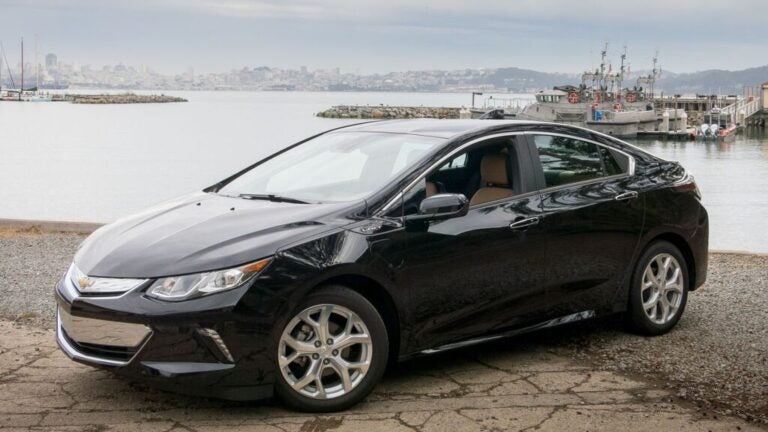
The 2016 Chevrolet Volt is a revelation: It’s an obvious, serious refinement of the current model, a product of General Motors fixing only what’s wrong, while quietly improving what’s already good. The result is a new and improved Volt that looks, feels, and performs better in almost every way.
From the low, pointed front end to the much bigger taillights and the side window trim that connects them, the new Volt looks more like a modern Honda Civic or FCX Clarity fuel-cell car than it looks like its old self.
This is not a bad thing; the best thing that can be said about the old Volt is it was an obvious product of the wind tunnel. The new car is one that would appeal to shoppers who’re just seeking a stylish compact sedan, never mind the Volt’s electric abilities.
Unlike the “Gen 1’’ Volt, for which Chevrolet had to guess what customers wanted in a range-extended electric car, the “Gen 2’’ model has 80,000 vocal owners who have provided massive feedback to the company about what needed to change for the new model. First among them was range—and Chevy delivered.
The company redesigned the lithium-ion battery pack to eliminate more than 30 percent of the battery cells, but increased the pack’s capacity overall. The result is the Volt is now certified to go 53 miles on electricity alone, before the new, larger 1.5-liter gasoline engine kicks in to keep it going up to 420 miles in total.
Story continues after gallery
The 2016 Chevy Volt and other “Green Car of the Year’’ finalists
[bdc-gallery id=”1429846″]
A new electric drive unit uses motors that have improved the 0-30 mph feel, giving the car a much more sprightly, agile feeling in everyday driving.
Despite being more than 200 pounds lighter, it’s still a heavy car, but it no longer feels like the hefty tank that the Gen 1 resembled. It’s replaced by an experience that can be best described as “premium,’’ thanks to the absolutely silent electric operation; nicely weighted, well-balanced steering; and smooth, well-damped ride.
Getting that 53 miles of range is not going to be difficult, either. In aggressive driving through the Marin Headlands north of San Francisco, I managed to get 45 miles, and another driver on my program made a point to drive conservatively and achieved 60 miles on electric power. Using the new “regen’’ button on the back of the steering wheel and keeping the transmission in “L’’ for more aggressive use of regenerative braking make a difference. Using the button to slow the car instead of tapping the brakes lets you recapture a lot of energy over time.

SLEEKER: Better design and updated electrics give the 2016 Volt an edge.
Four driving modes are available. Normal feels like the Gen 1’s Sport mode, with the new car’s higher torque output and more aggressive tuning. The new Sport mode is aggressive and a little too jumpy in stop-and-go traffic. Mountain is for driving in conditions with long uphill grades, as it keeps some battery power in reserve as you deplete it so as not to have to rely solely on the engine’s output to get you through the Rockies. And Hold mode allows you to keep the battery charge at whatever level it’s at when you push the button, which is useful on a long highway stretch.
In such conditions, the Volt is more efficient if you just let the engine help power the car at highway speeds, getting about 45 mpg in observed fuel economy (now on regular unleaded gasoline rather than premium), and keep the all-electric power for in-town driving, where electric is more efficient.
The Gen 2 Volt completely rethinks the interior, and the result is perhaps the best mixture of touch-screen tech and dedicated buttons I’ve yet seen on a new car.
All the materials inside have been upgraded, as have the displays—a new screen with updated graphics is behind the steering wheel, and the center touch screen is big and easy to use. Functions you use often are controlled by dedicated knobs and switches, while the deeper functions can be found easily using the latest version of Chevy MyLink. Apple CarPlay is standard and works well most of the time; our version crashed a couple of times while playing music over a USB cord from an iPhone 6S Plus. The new seats are comfortable and covered in high-quality leather or fabric. That fifth-place seat you’ve heard about in the rear? Forget about that. It’s easier to just accept that the Volt remains a four-seat car. Interior colors also feed the premium feel of the Volt, with a two-tone black-and-tan option that’s dramatic, if a bit too orangey.
My biggest gripe with the Volt remains visibility outward. The previous generation’s bisected rear window has been revised into a single, deeper glass panel out back, which helps rearward visibility, but there’s still no rear wiper option.
Chevy has added some additional safety features. Automatic lane keep assist, lane departure warning, blind spot monitor with rear cross-traffic alert, forward collision alert with autonomous braking, and automatic parallel parking are optional. They all work seamlessly.
In sum, the new 2016 Volt is an extremely impressive upgrade to what was already an enjoyable, if somewhat flawed vehicle. Starting nearly $1,200 less than the 2015 model, it’s more affordable as well.





To comment, please create a screen name in your profile
To comment, please verify your email address
Conversation
This discussion has ended. Please join elsewhere on Boston.com