
Your car is better at parking than you are, so why don’t you trust it?
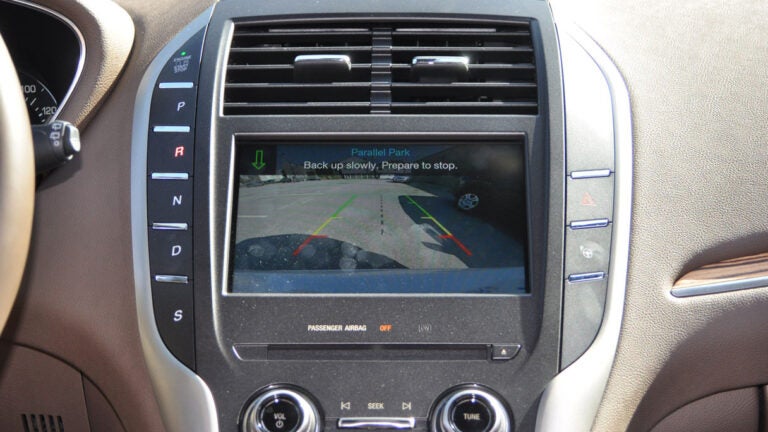
Despite greater availability of autonomous car features like self-parking technology, most drivers prefer to do the job themselves.
That’s the main takeaway from a recent study by AAA, which found nearly 80 percent of surveyed drivers are confident in their own parking abilities, and 72 percent of respondents do not trust self-parking systems.
But at the same time, AAA found self-parking technology does a better job of getting a vehicle into a parking space without striking the curb and using fewer maneuvers.
“While the vast majority of Americans say they would not trust self-parking technology, AAA found these features performed well in tests and warrant consideration of new car buyers,’’ said John Nielsen, AAA’s managing director of Automotive Engineering and Repair in a statement.
Story continues after gallery
Cars to make parking in Boston easier
[bdc-gallery id=”1419137″]
Not even close
AAA partnered with the Automobile Club of Southern California’s Automotive Research Center to test the self-driving technology on five vehicles: a 2015 Lincoln MKC, a 2015 Mercedes-Benz ML400 4Matic, a 2015 Cadillac CTS-V Sport, a 2015 BMW i3, and a 2015 Jeep Cherokee Limited.
Four drivers tested all five vehicles with each driver parking five consecutive times using the park-assist technology and another five times without using the technology. All cars had a back-up camera to assist drivers when parking manually, and the parking space was measured at 24 feet by 8 feet.
Self-driving technology handily outperformed drivers who parked on their own, experiencing 81 percent fewer curb strikes.
AAA also found the self-parking features were able to park with 47 percent fewer maneuvers than drivers who parked manually. Several vehicles were able to park using only one maneuver, while drivers who parked manually required between two and three maneuvers.
The automated cars also parked 10 percent faster than the humans and got 37 percent closer to the curb.
“While Americans report feeling confident in their parallel parking abilities, this technology proves there is room for improvement,’’ said Megan McKernan, manager of the Automobile Club of Southern California’s Automotive Research Center.
However, the study also found areas where self-driving technology could improve its performance as well. Several vehicles parked leaving “exceedingly short distances’’ between the vehicle’s wheels and the curb. AAA worries that parking too close will increase the likelihood that wheels and tires get scratched and require expensive repairs.
Easing into (vehicle) autonomy
John Paul, public affairs director for AAA Northeast, says he understands why some people are not interested in letting park-assist technology take over driving. But while many consumers see the technology as a “novelty’’ feature that they would not use all the time, he believes the technology will eventually catch on.
“Self-parking system are an answer to a question no one asked,’’ Paul told Boston.com. “As systems become more refined people will get used to them.’’
But Paul sees the increased availability of features like park assist systems as a bigger step towards the development of autonomous vehicles.
“These are the building blocks of vehicle autonomy,’’ said Paul. “It will take some time until the blocks are blended together into an autonomous vehicle.’’
Paul anticipates most drivers will need time to adjust to letting a car do all their driving tasks for them.
“Like all things that take the driver out of the picture, it will take a certain amount of trust for that to happen,’’ he said.





To comment, please create a screen name in your profile
To comment, please verify your email address
Conversation
This discussion has ended. Please join elsewhere on Boston.com