
Nissan’s 2016 370Z roadster: A ragtop rambler
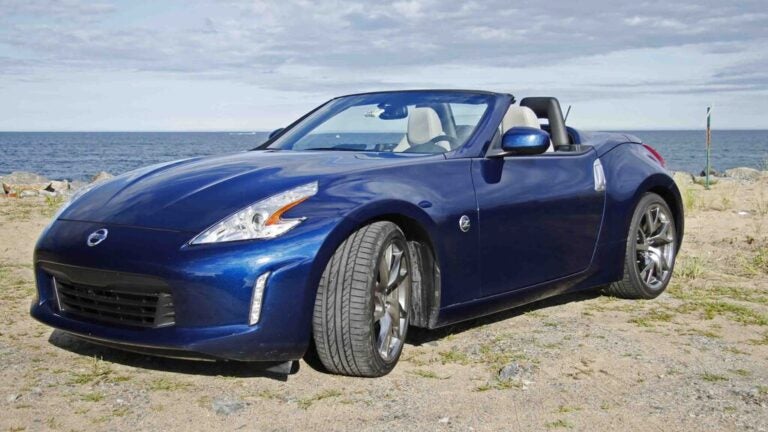
Driving one of Nissan’s Zs is a guaranteed good time.
Having a new (2016) 370Z roadster during a spell of great late-summer weather makes it even more fun.
The 370Z is one of those cars that looks great “just sitting there.’’
It was parked outside the WNBP (1450-AM, 106.1-FM) radio studios in Newburyport last week when I answered a late summons from host Wes Pettengill to appear on his Monday evening “Calling All Cars’’ show.
Looking down at the Z from above, we (Wes, I, and producer/co-owner of the station Pete Falcone) agreed that the Z looked great from that angle, too.
The Z, originally exported to the US market in late 1969, can take at least partial credit for establishing the Datsun/Nissan brand in the United States.
Those originals—most of which succumbed to rust decades ago—have become highly collectible.
To which we add that today’s test car is a worthy successor.
The present model pays homage to its heritage with the Z’s signature three gauge pods atop the center of the dashboard—oil temperature, voltmeter, and clock. Behind the wheel, the car’s speedometer and tachometer come to life with an initial sweep when the car is started. A combination driver’s information display/onboard computer sits to the left of the dashboard with fuel and coolant temperature tracked on a horizontal line of dots.
Our test vehicle was the top of the three trim levels—base, Touring, Touring Sports—available with convertible tops.

From the rear, you note the 370Z has wide haunches, LED taillights, dual exhaust outlets, and a lowered convertible top.
It had an MSRP of $49,400. Destination ($825) and carpeting ($220) pushed the bottom line to $50,445.
While we didn’t have the latest safety technology—adaptive cruise control, lane-keeping assist, autonomous braking—the Z otherwise is up to date.
You ask about the styling? The formula is long established: long hood, small cockpit, hefty haunches.
And about the top? In a time when many competitors have gone to retractable hardtops, Nissan has kept a well-insulated soft top. The top mechanism has a pronounced robotic herky-jerky motion but gets the job done (in either direction) in about 20 seconds. When down, the top is hidden under a hard tonneau painted in the body color.
A decent-sized glass window (with defogger) is part of the top, which is made of Stayfast, a three-layer composite product of Acton-based Haartz Corporation, a major supplier to the automotive industry. For the 370Zs, Haartz supplies tops in both black and a wine-colored Bordeaux material.

PLUSH APPOINTMENTS: The 370Z has lots of leather, a nicely arranged center stack, and gives a nod to its heritage with three gauges at the top center of the dashboard.
Driving with the top down is surprisingly civilized. A solid glass (polycarbonate?) wind deflector is built in just behind the seats. Speaking of the seats, they’re heated and cooled in the top two trim levels. It’s a welcome addition on a sunny day.
All models are powered by the same 3.7-liter V-6 engine. It sends the power to the rear wheels via a 7-speed automatic transmission. The transmission can be manually operated either via the shift lever on the center console or via paddle shifters. An algorithm assists rev-matching downshifts in the manual mode.
Our top-of-the-line version had 19-inch RAYS alloy wheels with an eye-catching pattern that showed off the bright red brake calipers with Nissan’s name on them.
Story continues after gallery
New and improved cars for 2016
[bdc-gallery id=”1424836″]
Nissan has done a nice job of tightening up the body’s structural rigidity, eliminating the body twist. We hit some nasty diagonal bridge expansion joints while driving the length of Route 495 and found little play, a tribute to Nissan’s engineers.
That leads to a tip of the cap for the folks who tuned the suspension. It was stiff overall but wonderful on the road and civilized enough on bumpy roads.
The noise-reduction folks don’t get the same kudos. We didn’t notice the road noise inside until both Mrs. G and I said, “I can’t hear the words on the songs on the radio. In fact, I can’t hear you, either.’’
Part of that is from the engine, which is loaded with power and very responsive, but it can get noisy when pushed. Hey, it’s something we’re supposed to do in testing.
Also inside, the main gauges (speedometer, tach, and indicators) are affixed to the steering column and move up and down when you adjust the steering wheel.
The nicely contoured seats each have four-way power adjustments while the driver’s seat has two more adjusting knobs to manually set the seat’s tilt and support.
Nissan has done a nice job of separating controls in the center stack. The 7-inch touch screen is responsive and obviously handles the navigation.
Radio controls are on the middle tier, with climate controls below. Of course, both audio and climate also can be controlled from the steering wheel, as can the Bluetooth function for the telephone and cruise control.
Nissan says the 2016 370Z is mostly a carryover from 2015. However, one change is a new color, Deep Blue Pearl. Naturally, our test car was that very color.
Must say, it looked great as we were styling.
2016 Nissan 370Z Roadster Touring Sport
THE BASICS
Price, base/as tested (with destination): $50,225/$50,445. Fuel economy, EPA estimated: 18 city/25 highway/21 combined. Fuel economy, Globe observed: 22.3. Drivetrain: 3.7-liter V-6, 7-speed automatic transmission, rear-wheel-drive. Body: 2-passenger roadster.
THE SPECIFICS
Horsepower: 332. Torque: 270 lb.-ft. Overall length: 167.2 in. Wheelbase: 100.4 in. Height: 72.6 in. Width: 52.2 in. Curb weight: 3,521 lbs.
THE GOOD
Handling, styling, value, interior quality.
THE BAD
Road noise, blind spots (with top up).
THE BOTTOM LINE
A delight to drive at any speed, especially with the top down.
ALSO CONSIDER
Audi A3, Audi TT, BMW 2- Series, Chevrolet Camaro, Ford Mustang, Infiniti Q60, Lexus IS 250 C, Mercedes-Benz SLK-Class, Volkswagen EOS.



To comment, please create a screen name in your profile
To comment, please verify your email address
Conversation
This discussion has ended. Please join elsewhere on Boston.com