
Two wagon options for those who shun SUVs
One of the perks of editing this Automotive section is that my boss can ask her expert writers for help in picking a new or used car. It’s been a tortured journey. Did she want to stick with a Subaru Outback—she was driving a 2005 Outback Limited—or switch to something else? Should she go new or used? High end or basic? What about the VW Sportwagen?
Now, one thing I know is telling a strong-minded, smart woman what she ‘should’ buy is fraught with peril.
That’s because buying a car mixes common sense, the ‘desirability factor,’ some level of status, some practical needs, and one’s own research.
My first response was, “Why don’t you look at one of the compact SUVs such as the Honda CR-V. They’re reliable, refined, and have good residual values.’’
“Too big. I’m looking for a hatchback/wagon vehicle.’’
So, dear readers, here’s the comparison she asked for:
Story continues after gallery
Gas vs. diesel: Total cost of ownership comparison
[bdc-gallery id=”1420611″]
Subaru Outback
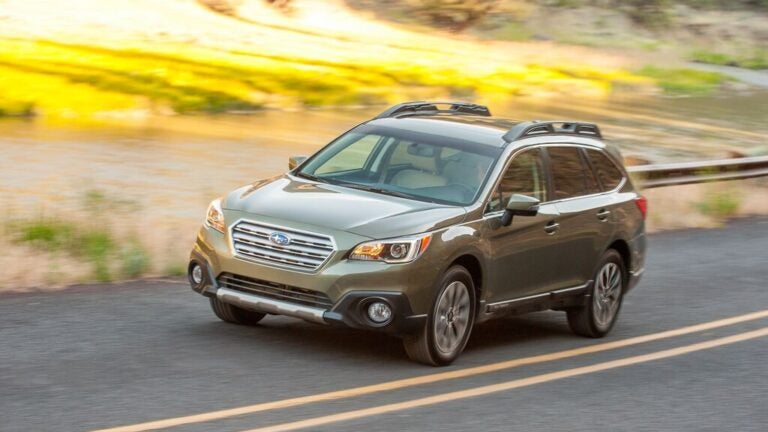
The Outback qualifies as a wagon, but it’s got a lot of crossover DNA from its close relatives, the Forester and Crosstrek.
From a purely practical point of view, the Outback is a can’t-miss choice. It’s all-wheel-drive and thus satisfies a lot of New Englanders, my boss included, for driving in rain, snow, sand, and dirt roads.
Subaru has lots of standard features, which also makes it a better “value proposition’’ as our town team’s football coach is won’t to say in making his roster decisions.
However, when it comes to the excitement factor, there’s not a lot in the Outback. Driving enthusiasts will miss the option for a manual transmission as all Outback versions now come with a continuously variable transmission.
That has helped cure Subaru’s previous failings in the fuel economy department. It now should average in the high 20s and get between 32-34 mpg on the highway.
Knowing that my questioner lives in the Bekrshire hills, the 6-cylinder would be a more refined choice over the base 4-cylinder with smoother “pulls’’ on steep uphill stretches. However, the mileage drops into the mid-20s overall.

The Subaru Outback has a comfy interiors and comes with AWD.
Ground clearance is a tad under 9 inches, meaning the car should be able to plow its way through most winter storms.
In addition, there’s a lot of space inside and Subaru has done a nice job upgrading the cabin. The driving position is elevated, adding to the car’s excellent outward visibility.
The optional Eyesight advanced safety array is an option on higher trim levels.
On the road, it has a refined ride leaning towards comfort, thanks to a relatively long wheelbase that comes from sharing a platform with the midsized Subaru Legacy and having long travel distances in the suspension.
The Outback appeals to a slightly more upscale buyer than its Forester and Crosstrek siblings.
Frankly, my boss had made a good choice in her previous purchases, and the new Outback is even better.
If it comes down to a choice between two vehicles, my advice is simple: Go to bed thinking that both are parked in your driveway. However, when you wake up in the morning, one will be gone. Which will you regret not keeping?
Volkswagen Sportwagen
Sport is in the name and in the driving experience.
The first big difference between the Outback and Sportwagen is that the latter doesn’t have an AWD version, though that could change in coming years.
However, the Sportwagen, redesigned for 2015 and moved into the Golf family, performs notably better in the drivability department.
The Golf platform leads to a more compact vehicle than the Outback.

Could the Volkswagen Golf Sportwagen can take over some of the Subaru Outback’s New England territory?.
However fuel economy is better in the Sportwagen with either the 1.8-liter turbo or the turbo diesel (TDI). The 1.8T averages 29 mpg combined with a manual transmission or the six-speed automatic. The TDI will easily reach 43-45 mpg on the highway and is rated at 35 mpg in combined driving.
Our experience has been that the diesel is a superb driving experience with the manual transmission, where the driver experiences the 236 lb.-ft. of torque instantly. VW’s DSG six-speed automatic is the other OK-but-less-fun option.
On the road, the Golf’s performance can be termed crisp and agile.
For those seeking a prestigious marque, there’s more than a hint of Audi DNA in this Volkswagen.

The Volkswagen Sportwagen also has a pleasant interiors and has a diesel engine option that offers great mileage.
That’s obvious in a near-premium interior with its intuitive controls.
The Sportwagen is about 500 pounds lighter than the Outback, sits lower to the ground, and is more of a driver’s car.
An optional driver assistance package (on the upper SE and SEL trim levels) adds front and rear parking sensors and a forward collision warning system, autonomous emergency braking, and lane departure warning.
In August, the Golf Sportwagen earned a 2015 Top Safety Pick+ from the Insurance Institute for Highway Safety (IIHS).
Information delivered; my boss drove both. Still uncertain.
Now she’s thinking the new Audi Q3 or maybe high-end used: like a Lexus CT 200h (a Prius drivetrain in a Lexus hatchback), maybe even a BMW. She hears there’s a new Prius coming in 2016.
True, I tell her, but I haven’t even see a photo of it yet.
“So what else is out there?’’ she asks.
I like the new Ford Escape, the Acura RDX, and Mazda CX-5. I love the new Volvo XC90, but that’s way too big for her. However, a good used wagon might be the XC70.
You might think that because I’m doing the writing, I’m going to get the last word. Hardly. Tune in next week to find out what she bought and why.





To comment, please create a screen name in your profile
To comment, please verify your email address
Conversation
This discussion has ended. Please join elsewhere on Boston.com