
Ford’s 2016 Escape: A strong seller for a reason
This comes from the “just thinking’’ department.
Once upon a time NASCAR races featured actual “stock’’ cars.
In those days, the industry maxim was “Win on Sunday, sell on Monday.’’ If memory serves correctly, it was a world dominated by Plymouth and Ford.
Today, NASCAR runs what it calls the Car of Tomorrow design. Although the cars wear Ford, Chevrolet, and Toyota badges, they all are the exact same body configuration, having to conform with NASCAR templates for each portion of the body.
They also run with dinosaur V-8 power at a time when the automotive industry pretty much has phased out V-8s in passenger cars, replacing them with the V-6 and, increasingly, turbocharged and direct-injected four-cylinder engines.
In addition, the mid-sized sedans ostensibly being raced now are being outsold by crossovers, the description increasingly being used for car-based utility vehicles.
So, if NASCAR were to go back to its roots, we’d be seeing racing among the current crop of front-wheel-drive, 4-cylinder crossovers, many of which aren’t available with manual transmissions.
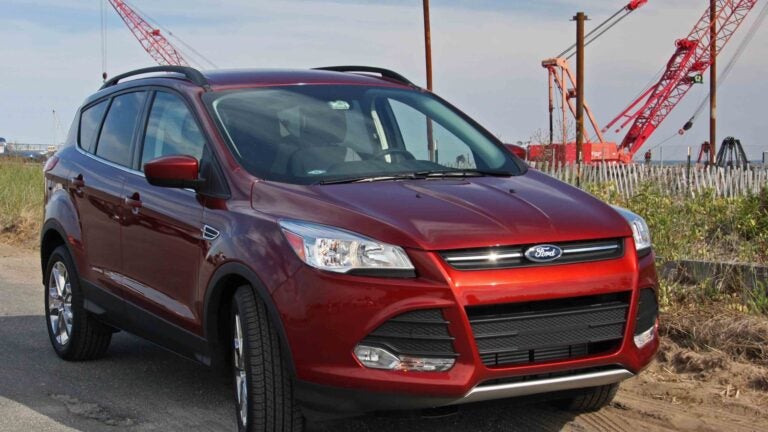
All of this brings us to today’s test car, a 2016 Ford Escape SE. It might be the leader of that compact pack should they go racing.
In a field of small crossovers, it’s a relative rocket. Our test vehicle was equipped with the 2.0-liter Ford EcoBoost engine. EcoBoost means turbocharged, and this tiny engine produces 240 horsepower and 270 lb.-ft. of torque. Escape’s other engine choices are the standard 2.5-liter (168 horsepower) and a 1.6-liter EcoBoost (178 HP).
Story continues after gallery
[bdc-gallery id=”1424970″]
While that’s not in a true performance-car category, this engine can get the 3,592-pound Escape from 0-to-60 miles per hour in about 7 seconds and also averages about 25 miles per gallon (25.4 in our testing). Our version of the Escape is EPA-rated at 22 mpg city, 30 highway, and 25 mpg overall.
This test car was the mid-trim SE with front-wheel-drive in a lineup that also includes the base S and top-of-the-line Titanium. A six-speed automatic transmission and front-wheel-drive are standard on all trims with all-wheel-drive available on the SE and Titanium versions.
Our Escape had a base price of $26,545 (including destination). The 2.0-liter EcoBoost engine is a $1,195 option. Other options on our test vehicle included navigation ($795), a power liftgate ($1,595), 18-inch chrome/alloy wheels ($595), and a SE Convenience package ($1,395). That brings the bottom line to $31,880.
The Escape is a bit pricey, but it’s also roomy, well-built, comfortable, and it has an array of both technology and safety features.
While the rearview camera is standard, that might not be of much use on the racetrack. But the integrated blind-spot mirrors (they’re a mirror within the outside mirrors) are an inexpensive blind-spot system in any situation.
Of much use on both the highway and track are Escape’s standard traction and stability control systems, antilock brakes, and curve control/torque vectoring systems.
Interior materials are high-quality, especially for the compact segment, and legroom is fine for 6-footers with a reclining feature for the rear seats.
On the road, the Escape handles a lot like the Focus—not surprising because it’s built on the Focus platform. The steering is responsive, and the suspension is a nice combination of capable-but-refined.
Another feature that wouldn’t appeal to race drivers is the MyFord Key that lets the car owner/administrator set speed and audio volume limits for other drivers, such as teens.
Ford sold more than 300,000 Escapes in the US market in 2014, and that looks to be a continuing sales chart as it was the No. 10 car in overall North American sales in July, trailing only the Honda CR-V in the compact crossover sales.
That’s a solid position in a market segment where Escape competes with the likes of the CR-V, GMC Terrain, Hyundai Tucson, Jeep Cherokee and Wrangler, Mazda CX-5, Nissan Rogue, Subaru Forester, and Toyota RAV4 among many others.
The Escape was plagued by recalls when this generation launched in 2013 but you have to think Ford now has the 2016 “sorted out.’’
In switching back and forth between the new subcompact-based crossovers and these compact vehicles, it’s obvious that the larger vehicles overall are superior in performance, quality of materials, noise control, power trains, and driving refinement.
That’s not to say the Escape is without its foibles.
Hit the wipers and the large blades each head to the outside of the windshield, then return to meet in the middle instead of the US norm of having them sweep in tandem.
Inside storage space is there, but in odd configurations. The center console storage is small but deep, and other than the center cupholders, there’s no obvious place to stash your smartphone. There are a couple of “What are these?’’ long, thin storage grooves on the outside of the front seats on the floor next to the door, plus built-in spaces in the doors. Perhaps if Ford exchanged the old-school emergency brake handle for an electronic brake, it would have freed up that needed storage spot.
Also, the steering-wheel controls seem to be flopped from other makes, which takes some getting used to.
However, Ford has made a big step forward with its Sync3 infotainment system. It’s intuitive to navigate and has a responsive touchscreen surface; however, until you get accustomed to using the steering-wheel controls, it still takes several steps to complete what one button once accomplished.
Another “just thinking’’ moment: I liked it.
2016 Ford Escape SE FWD Crossover
THE BASICS
Price, base/as tested (with destination): $26,545 / $31,880. Fuel economy, EPA estimated: 22 city, 30 highway, 25 combined. Fuel economy, Globe observed: 25.4. Drivetrain: 2.0-liter EcoBoost 4-cylinder engine, 6-speed automatic transmission, front-wheel-drive. Body: 5-passenger compact crossover.
THE SPECIFICS
Horsepower: 240. Torque: 270 lb.-ft. Overall length: 178.1 in. Wheelbase: 105.9 in. Height: 66.3 in. Width: 72.4 in. (81.8 in. w/mirrors) Curb weight: 3,592.
THE GOOD
Drivetrain, interior quality, refined ride, improved touchscreen.
THE BAD
Some controls confusing, need one more console storage pad.
THE BOTTOM LINE
A good choice in a competitive segment.
ALSO CONSIDER
GMC Terrain, Honda CR-V, Hyundai Tucson, Jeep Cherokee, Mazda CX-5, Nissan Rogue, Subaru Forester, Toyota RAV4.





To comment, please create a screen name in your profile
To comment, please verify your email address
Conversation
This discussion has ended. Please join elsewhere on Boston.com