
GMC’s Canyon 4×4: A Midsize Pickup That Measures Up
It was early on a spring morning when I walked down the driveway to pick up the morning Globe. [Side note: For the past decade, the paper’s delivery folks had driven up our shared driveway to leave two copies, but apparently the tough conditions this winter have resulted in drive-by drop-offs by those much-appreciated folks who toil from 3:30-5 a.m.]
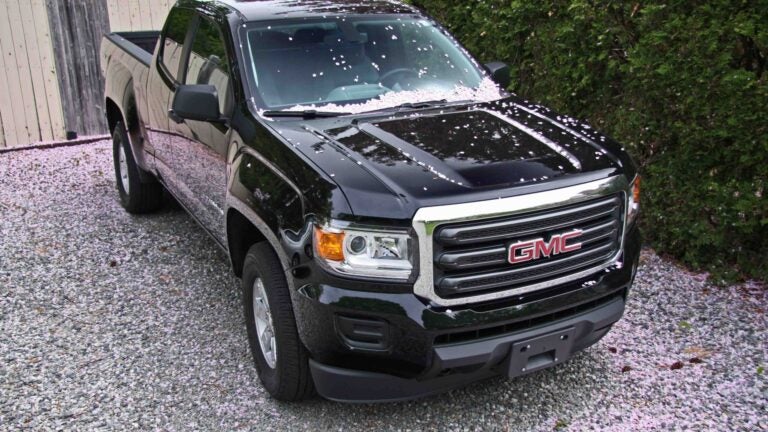
However, had I not made the walk, I might have missed the striking sight of today’s test truck. A base version of the 2015 GMC Canyon 4×4 Extended Cab pickup.
It was covered in what appeared to be pink confetti, as if it had been feted as the guest of honor in an overnight tickertape parade.
On closer look, it turns out that an overnight northeast sea breeze had taken the blossoms off a neighbor’s tree and sprinkled them liberally over the Canyon.
The sight was unusual enough to motivate me to climb two flights of stairs and return to take a photo once the sun broke through the early haze. That was a bit of an upset because I’ve long considered mornings for holding coffee cups, not cameras. Plus, I’d already taken some shots of the Canyon hanging out with the “Big Guys’’ at a local trucking company.
GM calls the Canyon and its Chevrolet sibling, the Colorado, midsize trucks. Certainly, they’re a bit shorter than their full-size Sierra and Silverado counterparts—roughly 18 inches shorter overall with a 15-inch shorter wheelbase—but they’re still good-size vehicles.
2015 GMC Canyon 4WD Extended Cab Pickup
[bdc-gallery id=”1423898″]
Our test Canyon had the longer (6-feet-2-inches vs. 5-feet-2-inches) of two available beds behind its extended cab. The longer bed enables a contractor or homeowner to carry standard 4×8-foot sheets of drywall or plywood within the vehicle’s confines with the tailgate down.
The Canyon attracted its share of admirers during our week together, but it also drew laments that GM (Chevy S10) and Ford (Ranger) no longer offer compact pickups. Instead, these new GM offerings compete with the midsize Nissan Frontier and the soon-to-be-redesigned Toyota Tacoma.
When the Canyon first arrived, I took it on a quick shakedown drive. My first impression was that the six-cylinder engine was a bit underpowered.
After getting home, I brought in the Monroney for a closer look at just how the truck was configured. [Side Note 2: the Monroney is the vehicle information sticker that’s named after former Oklahoma representative and Senator Michael Monroney, who sponsored the Automobile Information Disclosure Act of 1958.]
Monroney’s legacy gave me a first eye-opener on this truck: It wasn’t a V-6; instead, it was powered by a 2.5-liter 4-cylinder engine making 200 horsepower and 191 lb.-ft. of torque. The optional 3.5-liter V-6 makes 305 horsepower.
In normal driving, the 4-cylinder was smooth and fairly responsive; however, when you wanted to make this 4,100-pound vehicle move faster, the 6-speed automatic transmission needed to shift down a gear (or three).
The return is fuel economy rated at 19 miles per gallon in city driving, 25 on the highway, and 21 in combined driving.
The Canyon is offered with the two engines and a 6-speed automatic. A 6-speed manual transmission is offered only with the 2.5-liter engine in two-wheel-drive with both base and extended cab versions.
The Canyon also has a crew cab configuration. All three cab styles can be had in either 2WD or 4WD.
GMC’s 4WD setup for the Canyon has an “auto’’ setting that transforms the system to an AWD by automatically transferring power to the front wheels when needed.
Our test truck started at $28,860 (including a $925 destination charge). Options were a worthwhile convenience package ($590) that added remote keyless entry, cruise control, rear window defroster, GM’s EZ lift tailgate, and an alarm system; a $475 factory-installed, spray-on bed liner; and a $275 4.2-inch audio screen.
GMC’s big marketing push is that it’s “professional grade’’ and “more refined’’ than its Chevy counterparts.
Thus, it was strange not to have some expected amenities in a $30,000 vehicle. We had manual outside mirrors and no satellite radio or handgrip for the driver for climbing in and out. In shopping for a Canyon, a crew cab with a lot of the optional boxes checked will run north of $40,000, putting it in competition with a full-size truck.
We were pleased to see a rearview camera was standard equipment as were the rear bumper “corner steps’’ introduced a year ago on GM’s full-size pickups. An optional safety package (not on our vehicle) offers the valuable pair of forward collision warning and lane-departure warning for $395 in higher trim levels.
The ride was fairly comfortable and refined with the bed empty. The heaviest load we managed was a pile of mulch and garden soil bags that were plenty heavy for me to lug but barely made the truck even notice.
One place where the GMC showed its refinement was with interior appointments, even in the base model. Moving up to the SLE and SLT packages brings an 8-inch display screen, driver information center display, soft-touch instrument panel with aluminum trim, and available sliding rear window, navigation, and leather appointments.
Meanwhile, the second-row jump seats in the extended cab were suited to toting groceries and items you want to keep out of the weather. It’s kid-size—but that’s something you won’t say about the truck overall.
2015 GMC Canyon 4WD Extended Cab Pickup
THE BASICS
Price, base/as tested (with destination): $28,860/$30,200. Fuel economy, EPA estimated: 19 city/25 highway. Fuel economy, Globe observed: 21.2 mpg. Drivetrain: 2.5-liter 4-cylinder, 6-speed automatic, 4-wheel-drive. Body: Extended cab pickup truck.
THE SPECIFICS
Horsepower: 200. Torque: 191 lb.-ft. Overall length: 212.4 in. Wheelbase: 128.3 in. Height: 70.3 in. Width: 74.3 in. Curb weight: 4,100 lbs.
THE GOOD
Classy interior, competent suspension and ride, fuel economy, available contemporary technology, more comfortable maneuvering than full-size pickups in tight quarters.
THE BAD
Price nears that of full-size brethren, extended cab not really for extra passengers.
THE BOTTOM LINE
A slightly smaller version of the full-size Sierra.
ALSO CONSIDER
Nissan Frontier, Toyota Tacoma.




To comment, please create a screen name in your profile
To comment, please verify your email address
Conversation
This discussion has ended. Please join elsewhere on Boston.com