
‘Fix My Brakes,’ Says the Vehicle To Its Operators
The adaptive cruise control and forward collision warning systems on many new cars will apply the brakes under some emergency conditions; soon, your car may tell you when it’s time to replace those brakes.
The folks at Ford may not be reinventing the wheel, but they are refining the way we stop our wheels, developing an individualized notification system that will tell us it’s time to replace the brakes.
Now, knowing that your car needs a brake job generally hasn’t required you to be a rocket scientist.
For instance, return to your toddler days.
Many youngsters’ first car was a Cozy Cruiser. You remember those foot-powered plastic cars with a yellow top. Their “brakes’’ needed replacing when a tyke’s sneakers wore out.
The first time I had to replace brakes in a real car was on a well-used 1959 Ford Galaxie. A loud scraping and grinding announced that the brakes were shot and at least two of the brake drums needed to be turned (re-surfaced).
For me, it was a great leap forward when manufacturers converted to disc brakes and added a mechanical wear sensor that would cause a scraping noise that announced it was time to replace brake pads.
Electrical sensors followed in some vehicles.
Now, our friends at Ford are taking it a step further, trying to use an array of already existing onboard sensors to send owners a text, email, or letter, saying that their braking style indicates that it’s time to replace the brake pads.
“After changing the oil, brakes are one of the most wearable components on the vehicle,’’ says Oleg Gusikhin, a Ford technical leader. “This system is a way to prevent a customer from getting an additional service bill they didn’t expect during a routine oil change.’’
Traditionally, most repair shops and car owners have gauged brake life both by mileage and visual inspection.
“Mileage guidelines are for average brake wear,’’ says Gusikhin. “But in reality, it’s not how many miles you drive, but how often you use your brakes. Some vehicles do lots of highway driving and cover lots of miles with little brake wear. On the other hand, some city vehicles cover a small number of miles but show high brake wear.’’
The old-fashioned wear indicator is one way to tell when “it’s time to change pads,’’ but the new world demands computerization.
In engineer-speak, it’s a matter of physics and the amount of kinetic energy that’s created by your braking style that causes brake wear.
Gusikhin and his team have been getting data from 25 on-board sensors. The early data came from Ford’s in-house fleets and volunteer outside fleets, measuring how many “Joules’’ of energy are released each time the brake pedal is pushed and then released.
One Gusikhin mentioned “Joules,’’ my brain began imploding, remembering days in high school physics and dealing with what a great teacher named Mr. Gilchrist called “newton meters.’’ One lesson I took from that class was that engineering was not in my future.
Using the technology already in today’s connected cars, all of which will be part of the coming autonomous (self-driving) vehicles, the Ford team started compiling data by tracking Ford management’s driving.
There was a joke in there about employees monitoring their bosses’ driving, but Gusikhin wasn’t biting. Nor would he guesstimate how many “Joules’’ of life were in a new set of brake pads.
“Driving styles, temperature, and humidity are all variables [in brake wear],’’ he says.
“The Joules are a calculation of the mass of the car and the energy created,’’ says Gusikhin, “but the data prove that if you use a light pedal you get light wear.’’
When the study expanded to other fleets, where vehicles are in use 12 hours (or more) a day, the data became more valuable.
“Notifications of brake wear will allow fleet managers to plan servicing two months out to avoid interrupting work schedules and job routing,’’ says Gusikhin.
Getting that the news of an impending brake job to individual, as opposed to fleet, owners is an entirely different matter.
Gusikhin notes that “if we’re not careful, it could be pretty annoying if we start sending owners this information by text or email. We’re not committed to any system, yet. In the long run, we envision the car being able to tell you this.’’
For those who confuse breaks and brakes, it could be either “Braking News’’ or “Give me a break!’’
If this sounds a bit like Big Brother watching, guess what: The data already exist.
“In the case of braking data, we’ve only been sending information about the energy used by your brakes to the cloud. The rest of the data in the car stay with your vehicle.’’
For now, Ford is building a framework to “apply’’ to braking, but it surely could expand to other areas. “We’ll have experimental data in a reasonable time,’’ says Gusikhin. “Other components, such as a transmission, will take longer, but it will involve the same framework.’’
Etc.
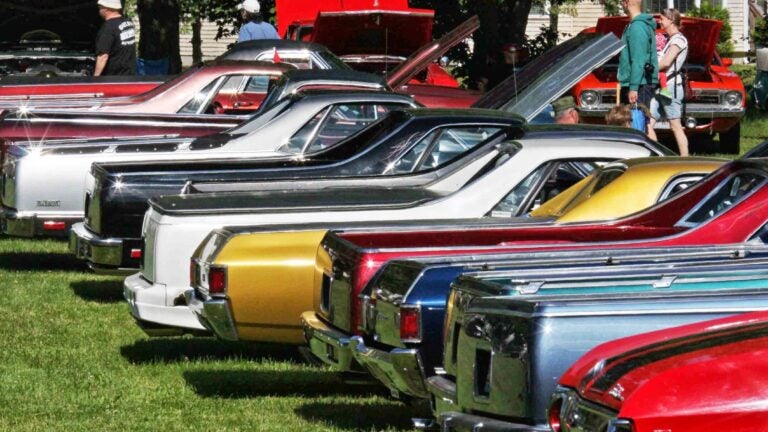
Memorial Day weekend is relatively quiet on the car show front, but things pick up next weekend. North of Boston, Skip’s Cruise Night in Merrimac (Rte. 110) has its opening day next May 30. …On May 31, New England Dragway plans a big swap meet, starting at 8 a.m., aiming to provide a home for the many folks who annually attended the long-running Amherst, NH, automotive flea market. …Also that Sunday, Larz Anderson Auto Museum has its second event of the season when the Antique Auto Club of America hosts antique cars, hot rods, trucks, and motorcycles from 10 a.m.-2 p.m. … “You don’t know what I got,’’ was a refrain in the Beach Boys’ “Little Deuce Coupe’’ song. It also applies to the contents of many local automotive collections. Paul Mennett, host of NESN’s “Cruisin’ New England,’’ has his annual “Magical Mystery Tour’’ of some of those collections on June 6. Details at his cruisinnewengland.com website.



To comment, please create a screen name in your profile
To comment, please verify your email address
Conversation
This discussion has ended. Please join elsewhere on Boston.com