
A Car That Prevents Crashes by Watching Your Body Language?
Researchers at Cornell and Stanford universities are developing the technology.
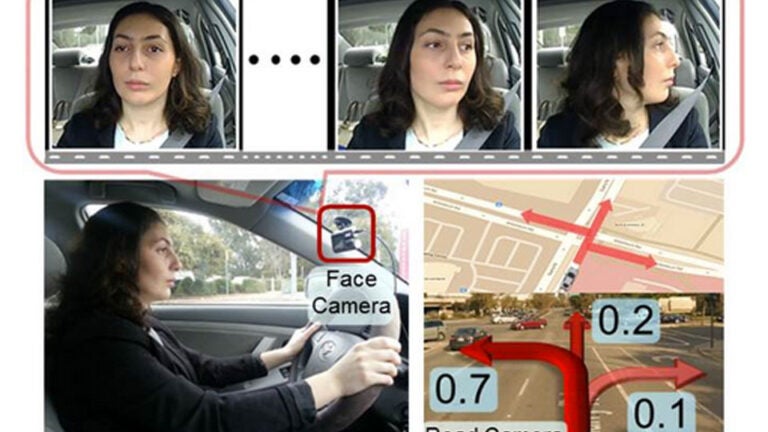
If you’ve ever changed lanes when you shouldn’t have and almost caused an accident, you might be interested in some of the new car safety technology being developed at Stanford and Cornell universities.
Most new car safety technology focuses on what’s going on outside the vehicle – Subarus and Volvos, for example, have cameras mounted on their windshields that “work like your eyes’’ to measure the speed and distance of nearby vehicles. But not many crash avoidance systems analyze drivers inside the car, according to the creators of “Brain4Cars,’’ an advanced driver assistance system (ADAS) that uses cameras and sensors to do just that.
Ashutosh Saxena, assistant computer science professor at Cornell University, and his Ph.D student Ashesh Jain had the idea in summer 2014 and have been pursuing it ever since, with the help of a team of researchers from Cornell and Stanford.
“Just having outdoor sensing is not enough,’’ Saxena told Boston.com. “We provide that additional data.’’
Using mounted cameras and tactile sensors on the dashboard, the safety system collects data on drivers and their surroundings, Saxena said. Brain4Cars then uses an algorithm to predict drivers’ maneuvers and detect when they seem drowsy or distracted, alerting them before potential accidents occur.
How the system alerts drivers to dangerous situations will depend on the car manufacturers, Jain said, but he expects it could involve a vibration of the seat or steering wheel, or a beeping sound.
[fragment number=0]
The research team collected thousands of miles of driving data to develop the technology, which they say could help curb some of the 83,000 crashes the National Highway Traffic Administration estimates are caused by drowsy U.S. drivers each year. Though the project is still in its early stages, Jain said some car manufacturers have already expressed interest.
“Now, we are improving the sensors in the car and collecting more data,’’ Jain said, adding that within six months to a year, the researchers hope to pursue formal talks with automakers.




To comment, please create a screen name in your profile
To comment, please verify your email address
Conversation
This discussion has ended. Please join elsewhere on Boston.com