
Tampa Museum Celebrates Early Engineering Feats
Car critic Bill Griffith gets a glimpse at rare cars on display at the Tampa Bay Auto Museum.
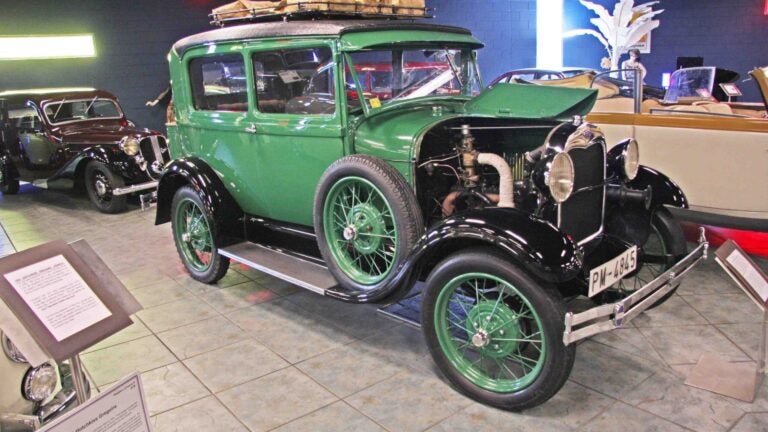
These days there are so many cruise nights and car shows that it’s easy to cop a “Been there, seen that’’ attitude to the suggestion of a visit to a local show or, gulp, a museum.
So many of us (and our dads and uncles) have saved the cars we grew up with that we’re surprised when we run across a unique American model.
One local place to see those outliers is at the marque-specific lawn events at the Larz Anderson Auto Museum in Brookline. First show there is Cadillac Day on Sunday, May 17.
Another is the Tampa Bay Auto Museum, a must-see day trip to put on your Snowbird itinerary for next winter. Truly, it beats exhibition baseball games.
The museum houses the collection of Alain Cerf, the owner and founder of Polypack, a manufacturer of automated packaging for consumer products.
Cerf was doing so much business in the United States that he moved his headquarters from outside Paris to America more than 30 years ago.
When he arrived, he brought a few cars that were important to him.
His first car was just that—his first car. It was a 1937 Peugeot Darl’Mat, one of only 103 built. At the time he bought it at auction in the 1950s, it was an abandoned pre-World War II relic.
Even then, however, it reflected Cerf’s passion for older, hand-built European cars from the 1920s and 1930s. The Peugeots both looked great and the racing roadsters had performed successfully at LeMans.
As Cerf added to his collection, he chose vehicles with the same respect for the technology and craftsmanship he had for the Peugeot. In other words, he was building a collection of vehicles that represented significant, unusual, or breakthrough engineering achievements.
Besides the Peugeot, Cerf originally brought three other cars to America: a 1951 rear-wheel-drive Salmson S4E; a 1952 (or ’53) Delahaye 235 with a Henri Chapron body (one of only 83 built); and a one-of-a-kind 1953 Talbot Lago T15 QL6.
Today, the collection has grown to nearly 70 vehicles, each of which is registered with a current daily-use Florida license plate.
“No antique or special interest plates,’’ says John Perodeau of the museum staff. “Mr. Cerf doesn’t want to have any restrictions on how or where he can drive his cars. They all may go to a car show or concours, but they also can be used as his daily drivers.’’
To prove that every auto story has a Massachusetts connection, Perodeau is formerly of Wayland, Mass., and tells visitors, “Please don’t touch the cars but take all the pictures you want.’’
Lest anyone be concerned about Mr. Cerf’s legacy, his twin sons, Emmanuel and Olivier, plus their wives, have major roles in both Polypack and the museum. The family’s goal is for the museum, housed in an artistically designed building, to flourish.
A special attraction at the museum is the only operating replica of the 1770 French Fardier de Cugnot, the world’s first self-propelled vehicle, a massive wooden carriage with steam power that’s capable of three miles per hour and was commissioned to move artillery pieces for the French army.
The museum’s mission is “to foster interest in and appreciation for technology, innovation, aesthetics, and the historical and cultural impact of the automobile to museum visitors of all ages, through the exhibition of its collection, and through docent tours, lectures, special events, and educational programs.’’
We wandered in on a Saturday morning in late March, a day when the automotive interest in the Tampa Bay area was concentrated on the nearby St. Petersburg Grand Prix.
Gary LaSasso was happy to take a break from tending to the collection and provide a guided tour for a dozen or so international visitors who were scattered throughout the three display halls. He told stories of the men (and women) behind the collection, names such as Gottlieb Daimler, Benz (Bertha and Karl), Wilhelm Maybach, August Horch, Benjamin Hotchkiss, and Jean-Albert Gregoire, and opened hoods to display all manner of engines.
Display cars included French vehicles (Tracta, Citroen, Panhard, Voisin); Czechoslovakian cars (Tatra, Aero); German marques (DKW and Mercedes); English (Alvis, Allard, BSA); Irish (DeLorean); and American (Cord, Ford, Willys Knight, and Ruxton).
Each has a story and technological bent.
Why the Fords? One was a 1965 Mustang prototype, the only production car to be equipped with Ferguson all-wheel-drive and an ABS system.
The other, a 1929 Model A, hardly would be unique. After all, Ford produced almost 5 million Model A’s between 1927 and 1931.
However, with the scarcity of gasoline in Europe in the late ’30s and early ’40s, folks got creative. This Model A was one of the era’s hybrids, set up to run on charcoal.
The driver would ignite a fire in a tank at the rear of the car, sending the hydrocarbon gas through a larger tank, which was then pumped forward for combustion in the engine.
In this case, the Model A uses a system manufactured in Spain in 1939. When found, the Ford was running on the island of Palma de Mallorca, near Barcelona. It still runs fine on charcoal from the local hardware store.
There’s no word on whether the Cerfs have plans to add a grill on top of the burner to have a barbecue once the Ford gets them to their destination.
But you could do a lot worse than make their museum your destination.



To comment, please create a screen name in your profile
To comment, please verify your email address
Conversation
This discussion has ended. Please join elsewhere on Boston.com