
CO2 from Drivers Up in Most Cities, Not Boston
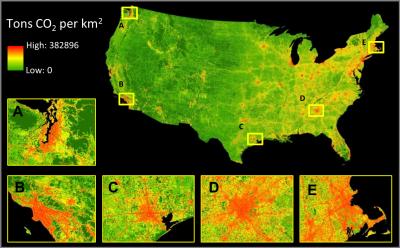
Conventional wisdom says that as cities grow denser and improve their public transit, they reduce the need for driving and therefore lower carbon dioxide emissions per capita. But new research paints a more complicated picture and shows that in some cases carbon emissions from vehicles in cities have been increasing.
Researchers from Boston University created DARTE, or the Database of Road Transportation Emissions, which maps out how much CO2 is emitted in a given area. Created from the Federal Highway Administration’s Highway Performance Monitoring System, DARTE features 33 years of data and can provide information on a kilometer-by-kilometer scale.
BU researchers’ main findings, which were published Monday in the science journal PNAS, included:
– Urban areas were responsible for 80 percent of the increase in CO2 emissions from 1980 to 2012.
– Population and density may not be predictors for CO2 production.
– The most visible declines in emissions per capita were in cities that were already densely populated, like Boston and New York.
Conor Gately, a graduate student at Boston University and the lead author on the PNAS paper, said that Boston stood out among the other big cities in the United States.
“Emissions go down when you get denser across the board,’’ Gately told Boston.com. “But it goes faster in a dense city. Boston has shown over the last three decades one of the largest declines from cars of all the major cities.’’
He said it is partially due to the fact Boston’s downtown has been getting denser with more infill development, therefore giving more people access to jobs and amenities without needing cars.
Gately said that public transit options to the suburbs, like Boston’s commuter rail, also help emissions to decline.
“Suburban landscapes can only support so many cars before they are so clogged with traffic,’’ he said. “That is part of why suburbs around New York and Boston can be denser because you can have people that don’t need to take their car into the city every day.’’
As CityLab points out, some of the data may be obvious – as more people move into cities there are more cars and emissions overall in those areas – DARTE is still important. CityLab wrote:
“Still, DARTE has tremendous value because it reveals how spatiality is correlating with per capita auto emissions at the metro level. In other words, it shows us many suburban commuters are pumping air pollution into cities.’’
This report comes a week after Governor Charlie Baker announced that an additional $2 million would be allocated to the Massachusetts Offers Rebates for Electric Vehicles (MOR-EV) program. The program gives rebates of up to $2,500 to residents in the Bay State who buy or lease clean electric vehicles.




To comment, please create a screen name in your profile
To comment, please verify your email address
Conversation
This discussion has ended. Please join elsewhere on Boston.com