
Will MassDOT’s Permanent Signs Actually Help Traffic Congestion?
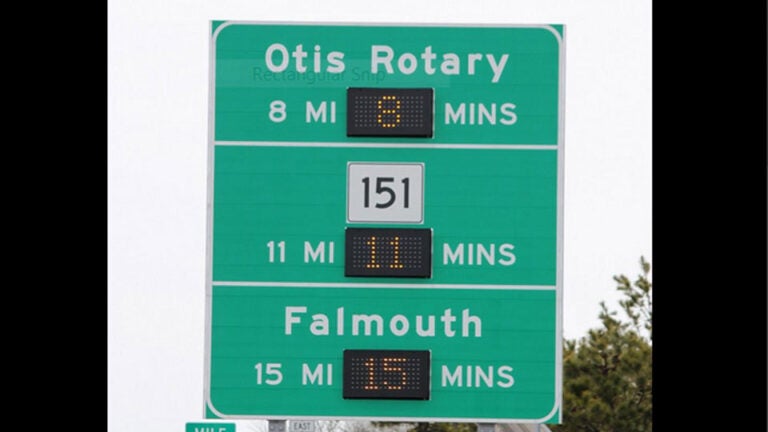
In an effort to give drivers real-time traffic information, the Massachusetts Department of Transportation (MassDOT) will finish installing permanent signs forecasting traffic congestion on state highways next year.
“In 2016, real-time traffic data will be available along over 600 miles of Massachusetts roadway,’’ said MassDOT spokesperson Amanda Richard. “The real time traffic boards will display the time and distance to logical destinations.’’
The signs will show up to three destinations on one board, informing drivers of the distance and number of minutes it will take to travel from the message sign to destinations between 5 and 10 miles down the highway. The signs will anonymously track Bluetooth technology carried by motorists and their vehicles, measuring average vehicle speeds and travel times. The signs will comply with new federal legislation requiring states provide real time traffic information to the public, Richard said.
The most recent implementation of the nine permanent signs and 11 roadside detectors/standalone readers along Route 6 in Cape Cod marks the third phase of the real-time traffic management system MassDOT has been working on since 2012, when 22 variable message signs were first installed along Interstate 93. The second phase was launched in 2013, with 42 signs installed along I-90 and Route 3 south to Cape Cod.
The entire GO Time Intelligent Transportation System, when completed, will include 132 new travel time signs and 121 Bluetooth readers, according to MassDOT. Richard said MassDOT plans to make an announcement regarding the locations for the last batch of signs.
Currently, road sensors update travel times every minute on portable variable message signs alongside the road at points on Interstate 93, Interstate 90 and Route 3 on the South Shore. Drivers can also get travel times on the MassDOT website, on an open data feed, and on a mobile app.
State officials said they hope the signs encourage drivers to avoid contributing to traffic jams.
“Our ability to build our way out of congestion is limited,’’ State Transportation Secretary Stephanie Pollock said at a recent budgetary meeting, saying she believes the permanent signs will be a “critical tool for congestion management,’’ according to a State House press release.
But staying out of traffic jams could prove hard for Bostonians.
News of the signs’ installation comes a few weeks after the release of an economic brief by the Office of the New York City Comptroller that cited Boston commuters as having the 7th longest weekly commute in the nation, behind New York City, Chicago, Philadelphia, San Francisco, Baltimore, and Washington D.C.
Evaluating the usual commuting time for America’s 30 largest cities, the Comptroller’s Office found that Bostonians spend on average four hours and 43 minutes commuting per week.
While it’s nice to know that New Yorkers are commuting just a little longer than we are, traffic experts say the congestion level in Boston is only worsening. On February 3 this past winter, things got so bad during evening rush hour that state police temporarily closed Exit 24A toward Government Center off Interstate 93. The horrific backups were largely due to the historic levels of snow that fell in the Hub, and public transportation didn’t fare much better with its wave of delayed and disabled trains.
[fragment number=0]
[fragment number=1]
But are things looking up?
On Monday, March 30, MBTA commuter rail trains operated at full service for the first time in over a month, and a new report by the American Public Transportation Authority showed that MBTA ridership hit a record of 400.8 million trips last year, showing that longer commutes might not hinder travelers from using public transit.
Only time will tell if the signs reduce traffic congestion – and if the MBTA continues to improve service — but in the mean time, Bostonians will probably just continue to complain about their commute.
[fragment number=2]
[fragment number=3]
[fragment number=4]



To comment, please create a screen name in your profile
To comment, please verify your email address
Conversation
This discussion has ended. Please join elsewhere on Boston.com