
TomTom Finds Boston Traffic Not That Bad, but Getting Worse
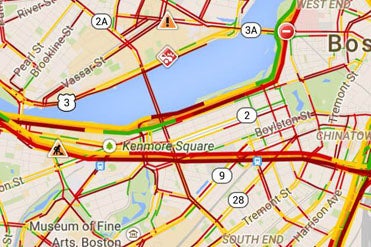
Some Bostonians love to complain about traffic, especially during this winter.
But actually, drivers in a lot of other cities have it worse off than we do in the Hub, according to an annual traffic study from GPS manufacturer, TomTom.
The study, which looked at average traffic congestion in 200 different cities worldwide, ranked Boston 94th out of the 146 cities included in the list and 16th out of the 53 cities ranked in the United States.
[fragment number=0]
TomTom used GPS measurements from TomTom’s historical traffic database to rank cities on congestion level during the whole day and during peak periods. Congestion was defined as as the percent increase in overall travel times for drivers in comparison to when there is no traffic at all.
Los Angeles was the only American city that made it in the top 10 most congested cities. The others were:
1) Istanbul
2) Mexico City
3) Rio de Janeiro
4) Moscow
5) Salvador, Brazil
6) Recife, Brazil
7) Saint Petersburg, Russia
8) Bucharest, Romania
9) Warsaw, Poland
10) Los Angeles
What’s traffic like in Boston?
[fragment number=1]
Boston had a 24-percent congestion rating. On an average day, a commute that would have taken 30 minutes without traffic took 49 minutes during rush hour. Those delays added up to the average driver with a 30 minute commute spending an extra 73 hours per year sitting in traffic.
The congestion level in Boston has only been increasing according to Nick Cohn, a senior traffic expert at TomTom. He said last year it was below 20 percent. But all that traffic might actually be a positive sign for Boston’s economy, according to Cohn.
“Generally an overall pattern is that we see a real correlation between where the economy has grown and where has congestion levels gone up,’’ Cohn told Boston.com. “So Boston was one of the cities that grew the most in terms of congestion in last few years.’’
Unfortunately, it’s not so good for the mental health of Boston drivers.
Bryan Porter, a professor of psychology at Old Dominion University who focuses on traffic behavior, said congested roadways can be more than just an annoyance.
“Behaviorally speaking, this is where some drivers will act out aggressively and out of frustration,’’ Porter told Boston.com. “That’s when you have a recipe for drivers to tailgate and cut people off.’’
A 2011 Swedish study linked commuting to “sleep disturbance, everyday stress, exhaustion, low self-rated health and sickness absence.’’
There are possible solutions.
[fragment number=2]
“We see some of the usual suspects in terms of where congestion was worst,’’ Cohn said. “Southeast expressway, I-95 North, Columbia Road North in Dorchester, and the Longfellow Bridge had really high individual road congestion levels. It’s not just expressways.’’
But he also said a lot of roads in Boston are not congested at all, a possible solution to Boston’s traffic woes.
Cohn said he understands that Boston does not have the easiest street patterns to navigate, but said there are opportunities to save time by taking a different road.
“Those are routes that are not as fast in theory,’’ Cohn said. “But people tend to stick to their routes and not deviate from them.
Other American cities, like Seattle and Honolulu, which were both found to have worse congestion than Boston, don’t have as many travel options in and out of the city, according to Cohn.
“We don’t want people driving through slow neighborhoods and streets,’’ Cohn said. “But if everyone was rerouting collectively we could shave some of that lost travel time off.’’
[fragment number=3]




To comment, please create a screen name in your profile
To comment, please verify your email address
Conversation
This discussion has ended. Please join elsewhere on Boston.com