
Harvard Design Panel Discusses Future of Our ‘Emotional Connection’ to Cars
Ford’s vice president of design told Harvard students he doesn’t want car design to become “sterilized.’’
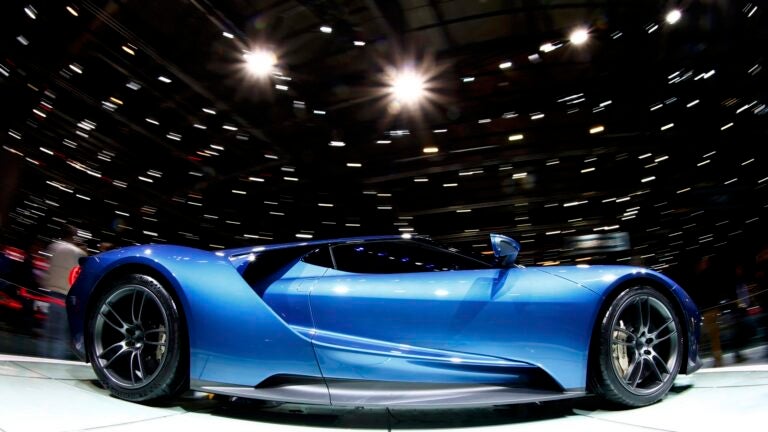
On Monday, Ford Motor Company’s vice president of design, Moray Callum, told a group of Harvard students he hopes future car designers will still be emotionally invested in their products, even if self-driving cars fundamentally change how people interact with their vehicles.
Callum spoke before a group of approximately 60 people at the Harvard Graduate School of Design about automotive design and the future relationship between cars and cities.
“Cars are a product that need an emotional connection in order to learn the aspirations of customers,’’ said Callum.
To emphasize the connection between automotive design and consumers, Callum showed the crowd of architecture students a PowerPoint slide with a wide array of automotive icons. He explained to the group that new automotive technology and features usually require new icons, but not all consumers could understand the new icons’ meaning.
If designers are not thinking about consumers’ reactions, then they risk consumers losing their connection to cars. Callum conveyed his point by highlighting one of the more confusing icons that featured a gas pump and three Xs below it. Callum jokingly suggested the icon could mean “adults only gasoline.’’
“Technology is great, but if the customer doesn’t understand it, that’s a great challenge for us,’’ he said.
To address this challenge, Callum said designers must focus on how the consumer will ultimately build a relationship with their vehicle. Keeping an emotional investment between car design and functionality is important in order to prevent cars from becoming too uniform, he said. If design does become too uniform, consumers will lose its emotional connection.
“You can’t sterilize everything and expect people to be happy,’’ he said.

From left to right: Harvard Graduate School of Design associate professor of architecture Mariana Ibanez, Ford Motor Company vice president of design Moray Callum, and Ryan Chin, managing direct of MIT’s Media Lab, discussed automotive design and the future of cars in urban areas at Harvard on Monday.
Following his address, Callum was joined by Mariana Ibanez, an associate professor of architecture at the Harvard Graduate School of Design, and Ryan Chin, managing direct of MIT’s Media Lab, to discuss the future of cars in urban areas. The panel explored a series of topics, including the future of urban mobility, the role of ride-sharing services, safety advancements, and the rise of autonomous vehicles.
Moray even predicted that cars will someday become “uncollidable,’’ pointing to currently available safety features like automatic braking and collision warning systems. If a car someday became “uncollidable’’ traditional safety features like the seat belt and air bag would no longer be necessary and would become obsolete, he said.
Ibanez said she was excited to see how car design and architecture will continue to influence each other.
“[Some of] the same technology that is available for automobiles is also available for architecture,’’ she said. “The other underlying aspect of mobility is how we live, not just how we move.’’
Chin predicted autonomous vehicles will grow in popularity in the future and someday may be able to communicate with other cars and even surrounding infrastructure. For example, a car could communicate to a traffic light when there is no oncoming traffic or pedestrians and indicate to the traffic light that it is safe to turn green.
“There’s no question autonomous cars are coming,’’ said Chin. Chin pointed out that California is allowing autonomous vehicles to be tested in some public areas. Meanwhile, Singapore has authorized autonomous vehicle testing in some parts of the city. But the real test will be seeing how self-driving cars and humans interact together, he said.
“Humans never follow the rules,’’ said Chin. “We smoke and drink in cars…We’ll have to see when it’s safe to mix humans and autonomous vehicles [together].’’
Moray said he hopes future designers will maintain an emotional connection when designing cars in any “brave new world’’ of autonomous vehicles that emerges.
He referenced Telsa’s CEO, Elon Musk, who predicted that self-driving cars could someday make human driving illegal. Moray said he hopes Musk’s prediction will be proven wrong in the future.
“I didn’t get into this business because I love technology,’’ he told the crowd. “I got into it because I love cars.’’
“We need to keep emotion in our work,’’ said Moray. “My fear is the car will someday become just another commodity like a fridge.’’




To comment, please create a screen name in your profile
To comment, please verify your email address
Conversation
This discussion has ended. Please join elsewhere on Boston.com