
Did You Know That Muscle Car Rumble is Coming Through Your Speakers?
As engines have gotten smaller and more fuel efficient, they’ve naturally become quieter.
Larry Chiodi, vice president of auto club Mustangs of Massachusetts says he recently took the 2015 Ford Mustang EcoBoost for a spin.
Chiodi found the performance “adequate’’ for what he described as an entry-level Mustang, but said he was ultimately disappointed with the experience. The 2015 EcoBoost didn’t sound like a classic Mustang.
“In terms of the engine – the roar, after knowing my 5.0-liter – that was absolutely disappointing,’’ said Chiodo, who owns 1987, 1988, and 2012 Mustangs. “No doubt, the engine sound and feeling was a letdown.’’
But Chiodi would have been even more disappointed if he’d heard the real engine, since what he did hear was enhanced. The 2015 EcoBoost’s engine sound is amplified through the car speakers.
“I think it’s deceptive when you’re giving someone an artificial experience,’’ Chiodi said. “If inside your car sounds one way, and you drive up and everyone outside hears something different than what you’re hearing, that’s not right.’’
Enhanced or synthesized engine noises have increasingly been used by automakers working with smaller, more fuel-efficient engines that are far quieter than older models’ engines. Though consumers generally see environmentally friendly engines as a good thing, some drivers may miss the roar of classic high-performance engines.
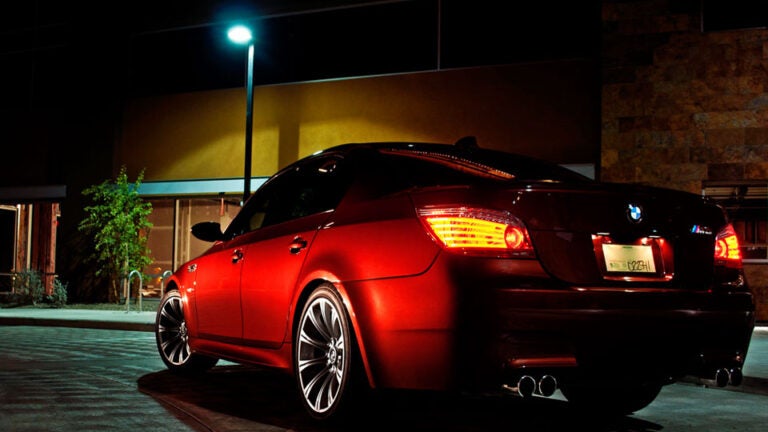
Using new tech called “Active Sound Design,’’ the BMW M5 artificially replicates engine noise in the cabin of the car using the stereo system, while Volkswagen’s Beetle uses a speaker called “Soundaktor’’ to play sound files.
Car experts are divided over the use of enhanced sound systems.
“If the engine noise is coming from the engine, no matter how it’s manipulated, I’m okay with it,’’ said Kelley Blue Book Analyst Karl Brauer. “If any engine noise is coming from the audio system, I’m not okay with it.’’
Unlike Brauer, Edmunds Editor-in-Chief Scott Oldham said he doesn’t have a problem with the new technology, regardless of whether the noise is amplified from the engine, or completely synthesized by the audio system.
“For the extreme hardcore enthusiast, it’s always easier for them to find blasphemy in the things car companies do,’’ Oldham said. “But the vast majority of auto consumers wouldn’t know the difference if nobody told them.’’
That’s what concerns Brauer, however. “I think car companies count on the average person not knowing,’’ Brauer said. “A car company will happily admit to fuel efficiency or safety or horsepower, but you’ll never hear them say, ‘That great engine sound is coming from the audio system.’ For the most part, none are owning up to it.’’
When asked about the BMW M5’s “Active Sound Design’’ system, BMW’s Product & Technology Communications Manager Matthew Russell said that with the advent of widespread use of engine turbocharging to reduce fuel consumption and boost power output, it has become necessary — on occasion — to boost the engine’s sound in the interior of some models through digital means.
“In addition to adding enjoyment during spirited driving, ‘Active Sound Design’ can play an important role for the serious driving enthusiast; it enables the driver to keep better track of the engine speed without needing to visually monitor the tachometer gauge,’’ Russell said. “Engine sounds used in BMW’s ‘Active Sound Design’ system are reproduced faithfully from the actual sound chords produced by the type of engine in each particular model,’’ he added.
“Active Sound Design’’ got its name because it can be scaled up or down depending on the driving situation.
“I don’t think there’s any dishonesty going on there,’’ Oldham said. “Other subsystems in cars have been modified over the years as technology has moved on and delivered real benefits to the consumer, but it hasn’t necessarily made it into the marketing campaigns.’’
Ford similarly defends its sound systems as authentic.
“This isn’t fake noise or a soundtrack,’’ said Ford spokesperson Vanessa Cook of the Ford F-150 trucks’ amplified engine noise technology. “This is real engine noise digitally refined in real-time to further enhance our EcoBoost engine sound using the truck’s speakers.’’ Only the F-150 EcoBoost models feature the Sony audio system. Non-Sony-equipped F-150s do not have the feature.
The consumer will ultimately decide whether synthesized engine noise catches fire in the auto industry, Oldham said. Currently, the technology is mostly relegated to cars long associated with powerfully noisy engines, like Ford trucks and Mustangs, and Porsche sports cars. “This is not the norm and is still in experimentation phase,’’ Oldham said. “Ultimately, the market will decide if these systems are desired from the consumer base.’’
Much like car enthusiasts’ divided stance over the ethics of synthesized engine noise, whether loud, it might just come down to personal taste whether rumbling engine noise matters or not, said AAA’s Car Doctor John Paul.
“It really is an ‘eye of the beholder’ type of thing,’’ Paul said, like color or style. “Some people want quiet and stealthy and some want the windows to rattle. It’s a very personal choice.’’




To comment, please create a screen name in your profile
To comment, please verify your email address
Conversation
This discussion has ended. Please join elsewhere on Boston.com