
Review: Car Data Collection Devices Can Make You a Better Driver
A connected device for your car could be the backseat driver every Boston motorist needs.
Are you a good driver?
If you’re like most people, you’re probably under the impression that you’re a great driver. And if you’re a Boston driver, you’re probably under the impression that you’re better than most drivers, and it’s everyone else honking and veering around you on the road that has a problem.
But there are a handful of connected car devices that can offer drivers a reality check. Car data devices collect data on your driving habits and tell you what kind of mistakes you might be making. The data comes directly from your car, so you know it’s unbiased. As a bonus, these gizmos are affordable, educational, and kind of fun.
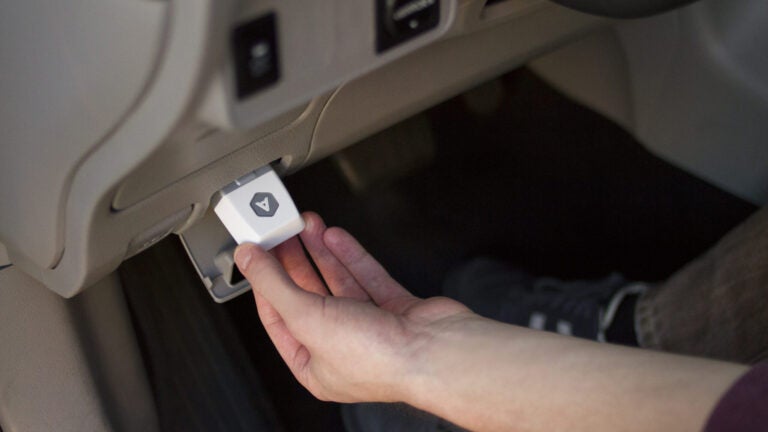
These devices can fit in the palm of your hand and plug into your car’s diagnostic port under the steering wheel. The devices record your trips, any brief stops you make along the way, and your average fuel economy.
You can also download an app to your smartphone or tablet, and sync it with the device. If you set up a digital profile, it will store the information online where you can review it later.
Since December, I’ve had the chance to take two of these devices for a test drive. Here’s what I found out about the technology and my own driving skills.
Automatic
On Christmas Eve of 2014, I started using Automatic on my 2003 Nissan Altima, which had about 106,000 miles on the odometer at the time. I plugged the device into my car’s diagnostic port and downloaded the app to my iPhone. (Just a head’s up, the Automatic app works on iPhones starting at the 5 model with iOS 7 and most Android devices that run on 4.0 and higher).
The Automatic app has a scanner that can read your car’s vehicle identification number and import data based on that information, including the car’s make and model. Once this data is imported, the device can determine your car’s estimated fuel economy. You also have the option to input the car’s odometer reading and license plate information, but can only do so manually.
The device can be purchased directly from the company’s website for $99.95. It is also available from Amazon. There is no subscription service involved.
Automatic uses audio cues help drivers realize and correct their behavior. The device emits one of three different “chirping’’ sounds if the connected car brakes too hard, accelerates too fast, or travels at more than 70 miles per hour.
“I think what sets Automatic apart is our attention to design and user experience,’’ chief product officer Ljuba Miljkovic told me in a January phone interview. “What we’re about is connecting your car to the Internet. Once that happens, we can build applications and services that make use of that connectivity.’’
And there are benefits beyond safety.
“People can get impartial decisions in order to adjust their driving style and save money on gas,’’ Miljkovic continued. “Driving style has a big impact on fuel economy. The device helps avoid those behaviors that can cost [drivers] money.’’
On my first trip using Automatic, my wife and I traveled to the Museum of Fine Arts from Waltham, and it didn’t take long for the Automatic device to make its presence felt.
Along the way, we hit a red light. Once the light turned green, I heard a chirp telling me that I had hit the gas a little too hard and was burning fuel needlessly. We left the MFA in the early afternoon and headed home. Unfortunately, I got another chirp warning me about my lead foot.
By the end of the week, I had accrued an additional “Hard Acceleration’’ alert, but Automatic tallied up an overall score of 98 out of 100 for my driving habits. During this time, I traveled 60.3 miles, spent three hours and 16 minutes in the car, burned $8.30 worth of fuel, and had a fuel economy of 29.9 miles per gallon.
I continued to use Automatic over the next three weeks, making a total of 41 trips. According to my profile information, I drove 482 miles and was in the car for 20 hours and 36 minutes. During this time, I burned $61.48 worth of fuel and reached an average fuel economy of 31.4 miles per gallon.
During this three-week period, I heard a few more chirps for hard accelerations, traveling faster than 70 miles per hour (on the Mass. Pike), and for hitting the brakes too hard when another driver switched lanes unexpectedly. But fortunately for me, these behaviors did not impact my overall driving score too negatively. My overall driving score was 99 out of 100 when the trial was over.
Zubie
Next up was Zubie, another connected device that also measures when a driver accelerates quickly, brakes too hard, and speeds over 70 miles per hour.

Zubie looks at how much time a car spends idling and how much driving occurs at night.
In addition to these behaviors, Zubie looks at how much time a car spends idling and how much driving occurs at night. According to the company’s website, the device measures idling on the highway or in a driveway because this behavior “can greatly reduce your gas mileage.’’ It factors in night driving because “darkness and drunk drivers make night driving risky.’’
Zubie’s platform has applications for both personal drivers and business owners with a fleet of vehicles. A personal subscription costs $99 per year with the device included. A business subscription costs $179.95 per vehicle per year.
In a phone interview, Zubie Senior Vice President of Customer Experience and Operations Prag Shah outlined how the device can help a company with a fleet of vehicles to make cost-efficient decisions.
“A typical small business in the U.S. has a couple dozen cars, light trucks, and drivers,’’ said Shah. “[One of the] most expensive parts of their business is related to maintenance, fuel, and the repair of cars.’’
“Zubie service is perfect for a business,’’ said Shah. “It can provide driver reports, which drivers are doing best, which ones are idling, taking inefficient routes, and allow owners to act on that data to bring down repair costs and maintenance costs.’’
The subscription includes perks such as discounts on roadside assistance, oil changes, and auto repairs. The service will also continuously monitor your car and its health, even when it is sitting idly in the driveway. Customers with good driving scores can also be available for insurance discounts with Progressive Insurance through Zubie’s Perks Platform.
After I downloaded Zubie’s app, I had a little trouble getting the scanner to read my VIN. After a few efforts, I gave up and entered the information manually instead. After I entered my car’s odometer mileage, Zubie offered me an estimated market value of my ’03 Nissan Altima based on data from Edmunds.com.
Zubie’s approach to correcting driving behavior differs from Automatic’s. Instead of offering audible signals, Zubie sends push alerts to your phone, which you can review after your trip.
Both Zubie and Automatic can also diagnose a problem when a car’s check engine light turns on. On February 7, my car’s check engine light switched on and the vehicle stalled in the middle of the street. Zubie gave me a diagnostic code of “P0300’’ and a message that read “Multiple Misfire Detected.’’ It also offered me an estimated cost to repair the problem, which fell between $500 and $1,000.
Between January 19 and February 17, I took a total of 53 trips while connected to Zubie. According to information available on my Zubie profile, I drove just over 500 miles and spent 27 hours and eight minutes behind the wheel during this time. There was only one instance of hard braking during this period and five “rapid accelerations.’’ My fuel costs came to $80.
But Zubie alerted me to something even more concerning about my driving: I spend too much time going nowhere. My report indicates I spent 23 percent of my travels idling, which includes my time spent stuck in traffic on the Mass. Pike during my daily commute.
When it was all over, my overall driving score with Zubie came to 84 out of 100, which earned me an “Average Joe’’ badge. As Zubie’s website puts it, “Not a bad place to be.’’
While both devices impressed me, I came away liking Automatic just slightly better than Zubie at the end of both trials.
Although I appreciated Zubie’s insights and perks, including discounts and getting an immediate estimate on how much a check engine light will cost me, I ultimately found Automatic’s tactic of using sounds to make me a better driver more effective.
But I must thank Zubie in particular. Because of the information I received during my trial, I decided it was time to put my old 2003 Altima out to pasture. After the check engine light came on, I decided to trade my old car in and started leasing a newer model in February.
Both devices are useful if you’re interested in learning more about your driving habits and want to improve. Now that I realize I have a lead foot, I find myself tapping my gas pedal a little easier.
These devices are handy not only for personal usage, but also businesses with a fleet of vehicles. If you’re a parent with a teen driver in the family, these devices could help you monitor your teen’s driving habits and teach new drivers about common driving mistakes at a young age.
Of course, these are just two connected devices that were put to the test. There are several other options out there with varying costs and benefits. Most of these devices work on cars built after 1996. Also, be sure to check any device’s smartphone requirements before you purchase anything.
UPDATE: An earlier version of this story said Amazon.com sold Automatic devices for $79.99. The price of an Automatic unit listed on Amazon.com has since increased.




To comment, please create a screen name in your profile
To comment, please verify your email address
Conversation
This discussion has ended. Please join elsewhere on Boston.com