
Robots Not Ready For Fast Lane
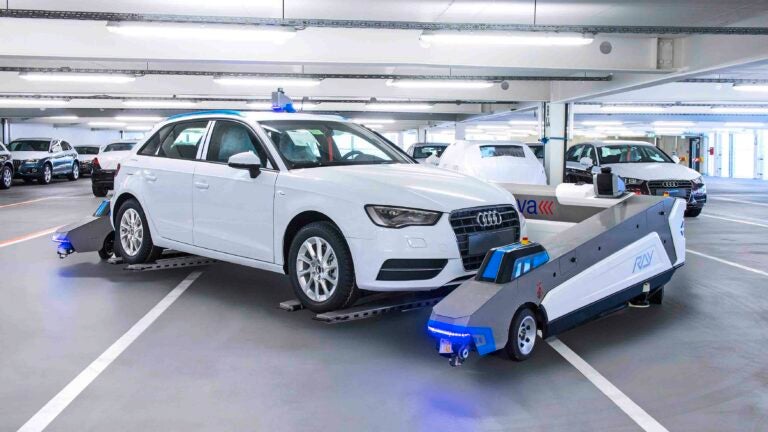
Ray the Robots take over the job of moving new Audis into line for shipping.
Automotive press releases are a lot like this winter’s snow in Boston: You get buried daily, and it’s a constant job to shovel out your inbox.
Still, every now and then one—like a single snowflake—catches your attention.
It happened when I spied this headline: “Audi plant uses robots to move cars.’’
Immediately, my reaction was: “Wow. They’ve got a whole new approach to the autonomous (self-driving) car. Instead of all these sensors built into the car, they’re putting them all into the robot that’s driving the car.’’
The possibilities seemed endless.
Imagine what it could do for over-the-road truckers: No need to limit driving to 10 or 12 hours per day. The robot can drive 24/7 until he (or she, or it) gently backs into the loading dock at the destination.
In a taxi, the robot would immediately know not only how to find your destination but also the quickest route to get you there.
Our robots would be ultra-safe school bus drivers, limo drivers who wait patiently for us and our delayed flights at the airport, the flexible worker able to ferry rental cars from one site to another, or the driver who delivers your car to your home or office after it’s been serviced at the dealer.
Perhaps the best use would be as a tow truck driver. The robotic repairman might be able to fix your broken-down car on the spot or, failing that, tow it to the dealership.
Imagine a robot valet at your favorite restaurant, parking your car safely in tight spaces and fetching it without confusion or dents.
So …
It was time to read the rest of the release.
Audi envisions this as “a pilot phase for driverless transport system in logistics.’’
I couldn’t wait to get a good look at “Ray,’’ which is what the robot’s fellow workers have dubbed him.
Like all new workers, Ray (and his sibling, also named Ray) started on the ground floor last month.
Their first job was to transport finished vehicles from the production line to an interim storage area.
From there, they sort the finished vehicles into position for loading onto railroad cars, according to their shipping destinations.
“This autonomous transport of our automobiles could allow us to eliminate long walking distances for our employees and to improve the ergonomics of their work,’’ says Prof. Hubert Waltl. “Systems like this also have the potential to significantly increase the efficiency of our processes.’’
Unfortunately, then there was a photo of Ray. We know it’s Ray because his name is painted in big blue letters on his flank.
The photo also notes an honor that’s already come his way, a nomination for the German Founder Award in 2013.
“Ray is freely movable and highly flexible,’’ it says. However, then came a disappointing description.
He consists of a frame six meters (19.5 feet) long and three meters wide. Hardly human proportions.
Instead of getting into the driver’s seat to move the car, he’s man (robot)-handling it from outside. In short, Ray is a “smart’’ forklift.
So it looks like we drivers still have a job.
Invisible Car?
Coincidence?
A study by insurance quotes.com shows an increase in insurance rates as the result of various moving violations.
For example, in Massachusetts, the website’s research shows speeding violations of 31-plus mph over the limit can cause up to a 23 percent increase in premiums, while a reckless driving citation can cost a 100 percent increase, and a DUI, 105 percent.
At about the same time we heard this news, we learned from the maker of Veil G5 Stealth Coating, a product applied to a vehicle’s headlights and other reflective surfaces to absorb police laser and infrared light, that the coating apparently makes it more difficult to measure a vehicle’s speed by laser guns and traffic enforcement cameras.
Somehow it seems easier to drive safely and avoid running afoul of enforcement systems that may or may not protect your individual vehicle.
Etc.
One of the sure signs of spring is the schedule of lawn events at Lars Anderson Auto Museum in Brookline. The bad news, which also may be the good news in terms of snow melt, is that the traditional first event isn’t until May: Cadillac Day on Sunday, the 17th.
Good friend Jim Vickers from Rhode Island loves his Honda CR-V but laments that the latest models have CVTs that aren’t suitable for towing behind his motor home. “I wish their market research had paid more attention to RV owners who tow a car (dinghy style),’’ he says. “They’ll lose a lot of business among the RV world.’’
Back in the late 1950s, you could make a case that it would have been the German automaker Borgward, and not BMW, that would become famous as that country’s leading automaker. However, it was BMW that survived after Borgward fell victim to politics, going out of business but paying off all its creditors. News out of the recent Geneva Auto Show is that the nameplate may come back after half a century as a Chinese-owned brand.
The folks at JC Whitney were reviewing some of the oddest accessories they’ve offered over the years. Does anyone remember a Deluxe Left Foot Accelerator from the 1960s? It was $3.98 and advertised to “give the right foot a rest….and an easy install on any make or model—with or without a clutch.’’





To comment, please create a screen name in your profile
To comment, please verify your email address
Conversation
This discussion has ended. Please join elsewhere on Boston.com