
Can Your Car See in the Dark?
Night vision technology can make driving in the dark a less frightening experience.
As if driving around Greater Boston wasn’t hard enough already, this year’s heavy snow volume has made it much harder – and more dangerous – than usual. Record-setting snow levels have made streets narrower for cars and some sidewalks impassable, forcing pedestrians to walk in the streets.
Speaking from experience, there have been a few nights when I’ve had to hit my brakes or swerve after encountering a pedestrian walking on a street I thought was empty. My headlights were on and I was traveling at a low speed, so there weren’t any close calls, but it’s still incredibly dangerous for pedestrians and cars to share the road right now.
Fortunately, recent developments in auto technology may provide an extra safety net for motorists and pedestrians. Autoliv, a Swedish-American company that manufactures safety equipment for cars, has partnered with BMW on night vision technology that can make driving around Boston’s snow-narrowed streets at night a little less scary.
According to the National Highway Transportation Safety Administration (NHTSA), about 72 percent of pedestrian fatalities occurred during the dark in 2013. Richard Seoane, general manager for Autoliv’s Night Vision System, believes his company’s technology will help save lives.
“No matter how young or old you are, you can only see what your headlamps illuminate, which is about 40 yards ahead of the car,’’ said Seoane. “Most people outdrive their headlamps. If you’re driving faster than 40 miles an hour and you see something in your headlights, it’s too late to react.’’
Earlier this month, the Autoliv offered me a chance to test two of their nighttime safety system technologies: Night Vision with pedestrian detection and Dynamic Light Spot, a motorized spotlight system. Both are part of Autoliv’s “active safety’’ technologies that allows vehicles to detect and avoid potential collisions.
[fragment number=0]
Night Vision
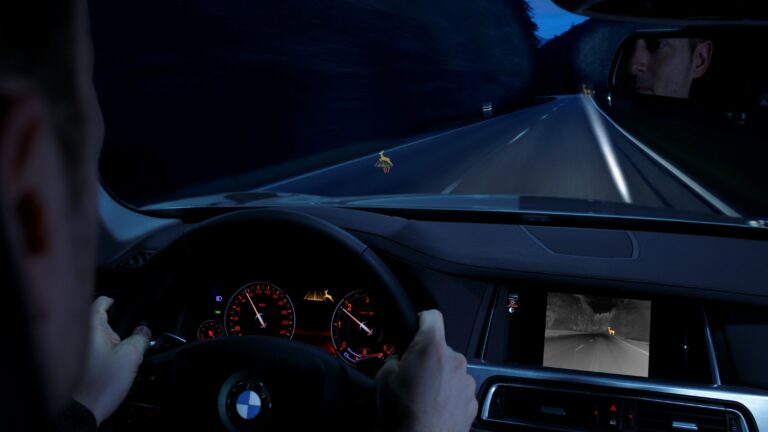
On March 2, Autoliv offered me the opportunity to test the company’s Night Vision Systems in a 2014 BMW 750Li xDrive for a week. The system uses infrared technology to detect pedestrians and animals that could cross paths with a moving automobile.
Autoliv’s system uses an infrared sensor that can pick up the body heat emanating from a pedestrian crossing the street or from an animal bounding out of the wilderness, and highlights the figures in yellow.
These sensors can also present a clear outline of objects that might otherwise remain unseen in the dark, including parked cars, houses, trees, and more.
The Night Vision can be viewed on the car’s center console and has to be activated by pressing a button to the left of the steering wheel.
The MSRP of a 2014 BMW 750Li xDrive is $94,000. But the model I was loaned – which included the optional Night Vision system worth $2,600 – was worth more than $117,000.
On the first night behind the wheel, I tried to use the Night Vision to detect wildlife. My wife came along for the ride and we drove through the more rural community of Weston, one town over from where we live. While there were no Bambi sightings, the Night Vision illuminated a handful of pedestrians roughly two city blocks away.
The real test of the system came on Tuesday, March 3 when the Boston area got another batch of snow. By the time we drove the BMW to have dinner at Jake n JOES Sports Grille in Waltham, the snow was coming down pretty fast.
While this was by no means the worst storm we’ve had to deal with this winter, the Night Vision’s ability to clearly outline objects such as parked cars and buildings was slightly hindered by the steady snowfall, which made the objects much harder to see on the vehicle’s monitor.
In comparison, the snowfall did not appear to interfere with the Night Vision pedestrian detection system. While driving home from dinner, I was able to see the heat signature of pedestrians at least a quarter of a mile away and adjust my speed accordingly.
On Wednesday night, an accident on Exit 20 of I-93 North caused traffic delays and forced cars to travel down a single lane around the scene of the collision. On this occasion I was traveling at less than 5 miles per hour but the system helped me detect police officers and other emergency workers as they moved around emergency vehicles and removed broken glass from the traffic lanes.
My daily and nightly commutes take me through the very hectic Newton Corner, referred to as “the circle of death’’ by some. Overall, this area is where Autoliv’s Night Vision technology came in most handy. In this area, cars can change lanes quickly to get on or off the Mass. Pike. Meanwhile, other cars are frequently double-parked and drivers have to quickly change lanes to avoid them.
On Thursday night, a car stopped abruptly and double-parked on Newton’s Washington Street. From afar, I was able to see a yellow-highlighted pedestrian emerge from the car several feet away and carefully navigated around the car and the pedestrian.
On Saturday night, my wife and I went to dinner in Boston’s Seaport District. Glancing at the monitor while driving down Seaport Boulevard, I was able to see a pair of pedestrians emerge from between parked cars. These folks were trying to get into their own car that was parked on the street and were hard to detect by relying only on the neighborhood’s street lighting. I moved the car aside to give them the space they needed to get into their car.
At the end of the week, it was clear to me what I was not seeing while driving at night. Detecting a pedestrian can be difficult in the dark when relying solely on street lighting and standard headlights. The light from oncoming traffic can make it even harder to detect what could be right in front of your car.
Night Vision definitely came in handy while driving home in these hours. Knowing that a pedestrian or a cyclist was just ahead of me caused me to become more cognizant of my driving. Even when there were no pedestrians in sight, I found myself slowing down and driving with a heightened sense of caution.
At first, the center console was slightly distracting, but after one or two nights, the novelty of the technology wore off (a little) and I found myself glancing at the screen at a more controlled pace.
Autoliv’s Night Vision technology is currently only available in a few luxury brands: BMW, Mercedes-Benz, Audi, and Rolls Royce. Some of these brands offer a heads-up display on the vehicle’s windshield or a console display for the Night Vision technology.
Seoane believes consumers can expect to see the technology move beyond luxury auto brands in the near future.
Dynamic Light Spot
In addition to testing Autoliv’s Night Vision, I was also given a brief chance to test another one of the company’s safety features: Dynamic Light Spot on a 2014 BMW X5.
Autoliv’s Dynamic Light Spot uses sensors to detect objects in front of a car. Once an object is detected, the Dynamic Light Spot uses a motorized spotlight to project a bright beam that highlights the object of concern in front of the car’s path. This beam continues to follow the object like a spotlight as long as it is still in front of the car.
“[With Dynamic Light Spot], you can keep driving with your eyes on the road and the beam will automatically highlight an animal or pedestrian close to the car,’’ said Seoane.
In order to test the Dynamic Light Spot technology in the short time we had, Seoane and I, along with Boston.com cameraman Mylan Cannon and Autoliv night vision system publicist Pierre Kanter, drove the BMW X5 to a relatively empty lot on the UMass-Boston campus in Dorchester.
Pierre volunteered to be the moving target and we left him at a crosswalk and prepared to put the technology to the test.
Traveling at just over 15 mph, the Dynamic Light Spot shot a single bright beam from the X5’s headlight position and found Pierre, who was about 40 feet away. The light continued to follow him like a spotlight as he moved across the street.
The X5 also came with Autoliv’s Night Vision pedestrian detection and we could also see an infrared reading of Pierre from a distance.
Dynamic Light Spot technology is not currently approved for public use by the NHTSA because the agency fears the motorized beam could blind pedestrians. I was loaned the manufacturer’s model X5, which is authorized for limited use.
However, Seoane insisted that the beam does not reach pedestrians (or animal) eye level and is hoping to get the agency to loosen its regulations.
“We don’t want to blind pedestrians, so the light is aimed at the ground [instead of] at eye-level,’’ said Seoane.
He also hopes NHTSA will update its regulations to allow the Dynamic Light Spot technology to be used on the road.
“The regulation is over 40 years old and has not been updated in a long time,’’ he said. “But the agency is starting to look at how to change their regulations to allow better lights on vehicles. There is definitely some work to be done.’’



To comment, please create a screen name in your profile
To comment, please verify your email address
Conversation
This discussion has ended. Please join elsewhere on Boston.com