
New Solutions to Road Salt-Related Problems
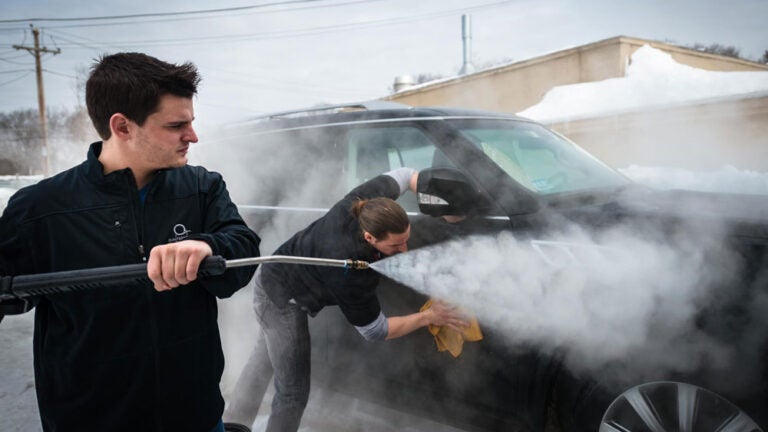
A local company may have found a new solution to removing stubborn salt deposits from a car, and it couldn’t come at a better time.
Boston’s streets and sidewalks have been treated with road salt ever since the first snowflakes of this now-epic winter started battering the region. While coating the region with salt may help break up the ice and snow, it comes with unintended consequences for cars and roadways. Trapped salt deposits can cause corrosion in cars and cause rust in metal guardrails and bridges.
Salt that bounces into a vehicle’s undercarriage can corrode important parts if it’s allowed to linger. AAA Southern New England recommends motorists take steps to protect their vehicles by getting regular washes and using a car wash detergent with a low pH balance. But AAA also warns that forceful blasts at some car washes can push salt further into a vehicle’s cracks, making it harder to remove.
That’s where Burlington-based Q Car Care comes in. The company offers consumers a steam wash treatment that owner Ben Pirri says can reach salt nestled into a car’s underbelly.
“The steam dissolves the salt and turns it into a liquid state,’’ Pirri told Boston.com. “The steam can get deeper into the car and allows the salt to run out of the crevices.’’
Pirri says the electric-powered washer his company uses is also used to treat range hoods in restaurant stoves and even sanitize slaughterhouses.
He says the cleaning process typically takes about 10 to 15 minutes, depending on how dirty the car is. A full exterior wash costs $29.
Pirri also claims his company’s process is more eco-friendly and effective than the competition.
“We’re using 90 percent less water than a [traditional] car wash,’’ Pirri told Boston.com. “With the steam, you get a deeper clean that can get into deeper crevices.’’
Meanwhile, a company in Montana is offering a new method to prevent the corrosive effects of salt brine de-icers traditionally used by state and municipal transportation agencies.
Rivertop Renewables claims its product, called Headwaters, can reduce corrosion by 70 percent when used with de-icing brines. Headwaters uses glucaric acid, a chemical recognized by the U.S. Department of Energy as a top “building block chemical’’ that can be used in multiple applications.
Jason Kiely, Rivertop Renewables’s de-icing industry manager, says his company’s product not only helps everyday motorists, but it can also help states save money by preventing major infrastructure problems.
“Essentially, the chloride component of salt is the biggest problem,’’ Kiely told Boston.com in a phone call. “It dissolves the protective barrier around iron, causing it to rust.’’
Once that happens, Kiely said the corrosion can accelerate and eat away at layers of steel. This could be potentially hazardous for roads, bridges, and guardrails.
“It’s not just the driving public that sees corrosion in their vehicle,’’ said Kiely. “Trucking firms are particularly concerned for their fleets. States are interested in preventing damage to their [snow removal] equipment.’’
While Headwaters adds roughly 15 cents to the cost of every gallon of brine produced, Kiely claimed the higher expense pays off long term for transportation agencies.
“We’re offering states a return on their investment,’’ said Kiely. “States and municipalities are getting ahead in terms of reduced expenses on the depreciation and repair of equipment and vehicles.’’
The product is currently being used by the Montana Department of Transportation in the western part of that state. A spokesperson for the state’s transportation office said officials are pleased with the product’s results.




To comment, please create a screen name in your profile
To comment, please verify your email address
Conversation
This discussion has ended. Please join elsewhere on Boston.com