
What’s a Rat Rod? A Do-It-Yourselfer with Personality
TARPON SPRINGS, FL—Hundreds of brightly shined muscle cars lined the streets and parking lots around Suncoast Speed & Custom cars on Rte. 19A in the heart of this southwest Florida city on the last Sunday in January.
It was a car show with no entry fee and no awards. This one had a higher calling.
Roughly 400 car owners had gathered to make donations to the Officer Charles Kondek Memorial Fund. Officer Kondek, 45, was murdered early on the Sunday morning before Christmas while responding to a call. He was a 17-year veteran of the Tarpon Springs Police Department, which he had joined after five years as a New York City police officer.
Word had gone out throughout the surrounding area: “Even if you don’t usually bring your car to shows, make it to this one. And bring your wallet.’’ The show itself raised more than $25,000 with more to come from the police benevolent fund.
We stumbled upon the show while visiting friends in the Tampa area for a few days before heading farther south, even though there’s no truth to the rumor we were trying to put as much distance between us and the snow machine that’s been burying Boston.
My old friend Ken—and the old refers to the number of years we’ve been friends AND our ages—asked, “See anything you’d like to write about?’’
Every car has it’s own story, but I was looking for something I hadn’t seen before so I pointed and said, “That one. The rat rod. It looks like it belongs in a music video or on an old ZZ Top CD cover.’’
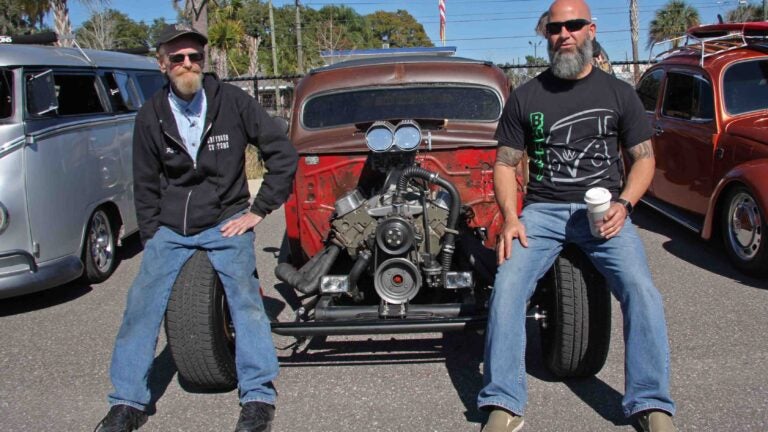
Neither of us knew exactly what this rat rod was, so we started chatting up its owner, Ron Henning of Tarpon Springs. Henning and his son-in-law, Scott Siben, built the rod in a little less than a year.
Siben found the body—actually a cab and bed from a 1948 Ford F3 pickup—on Craigslist in Lakeland, Florida, around Thanksgiving 2013. The guys then welded a frame of 2- x 3-inch rails of 1/8-inch walled steel.
A Pontiac 400 cubic-inch engine, originally out of a 1968 GTO, went into the frame, along with a Turbo 400 automatic transmission. Henning built his own headers for the engine, fabricating homemade mufflers as well using low-budget SOS pads and boat fiberglass wrap for sound-deadening.
Up front is a drop-axle front end with disc brakes. In back, they used a rear end and independent suspension out of a 1968 Cougar. “The sellers offered to throw in the rear end when we bought the cab, so we grabbed it,’’ says Siben.
However, because the guys also added a hydraulic lowering kit, the bed was sitting on the ground at the auto show, the whole thing looking as if it had just been dumped off a flatbed truck. Adding to that appearance was the lack of a radiator or front grille.
Walking around the truck, it was obvious that a wooden-bed floor had been constructed with hinges. Below one portion was the hydraulic system and a pair of air horns. “They’ll rattle your brain,’’ says Henning. Behind the rear portion of the bed was the radiator and an electric fan.
“We finished it up this November,’’ says Henning. “It was just in time to take it to the Daytona Turkey Run.’’ That’s arguably the biggest car show/swap meet in the land, held annually at the Daytona Motor Speedway the Friday through Sunday after Thanksgiving, drawing nearly 7,000 cars and 130,000 spectators.
“We drove it over, and it ran fine the whole way,’’ says Henning.
Siben says the project cost about $700 in cash, plus their endless hours of labor. Someone offered us $25,000 for it at Daytona,’’ he says, “but we’re holding out for $35,000. Actually, we don’t have any desire to sell it.’’
The cash Siben was eyeing this day was a big 50/50 raffle at the show. “If we win it, it’s going right into the Kondek Family Fund,’’ he says.
That seems to be the local attitude. Nick Ramdas of the Suncoast Speed and Custom shop has started a gofund.com project to build a 1955 Chevy Bel Air with plans to auction it at Barrett Jackson’s charity event, again with proceeds to benefit the family.
That restoration will be more high tech than the rat rod’s.
As an example. “Tell them how you got the driver’s door to match the rest of the rust,’’ suggests Tami Siben, who owns and runs a local day care center with her husband. “It was in primer when you bought it.’’
“It took us 10 minutes with a mix of peroxide and salt,’’says Siben of the door’s now rusty surface—a patina it took the rest of the cab decades to acquire.
“Air conditioning’’ comes from the original flip-up vent in front of the windshield and from the big sunroof the boys cut in the roof and cover with a custom vinyl cover.
The cab’s roof, of course, was chopped with new,narrow, homemade windows of Lexan. “We chop all our cars,’’ says Siben.
That leads to talk of their 1946 Ford, a 1966 chopped and customized VW bus, and a 1971 VW bug that is for sale.
Siben, who transports children at the day care center, says the kids love seeing the custom cars. He hopes some of them catch his love of old cars.
Well, this rat rod just goes to prove that there is, indeed, a story behind every car and its owner(s).



To comment, please create a screen name in your profile
To comment, please verify your email address
Conversation
This discussion has ended. Please join elsewhere on Boston.com