
Dealers Clean Up; A Parking Spotter; Smashing an F-150
Most of us have a snow shoveling routine. You know, start with the steps, then clear a path to the driveway, then the driveway, and finally the dreaded heavy stuff to break through to the street.
Then, just when you think you’re finished, there they are: Those two igloos over by the side. A pair of cars, or even worse, a pair of SUVs, to be cleaned off.
That means snow brushes or, hopefully, you have one of those Styrofoam snow rakes on a long handle to get the snow off the car. After that, you open the door, letting in all sorts of loose snow. Once you get the car moved, then it’s time to clean up all the snow you’ve dumped back onto the driveway.
Now imagine you’re an auto dealer. You’ve got anywhere from 50 to 500 cars on the lot.
All have to be cleaned and moved so the lot can be plowed. And these are new cars, so you have to be careful not to scratch the paint.
This winter, there’s no leaving that job to the lot boys. There’s too much snow and too many cars. At most dealerships everyone’s involved in the process.
Why is this important? Because it’s an answer to those readers who like to ask, “When’s a good time to buy?’’
You have to believe that the answer is “Now.’’ You might even call it a snow clearance sale.
Dealers have been looking to make space for new inventory and the specials they’ve got in place for Presidents’ Day, which actually now is a month-long sales event.
So, if you’re looking for a parking space, your local dealership probably has a bunch cleared out for customers.
Wouldn’t be a bad time to try something with heated seats, a heated steering wheel, and perhaps headlamp washers.
A Parking Spotter?
The concept is fabulous. Ford’s R&D people are working with Georgia Tech on a couple of systems to make our lives easier.
One is finding that elusive parking space for us; the other is to have a valet system to remotely reposition cars.
The parking spotter uses systems already in many Ford vehicles to gather information—in this case, an empty parking space—and send it to a prototype system that works with the cloud to alert other vehicles with the same onboard system that a space is open.
Ford notes that in parking-challenged urban areas such as Boston, the average driver spends 20 minutes a day (3.5 days a year) looking for a parking spot. Only 12 percent of drivers, on a given day, find that elusive spot immediately.
As always, we have a few questions. 1) What if that spot is in one of our neighborhoods claimed by one of those ubiquitous white plastic chairs? 2) Don’t you usually find someone already lined up to take your space before you pull away from the curb? 3) Who is going to tell that driver that Ford has reserved that space for you?
Just asking, you understand.
Also wondering if our astute automotive friends at MIT passed on this study, figuring that if there are more cars than available spaces, it’s impossible to please all of the drivers all of the time.
The second system, called remote repositioning, is another step along the road to autonomous driving, using a remote driver to move driverless vehicles around an enclosed area, such as a rental car agency’s lot.
This system relies on existing technology as well as the LTE cellular connection on today’s mobile phones to permit the remote shuffling of vehicles.
You have to wonder how they’d work if all the snow isn’t off the sensors and whether local dealers would dare use such a system to move cars during the cleaning process after our series of storms.
Sledgehammering a Truck
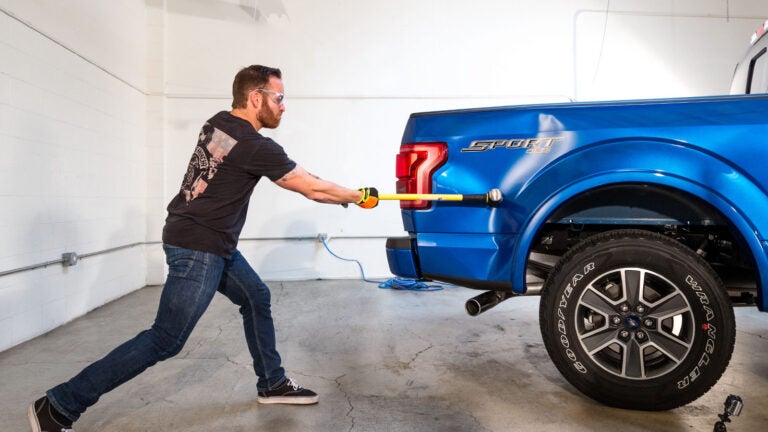
One more thing that’s hard to imagine: Someone who loves cars or trucks being capable of taking a sledgehammer to the aluminum body of a new pickup truck.
That’s just what the folks at Edmunds.com did the day after they paid $52,000 for a 2015 Ford F-150. The video of a staffer putting his all into smashing the side of the bed is impressive.
So, too, was the resiliency of the bed wall, which flexed considerably, but was dented.
“We wanted to find out if repairing the aluminum-bodied Ford is more expensive and time-intensive than repairing traditional steel-bodied trucks,’’ says Edmunds.com associate editor (and eight-pound sledge wielder) Travis Langness “So in the name of consumer awareness, we dented our truck with two big blows from a sledgehammer, and drove it straight from the Edmunds garage to our local Ford dealer and asked for an estimate.’’
The original estimate was $2,082.73 but that rose to $2,938.44 after the dealership discovered Langness had cracked the taillight assembly (which included a blind spot sensor) in his enthusiastic hammering.
His conclusion: The repairs were more costly and time-consuming (seven days) than they would have been for a steel-bodied version. But the dealership—Santa Monica (CA) Ford—did an “almost perfect’’ job on the repair.
The only quibble: the “Sport 4×4’’ decal was replaced in the wrong spot.
Still, we’d consider the repair cost to be a hammer blow.





To comment, please create a screen name in your profile
To comment, please verify your email address
Conversation
This discussion has ended. Please join elsewhere on Boston.com