
How Will Bikes and Cars Get Along in Boston?
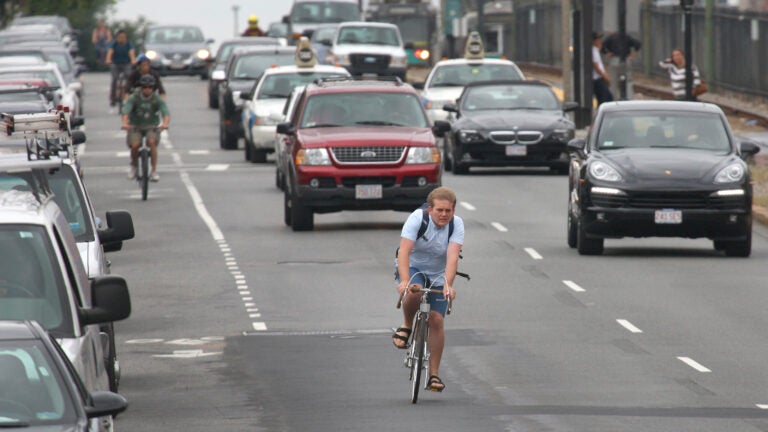
In a city where roads can get easily congested and parking is nearly impossible to find, many have turned to biking as an alternative. But is Boston equipped to offer a safe experience for its cyclists?
Last week, London approved “cycle superhighways’’ — bike lanes physically segregated from the flow of motor vehicle traffic — to span the city, as part of a $6 billion Road Modernization Plan. The main thoroughfare, an 18-mile route running east-west, will be the longest segregated bike route in Europe, according to The Guardian, and the world’s first cyclist superhighway.
The bike lanes, which will cost around $240 million, will be blocked off from other motor vehicle traffic with curbing, making the route safer for cyclists.
Though the plan has gotten opposition from London taxi drivers and land developers, who say the lanes would take too much space away from cars and create more traffic jams, London Mayor Boris Johnson has been a key proponent for the change.
“Getting more people on to their bikes will reduce pressure on the road, bus, and rail networks, cut pollution, and improve life for everyone, whether or not they cycle themselves,’’ Johnson told BBC in September.
Bicycle enthusiasts in the U.S. are quick to applaud the plan.
“The vision and concept — connecting all the way across the city — is really powerful,’’ said Martha Roskowski, vice president of local innovation for PeopleForBikes, a nonprofit based in Colorado. “They’re raising the bar.’’
While the City of Boston declined to comment specifically on London’s initiatives, it turns out, there are some big changes coming to bike lanes here, too.
City Hall’s Climate Action Plan has pledged to increase the share of commute trips by bike to 10 percent by 2020, and the 2013 Cyclist Safety Report wants to decrease cyclist crashes by 50 percent.
The Boston Bike Network Plan, jumpstarted in 2013 under the late Mayor Thomas Menino, calls for 75 miles of new bicycle facilities in the next five years and 356 miles in the next 30 years.
According to Nicole Freedman, director of Boston Bikes or the city’s “bike czar,’’ if all goes well, Boston should be getting its 100th mile of bike lane by the end of this year. Other initiatives include installing bike lanes throughout historic Boston sites under the “Connect Historic Boston’’ initiative and a reconstruction plan for Commonwealth Avenue, one of the city’s most dangerous throughways for cyclists.
In 2013, the network of cyclist paths looked like this:

The blue lines represent bike lanes delineated with pavement markings or signs right next to traffic, or buffered lanes, which have some extra space between bikes and cars. The green represents shared use paths, which are off-road pathways shared by cyclists and pedestrians.
The purple, Western Avenue in Allston, was the only protected lane where bikes are separated from motor vehicle lanes by parked cars as of 2013. In 2014, a section of Mt. Vernon Street in Dorchester also included a protected lane separated by flexible vertical posts.
Protected bike lanes — similar to London’s cycle superhighways — are a “cornerstone’’ of the bike network plan, Freedman said.
In March 2014, PeopleForBikes selected Boston as one of six cities in the country for its two-year Green Lane Project to create protected bike lanes, also known as cycle tracks, with physical barriers between bikers and drivers. The Green Lane Project is providing each city with small grants, studies, and general publicity.
“There is so much potential in Boston,’’ Roskowski said. “The city really can’t fit more cars into the downtown area and is pretty maxed out in terms of car capacity, so they have to think about how to move people differently.’’
Transportation officials hope the city will look like this, within the next five years:

Can they do it?
“The single biggest predictor in change is mayoral support,’’ Roskowski said.
Though many of the ongoing initiatives began under Menino, Mayor Martin Walsh has voiced his support for bike safety initiatives.
“When you look at the projects [that are taking place], it speaks to the mayor’s commitment to make sure the streets are safe for all users of the road,’’ Freedman said.
While drivers may protest that building more bike lanes would further snarl traffic on Boston’s already-crowded roads, bike advocates say otherwise.
“There are about 70,000 to 80,000 bike trips a day in good weather,’’ Freedman said. “It benefits everybody when people are biking and not in cars, and there are fewer people looking for parking and on the roads.’’
Roskowski added that cities must convince people who are resistant to change. “It’s getting people over the hump of, ‘Oh my god, you’re making it harder to drive,’ which isn’t necessarily true,’’ she said.
Pete Stidman, director of Boston Cyclists Union, said his group is focused on roads that have lower traffic flow than they were designed for, and therefore it might be possible to explore reducing lanes for improved bike travel.
“Engineers can be creative and find ways,’’ Stidman said.
Stidman’s group, which has over 1,300 dues-paying members in Boston, has identified one cross-town route, from Mattapan Square to Assembly Row in Somerville, and is working on identifying more. It has identified high-potential areas and is interviewing neighborhood residents to better understand needs.
Boston Cyclists Union is also working with the city to send relief to Commonwealth Avenue between Packard’s Corner and the Boston University Bridge, which is known as a “door zone.’’ Bikes travel in the space where the doors of adjacently parked car doors open.
“Menino was a strong supporter, and the Walsh administration took some time, but now he seems to understand,’’ Stidman said.
“We’ve been able to win a lot of arguments [in the past 5 years] to get safer infrastructure in,’’ Stidman added. “The effect of all this will begin to hit in the coming years.’’





To comment, please create a screen name in your profile
To comment, please verify your email address
Conversation
This discussion has ended. Please join elsewhere on Boston.com