
City’s New Car Share Program At Least Trying Not to Ruin Parking for Everyone
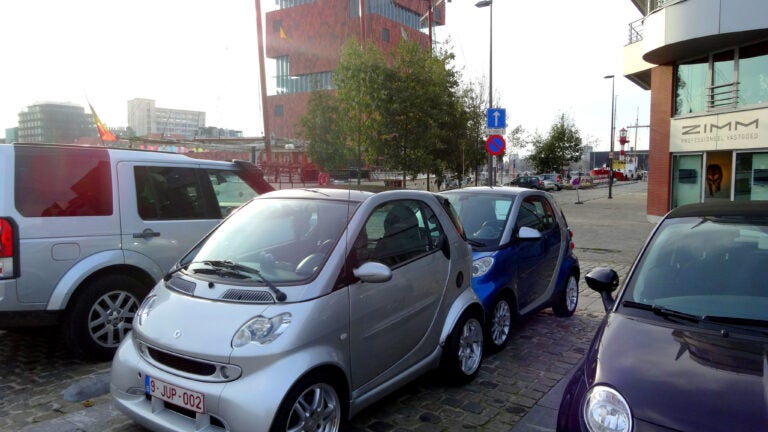
Over the weekend, Bostonians were introduced to the broad outlines of a city plan to make several hundred municipal parking spots available to car sharing companies. Initial reactions included fear and anger that the program would “gobble up’’ badly needed city parking spots, according to the Boston Globe.
Since then, the Department of Transportation has released a request for proposals (RFP), which provides more details about the DriveBoston pilot program and makes it clear the city is at least trying not to thoroughly ruin everyone’s chance of finding a parking spot in Boston.
The RFP, which guides car share operators through the process of applying to the pilot program, lays out two separate models of car sharing.
Under the “Traditional Dedicated Parking Permits’’ program, the city is looking to sell up to 80 parking spots to what it calls “traditional’’ car share operators (with a maximum of 40 going to each company). Those include companies like Zipcar and Enterprise CarShare, which would own specific parking spots and would require drivers to pick up and drop off their cars in the same spot.
There are a number of rules aimed at making sure the designated spots are not in already overcrowded central areas, but in neighborhoods currently underserved by transportation options, like Roxbury, West Roxbury, Dorchester, and Mattapan.
No more than 16 of the 80 are allowed to be in the “Downtown Core,’’ which includes neighborhoods like the Financial District, Chinatown, Beacon Hill, and the North End. Parking spots in that area will also cost companies substantially more than spots in the surrounding neighborhoods.

A map from the city’s request for proposals showing public transit access (purple) and municipal lots (blue dots) where spots will soon be available to car share companies.
Another 150 permits will be awarded to one company under the “Free-Floating Car Share’’ program, and this is where things get more controversial. Those permits will allow drivers to park that company’s vehicles in any city spot (except at Logan Airport) without paying meters or worrying about residential permits. All time limit restrictions over two hours will also be waived.
The free-floating or point-to-point model of car sharing was pioneered in the U.S. by car2go, which is owned by the car manufacturer Daimler and started in Germany in 2008. It launched in Austin in 2010 and now operates in about a dozen American cities. Car2go’s expansion hasfrequentlybeen met with skepticism from residents concerned with a lack of parking (and was blocked in San Francisco).
Car2go has expressed interest in coming to Boston, but would not confirm to the Boston Globe whether it has plans to bid on the new pilot. A spokeswoman did not immediately respond to Boston.com’s request for comment.
Because the cars can be driven and parked anywhere, there’s potential for them to reinforce the worst patterns of Boston commuters: driving to crowded business centers in the morning and back to crowded residential districts at night.
Kristopher Carter, the director of programming in the Mayor’s Office of New Urban Mechanics, said the RFP tries to counterbalance that tendency. Whatever company bids on the 150 free-floating permits will have to make sure no car sits in the same place for more than 24 hours.
The operator will also have to maintain at least one car in every Boston neighborhood at all times, an attempt to keep the fleet from bunching up in certain areas. Carter said companies will be expected to tell the city in their responses to the RFP how they plan to jump that logistical hurdle.
He also emphasized that drivers of cars with free-floating permits will not get special treatment.
“You’re going to be searching just like everybody else,’’ Carter said. “There’s some sort of natural deterrent to everyone taking these cars downtown.’’
Perhaps unsurprisingly, traditional car share operators are among the biggest skeptics of the newer free-floating model.
“There’s still a lot of questions in the industry as to the long-term benefits and impacts of those services,’’ Kyle Sabie, corporate manager at Enterprise CarShare, said.
“Zipcar has been proven to reduce car ownership in cities like Boston,’’ Lisa Feldman, Zipcar Boston general manager, said. “As of now, there is no research on the impact of free-floating car sharing on congestion or car ownership.
Carter said the city wants to include both traditional and free-floating car sharing programs because providing a diversity of travel options was one of the main goals of the RFP. He said the city is willing to be a test ground and plans to ask all operators to provide detailed data officials can review and respond to.
“We’re doing this as a pilot because we want to learn from it,’’ Carter said. The first round of permits are set to be awarded in the late spring for a period of 18 months, but the RFP says the city can extend licenses for up to an additional two years.
As for the initial reaction of Bostonians worried about their parking spots, Carter said he wasn’t exactly surprised.
“I think people feel very strongly about parking in Boston,’’ he said. “Before people actually saw the details of the RFP, initially it feels a little bit scary. When you get into the details it seems like something that can be done.’’
The RFP also says there will be a public hearing process before final permits are awarded, so Bostonians will have an opportunity to sound off before anything becomes set in stone.





To comment, please create a screen name in your profile
To comment, please verify your email address
Conversation
This discussion has ended. Please join elsewhere on Boston.com