
‘All Our Patent Are Belong to You’ and Other Words That Shook the Auto Industry in 2014
If you had your ear to the ground of the auto industry in 2014, you heard the tremors that could lead to seismic shifts in how we buy and drive cars.
Whether Tesla was introducing the idea of “open source’’ to a closed off industry or Massachusetts lawmakers were announcing major new funding for roads around the state, there were many announcements indicating big changes in 2015 and beyond.
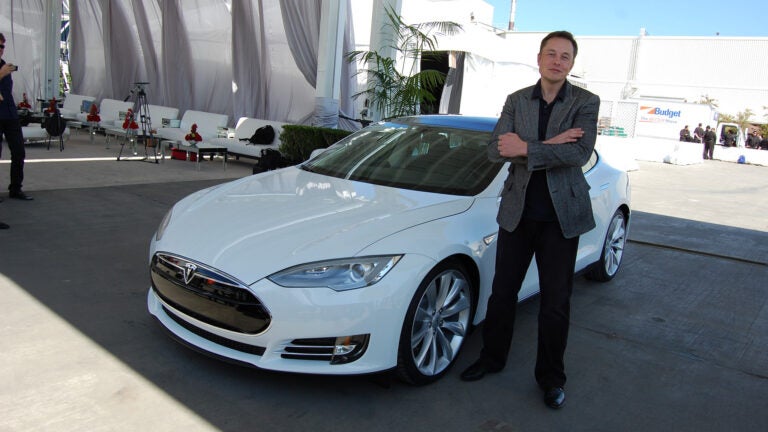
“All our patent are belong to you’’ – Elon Musk, CEO of Tesla Motors, June 12
Elon Musk wasn’t struggling with his grammar this summer when he titled a blog post on the website of his company Tesla Motors. He was alluding to an internet meme, thereby referencing the open, fluid, and creative culture he wants to foster in the auto industry.
The post announced that the electric car company was making its lucrative inventions available for anyone to copy. “Tesla will not initiate patent lawsuits against anyone who, in good faith, wants to use our technology,’’ Musk wrote.
He said the intellectual property protections were standing in the way of global progress toward electric cars and other sustainable transportation.
Musk actually hopes legacy car manufacturers will steal his ideas and use them to mass produce electric cars: “We believe that Tesla, other companies making electric cars, and the world would all benefit from a common, rapidly-evolving technology platform.’’
Tesla has been making noise in other quarters all year, needling its auto brethren to change their ways when Musk thinks they are backward or outdated. The company’s non-traditional sales method has been a thorn in the side of dealerships in states like New Jersey and Michigan. Don’t expect Musk to shut up until he gets what he wants.
“I am deeply sorry.’’ – Mary Barra, CEO of General Motors, April 1
The behemoth General Motors is not yet at risk of losing significant sales to the still-tiny Tesla Motors, but self-inflicted wounds stung GM this year. At a congressional hearing in April, CEO Mary Barra admitted that the company hid a deadly design flaw for more than a decade.
“Sitting here today, I cannot tell you why it took years for a safety defect to be announced in [the small cars] program, but I can tell you that we will find out,’’ she said. GM recalled more than two million cars for defective ignition switches linked to at least 42 deaths.
But the GM recall was dwarfed by one related to faulty airbags that affected Honda and a handful of other carmakers. All together, the US auto industry issued 63 million recalls in 2014, according to the New York Times, far more than any other year in history.
Sixty two million car owners are not going to turn their backs on legacy car manufacturers over these recalls, but don’t be surprised if some people start looking around for alternative transportation options.
“ONE>WAY service is now open to all current Zipcar members located in or travelling to the Boston area.’’ – Zipcar announcement, December 16
If any of those people live here in Boston, Zipcar is looking to attract glances. Just a few weeks ago the car-sharing company announced a pilot program in Boston that allows members to take cars on one-way trips.
“The new transportation option, which Zipcar has been testing since May, enables members to take point-to-point trips with a reserved parking spot at both the pick-up and drop-off locations,’’ read the announcement.
The Zipcar program is one of several focusing on city-dwellers who only need a car occasionally to supplement the public transportation system. If Zipcar could partner with the MIT team working on autonomous carpooling in Singapore, we’d really have something industry-changing.
“These important funds show our commitment to transportation across the state,’’ – State Senator Thomas M. McGee (D-Lynn), Senate Chair of the Joint Committee on Transportation, March 6
Speaking of public transportation, this year’s state bill authorizing funding for transit construction and repairs includes billions of dollars for the MBTA to improve the T system. More than $1.3 billion will go towards the extension of the Green Line to Medford, giving more people the option of car-less transportation.
And the people who do still drive will be happy to hear that cities and towns will be able to take advantage of the full construction season in 2015 to fix their roads. That hasn’t always been the case due to funding delays, but this year the bill came in on time and allotted $300 million to statewide repairs.
Our rail and road systems are integrally tied up with the fate of cars in our country, so keep an eye on how funding priorities change during 2015 and beyond.


To comment, please create a screen name in your profile
To comment, please verify your email address
Conversation
This discussion has ended. Please join elsewhere on Boston.com