
Self-Driving Tech Coming Bit-by-Bit; Fuel Cell Future
Somewhere out there, just a bit over our horizon, is the self-driving (autonomous) car. Google’s fleet of autonomous vehicles seems to be in the news regularly.
Most every automaker is working on a similar project, either alone or in developmental groups. As they said in the lead-in to “The Six Million Dollar Man’’ TV show back in the 1970s, “We have the technology.’’
However, many legal, ethical, and infrastructure hurdles remain before those cars become common. Chief among them is liability when the inevitable accidents and fatalities happen.
While the scenarios about self-driving vehicles play out, most of the technologies they’ll use are starting to proliferate.
If you’re in and out of new cars these days—buying them, renting them, riding in them—you can’t help but notice the profusion of new systems, all seemingly headed down that road to the autonomous vehicle.
Maybe it’s just seeing a warning light shining in a side mirror, or a beep telling you that you keep wandering out of the marked lane, but they’re there.
Cadillac plans to offer a system it’s calling “Super Cruise’’ in an all-new 2017 vehicle. In addition, it will equip the 2017 CTS with vehicle-to-vehicle (V2V) communication capability.
Super Cruise, still a working name for GM’s automated driving technology, includes hands-free lane following, braking, and speed control in certain highway conditions.
V2V at first will monitor basic information such as location, speed, and direction of vehicles and be a supplement to active safety such as already existing (on some cars) forward collision warning.
Volvo says its 360-degree view is the key technology in its goal of no fatal accidents by 2020.
This month is the end of a four-year Non-Hit Car and Truck Project, a Swedish collaboration among academia, industry, and government aimed at developing new accident-mitigation technologies and improving existing ones.
The main achievement of the project is the 360-degree vehicle-surrounding sensor system that enables existing systems—cameras, radar, lidar (laser detection), and GPS—to share information seamlessly.
One benefit of the system is that it can perceive potential objects a driver otherwise might not be able to see.
In addition to this threat assessment, a feature called the “Maneuver Generator’’ can identify collision-free escape routes in all traffic scenarios, incorporating auto-braking and steering.
“With the Non-Hit Car and Truck project, we’ve taken a significant step toward realizing the vision that by 2020 no one should be killed or seriously injured in a new Volvo car,’’ says Anders Almevad, Volvo’s project manager in the program.
This, too, has ramifications for the self-driving future.
“The technology is imperative for the development of self-driving cars, which will be able to steer and brake to avoid collision with any object in any situation. Our primary objective is to focus on preventing different types of accident scenarios. Going forward, we also will work on developing cars that adapt to each driver’s unique behavior,’’ he says.
Lexus has announced it will introduce the “Lexus Safety System +,’’ a new suite of active technologies designed to prevent or mitigate collisions. The rollout should include all models sold in Japan, North America, and Europe by the end of 2017.
The Lexus system builds on existing systems and includes a Pre-Collision System (PCS) with pedestrian detection.
This system uses millimeter-wave radar and a camera to detect pedestrians as well as vehicles. Both audio (buzzer/alarm) and visual (flashing warning) alerts will warn the driver, followed by brake assist and actual automated braking, if necessary The automated braking works at speeds between 6 and 50 mph and can reduce speed by approximately 18 mph for potential pedestrian collisions and 25 mph for potential vehicle collisions.
Also included will be Lane Departure Alert (LDA), automatic high beams, and radar cruise control.
Tilt Toward Fuel Cells
There’s the feeling that carmakers are starting to lean in the direction of hydrogen-powered fuel cells as the best road ahead for electric vehicles. Refueling, when available, is quick, similar to gasoline.
Solved, or avoided, is the twin problem of limited range and lengthy recharging times that battery technology hasn’t yet solved. Not resolved for either vehicle is the need for fossil-fuel use in the production of hydrogen and electricity.
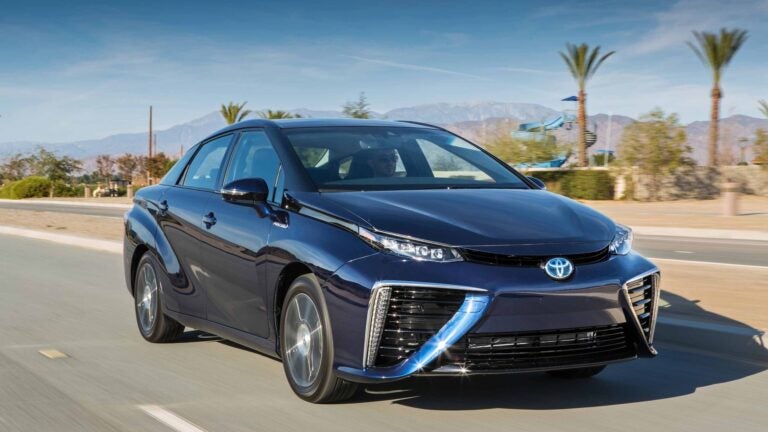
Many automakers not only have fuel-cell technology in house, but are making design and efficiency improvements. Honda, for example, is just waiting for a refueling infrastructure to come into place before following Hyundai and, now Toyota, with its four-passenger Mirai, in launching retail sales in limited markets.
It reminds me of high-definition (HD) television’s introduction, except that much bigger dollars and more complicated logistics are at play here.
When the first HD TVs came on the market, there was a classic chicken-and-egg situation regarding which would come first, the TVs or the HD programming? Eventually, both sales and programming grew together.
Solving this is a business investment proposition, which seems more easily resolved than the 100-year quest to build a better battery.



To comment, please create a screen name in your profile
To comment, please verify your email address
Conversation
This discussion has ended. Please join elsewhere on Boston.com