
New Honda HR-V; Ciccolo’s Charity; CR on Reliability
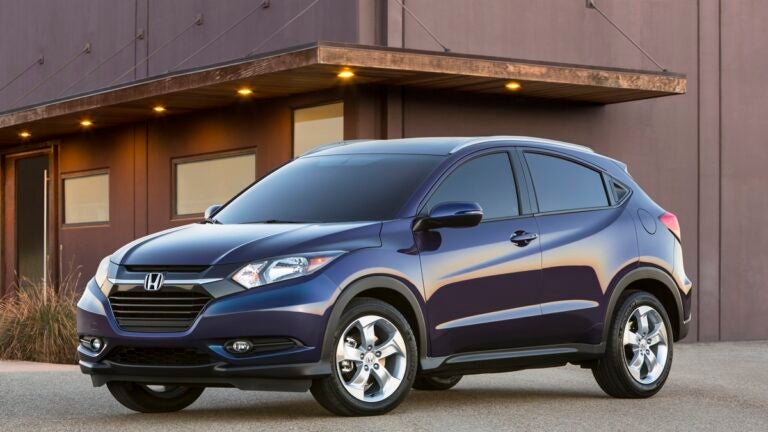
It’s no secret that compact SUVs are popular, ranking No. 4 in segment sales, trailing only large trucks, and midsize and compact cars in US sales.
The segment has doubled its market share, from 5.4 percent to 10.8 percent over the past 10 years.
Honda’s recently redesigned CR-V has been atop the segment for years. Now Honda is going to introduce a smaller offering, the HR-V. The company says the HR-V will be a crossover and serve as “the entry point to the Honda light truck lineup.’’
The HR-V will make its North American debut in mid-month at the Los Angeles Auto Show, but far from being a concept, this is the actual vehicle that will launch over the winter.
It’s built on the same compact platform as the popular subcompact Fit, and Honda says its spacious interior is made possible by an innovative center fuel tank design. Honda’s trademarked “Magic Seat’’ will permit a variety of seating arrangements and the versatility to fold the second row seats completely flat.
CUVs, Part 2
Those ubiquitous little SUVs are holding up well, too. Figures compiled by Edmunds.com give these five-year residual values: 1) CR-V, 50.7 percent; 2) Toyota RAV4, 48.6; 3) Subaru Forester, 47.1; 4) Ford Escape, 45.7; 5) Nissan Rogue, 43.5; and 6) Mazda CX-5, 43.2.
Why are they popular? The opinion here is that people like the elevated driving position, which translates to a better view of the road and good forward visibility. Secondary factors are utility, decent fuel economy (compared to midsize SUVs), and more reasonable pricing.
Two other Edmunds’ figures: 52.4 percent of CUV buyers are women and 50 percent of buyers are over 50 years of age.
It Takes a Village
Ray Ciccolo, president and CEO of the Village Automotive Group, wants to let veterans know that his dealerships have a service special for local families with a husband or wife deployed overseas.
“If they have any safety problems, we’ll fix it for free,’’ he says.
His nine dealerships also supported October’s Breast Cancer Awareness.
What he didn’t mention was that his group was being honored by the Boston Business Journal’s Corporate Citizenship Summit in late September as one of Massachusetts’ top 73 charitable contributors of 2014.
The Journal publishes an annual list to recognize Greater Boston companies with contributions in excess of $100,000 to local nonprofits.
Village Automotive was far above that threshold, donating $375,000 to Mass.-based charitable organizations.
To celebrate his 50th anniversary in the automotive business, Ciccolo donated $50,000 to a number of local groups.
“I am privileged to have wonderful employees who are dedicated to giving back and passionate about improving the quality of life of those in need,’’ he says. “It’s an honor to be recognized for our efforts.’’
Reliability, CR-Style
Consumer Reports is out with its 2014 annual reliability survey, crunching data on 1.1 million of its subscribers’ vehicles.
Two constants came out of the results. One, Lexus and Toyota ranked 1 and 2. One of them has been atop the list since 2008. Two, infotainment system complaints again rank No. 1 among problems.
The Toyota family sticks with its winning formula.
“Toyota is conservative with its redesigns,’’ says Jake Fisher, CR’s director of auto testing. “Compare that with Ford, for example, which is more aggressive in changing platforms, engines, transmissions, and electronics.’’
One could speculate that CR’s readership skews to an older demographic and that older drivers simply have more trouble with the technology.
“Not so,’’ says Fisher. “Younger users are more likely to go deeper into the systems and encounter problems there.’’
Complaints in the past have been trouble in pairing mobile phones and unresponsive touch screens. This year, says Fisher, multi-use controllers join that list.
For what it’s worth, I’ve been in more than 150 different cars in the past three years and haven’t encountered any of those problems.
What can be tough is figuring out the logic that makes using these systems second nature, learning to rely on steering wheel controls, and making the leap to using voice recognition.
Mazda, Honda, and Audi rounded out the Top 5 in most reliable with Buick the top domestic at No. 6.
Pickup truck woes knocked GMC down 10 spots to No. 19 and Ram down seven positions to No. 26 among the 28 brands ranked.
Ford, which was knocked to the bottom tier over the past five years with complaints on its MyTouch infotainment system, was up three places to No. 23 and Lincoln improved 12 notches to No. 15.
For what it’s worth, it would be interesting to have CR eliminate all the infotainment glitches, which generally won’t leave you stranded on the roadside, and reposition everyone.
“Infotainment system problems generally don’t exist in a vacuum,’’ says Fisher. “A close look at the results suggests that cars with a lot of in-car electronic issues usually have plenty of other troubles, too.’’
The View Behind
Logic and personal experience tell us that rearview cameras are a feature that should be on every new car already even though they’ll be required in passenger vehicles beginning in 2016 and across the board in 2018.
Now, AAA is out with a study that says the systems improve rear visibility an average of 46 percent. That ranged from 36 percent improvement in smaller sedans to 75 percent in hatchbacks. Large trucks and SUVs scored in the mid-range of the 17 vehicles from 11 manufacturers that were tested.
“Cameras don’t replace the need to check around your vehicle before getting in to back up,’’ says John Nielsen, AAA managing director of automotive engineering, “but they do dramatically improve rear visibility and are especially helpful for viewing the first 10 feet behind the vehicle.’’




To comment, please create a screen name in your profile
To comment, please verify your email address
Conversation
This discussion has ended. Please join elsewhere on Boston.com